Key facts
- AFRL tested whether a UNI-PAC III life raft, capable of carrying 20 people with a 72-hour survival kit, could fit into the Starfall capsule for future missions.
- The U.S. Air Force Research Laboratory (AFRL) plans to use data from the Starfall test to assess the feasibility of transporting tens of tons of cargo per launch as part of its Rocket Cargo program.
- The U.S. Air Force Research Laboratory (AFRL) aims to eventually use multiple space launch companies for global cargo delivery, not just SpaceX.
- The Starfall capsule’s carbon-fiber thermal protection system and compressed-gas engines for attitude control enable it to withstand reentry temperatures and maintain stability during descent.
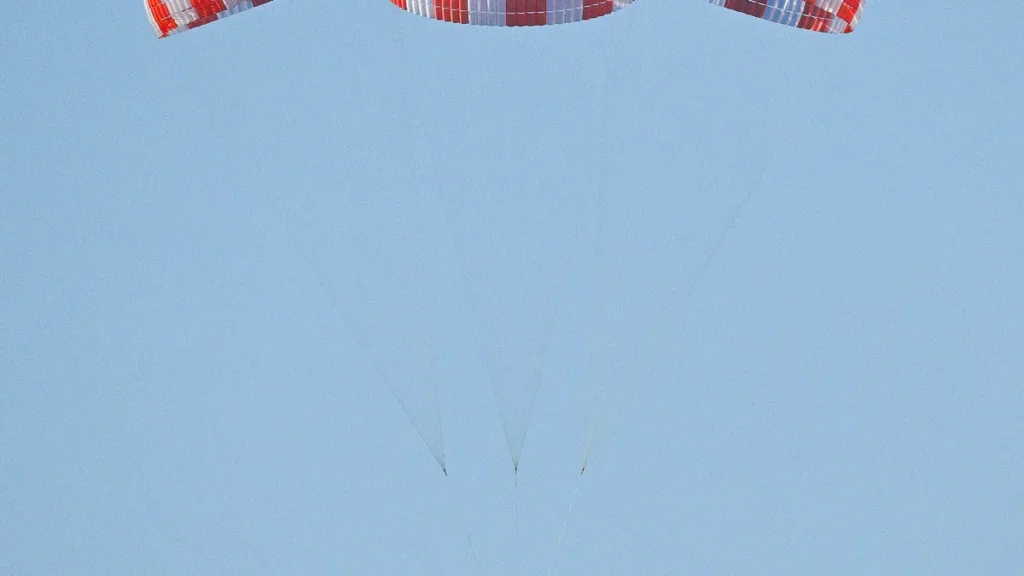
The U.S. Air Force Research Laboratory launched SpaceX’s Starfall capsule aboard a Falcon 9 rocket from Cape Canaveral Space Force Station on October 20, 2026, as part of the Bandwagon-5 rideshare mission to test point-to-point cargo delivery. The laboratory recovered experimental cargo modules from the capsule in the Pacific Ocean on October 26, 2026, completing the first successful point-to-point space delivery test. AFRL reported successful retrieval with SpaceX support after splashdown.
AFRL released photographs showing service members unpacking and inspecting the recovered Starfall cargo modules on October 26, 2026. The inspection process is part of AFRL’s evaluation of the capsule’s performance and the condition of the cargo after reentry and recovery, providing critical data for future missions.
SpaceX’s Starfall capsule can carry up to 1,000 kilograms (2,205 pounds) of cargo and features a disc-shaped design with a diameter of approximately 3.1 meters. The vehicle uses carbon-fiber thermal protection and compressed-gas engines for attitude control during reentry, enabling it to withstand reentry temperatures and maintain stability during descent. These systems are critical for ensuring the capsule’s structural integrity and the safety of its cargo during the extreme thermal and aerodynamic stresses of atmospheric reentry. A parachute system with a single main parachute, along with pilot and drogue parachutes, achieves a controlled landing after reentry, and a heat shield protects the vehicle during high-temperature reentry.
AFRL loaded the capsule with experimental cargo pods containing a satellite communications-enabled tracker, batteries, a reverse-osmosis water desalination system, emergency medical supplies, food rations, and survival gear. These items were selected to simulate critical supplies needed in austere or emergency environments, such as disaster zones or contested operational areas where traditional logistics are impractical.
The U.S. Air Force Research Laboratory is exploring the use of commercial space vehicles for rapid cargo delivery to remote or contested locations where traditional logistics infrastructure may be unavailable. AFRL’s collaboration with SpaceX and other industry partners is intended to reduce technical risks and accelerate the development of orbital delivery systems.
The cargo pods also carried environmental sensors to measure shock, temperature, and vibration during the journey to space and back. AFRL emphasized measuring durability to inform future designs for orbital delivery systems. The sensors were critical for evaluating how sensitive military equipment, including electronics and survival gear, endure the extreme conditions of launch, microgravity exposure, and atmospheric reentry. AFRL tested whether a UNI-PAC III life raft, capable of carrying 20 people with a 72-hour survival kit, could fit into the Starfall capsule for future missions, supporting the program’s focus on delivering materiel to remote or contested locations where traditional logistics infrastructure may be unavailable.
AFRL aims to use SpaceX’s Starfall capsule and other commercial rockets to deliver tens of tons of cargo globally in a single launch, supporting rapid response in contested environments, expeditionary operations, and disaster relief. The Rocket Cargo program seeks to evaluate the viability of using large commercial liquid-propellant rockets for rapid global delivery of materiel on tactical timelines, including responses to chemical, biological, radiological, and nuclear hazards, and to assess the feasibility of orbital delivery systems for austere sites without access to runways or roads. The laboratory plans to use data from the Starfall test to assess the feasibility of transporting tens of tons of cargo per launch as part of its Rocket Cargo program, a capacity intended to enable rapid global mobility for expeditionary operations, disaster relief, and response to chemical, biological, radiological, and nuclear hazards. AFRL aims to eventually use multiple space launch companies for global cargo delivery, not just SpaceX, as part of a broader effort to diversify its industrial base and ensure redundancy in rapid cargo delivery capabilities.
Brigadier General Douglas P. Wickert, commander of AFRL, stated on October 20, 2026, that the Starfall launch demonstrated AFRL’s partnership with industry to reduce risks and deliver war-winning technologies for operational forces. Adam Remaly, director of the AFRL Technology Transition Office, called the Starfall test a critical achievement for Rocket Cargo’s potential to enable point-to-point rapid global mobility for the Future Force. General Wickert emphasized the importance of collecting hard data and collaborating with industry to accelerate the development of advanced military logistics capabilities. Remaly highlighted the importance of cross-discipline collaborations and leveraging the defense industrial base to maximize capability and ensure future military readiness.


Join the discussion