Key facts
- Leo is a rival to SpaceX's Starlink.
- The deal was first announced in April.
- Earlier this month, U.S. carriers AT&T, T-Mobile US, and Verizon formed a direct-to-device satellite-focused spectrum-pooling joint venture.
The FCC approved Amazon Leo’s $11.5 billion acquisition of mobile-satellite operator Globalstar in the United States on Oct. 28, 2026. The transaction gives Amazon control of Globalstar’s two dozen satellites and approximately 25 megahertz of internationally harmonized mobile-satellite service spectrum. Amazon plans to use this spectrum and Globalstar’s infrastructure to augment existing services with added capacity and capabilities beyond terrestrial wireless reach. Those assets add to Amazon Leo’s existing network of over 200 satellites as the company builds its low-Earth-orbit broadband service, bolstering Amazon’s satellite-based communications network as it positions to compete with Starlink.
The FCC said the transaction is likely to benefit the public by enhancing data coverage in unserved or underserved areas. FCC Chairman Brendan Carr said the authorization empowers Amazon Leo to deliver fast, next-generation satellite broadband services, increase competition, and help communities stay connected all across the country. Carr tied the approval to President Trump’s technology leadership goal and described it as a significant step toward advancing next-generation connectivity.
The FCC said Amazon Leo’s combined assets will strengthen its move into direct-to-device services and support an operator that offers fixed and mobile service to homes, businesses, and government customers. Amazon said the deal is designed to allow Leo to deliver direct-to-device service. Direct-to-device satellite technology enables smartphones and other devices to connect directly to satellites.
SpaceNews said the FCC approval removes a key regulatory barrier for Amazon’s direct-to-device connectivity plans. The approval comes after the Space Bureau gave Globalstar U.S. market access for its non-geostationary C-3 System last week. This prior authorization allows Amazon Leo, after the transaction closes, to use the C-3 grant to build and launch the newly authorized system.
Globalstar provides Apple’s emergency satellite connectivity for compatible iPhones and Watches. The company’s satellite-based safety features include Emergency SOS and Find My for Apple device users. As part of the deal, Leo will power satellite services for supported iPhone and Apple Watch models.
Amazon previously stated it signed an agreement with Apple to continue providing Emergency SOS and Find My services after the acquisition closes. Apple invested about $1.5 billion in Globalstar in 2024, acquiring a 20 per cent equity stake. DCDNoticias dates Apple’s purchase to November 2024 and values the equity deal at around $400 million.
Amazon plans to acquire Apple’s stake in Globalstar, according to the FCC, transferring Apple’s 20 percent equity interest as part of the transaction terms. The technology company also held a 20 percent stake in Globalstar before Amazon Leo’s acquisition. Apple accounted for about 63 percent of Globalstar’s revenue last year.
Amazon has committed to investing more than $10 billion in Leo. The company expects to roll out commercial satellite services by the end of 2026 as part of its broader Leo satellite network plans. Amazon filed in July to deploy up to 5,105 of its Leo D2D System satellites in the next few years, a filing separate from the Globalstar acquisition.
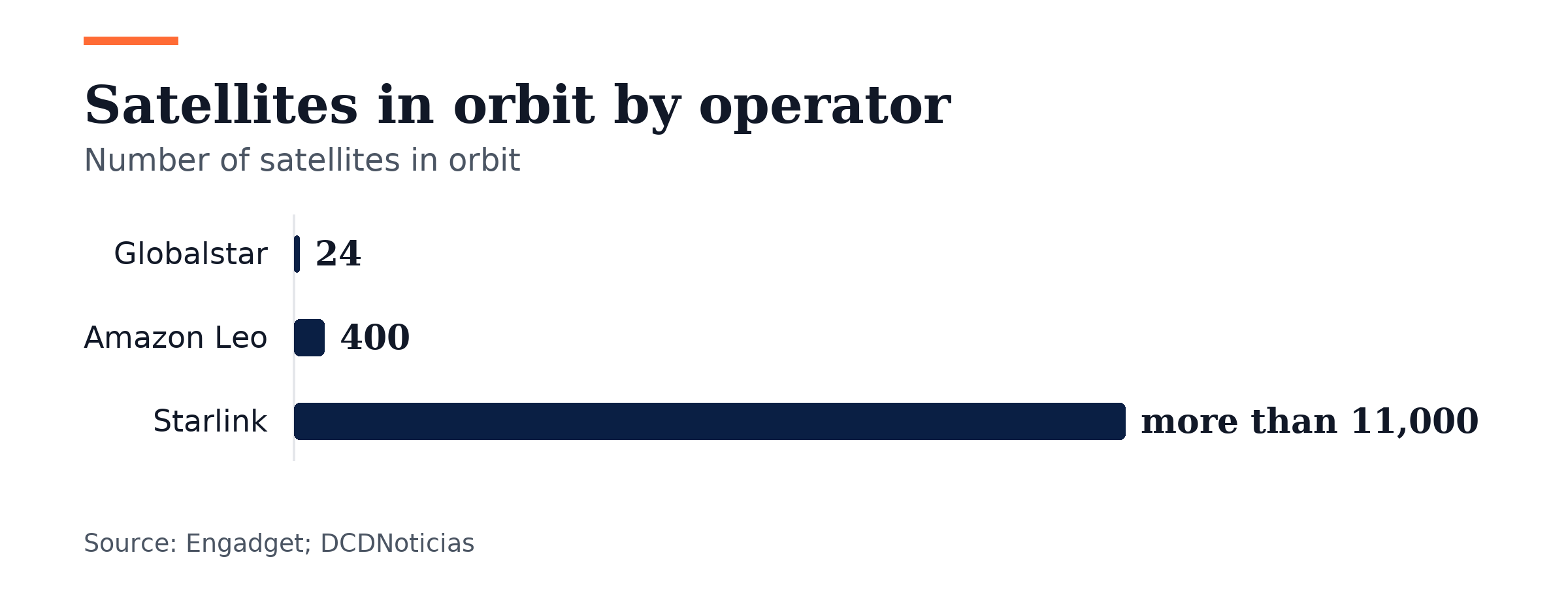
Engadget reported that Leo recently announced it has 400 satellites in orbit. ETTelecom said Amazon Leo launched more than 300 satellites since April 2025. DCDNoticias said Amazon has launched nearly 400 satellites and plans to deploy thousands in low Earth orbit by 2029. Amazon recently added six new Arianespace launches, expanding launch capacity for its satellite constellation alongside the Globalstar acquisition.
Amazon Leo aims to deploy 3,200 satellites by 2029 for its communication network. This deployment target is part of Amazon’s low Earth orbit communication network plans, according to ETTelecom. Amazon aims to have more than 3,000 low-earth orbit satellites in the near future, well short of SpaceX’s 11,000 satellites. This scale gap separates Amazon’s planned constellation from SpaceX’s existing Starlink fleet.
Starlink operates a network of more than 11,000 satellites. Leo is a rival to SpaceX‘s Starlink in the satellite broadband market, with Amazon’s satellite subsidiary competing with Elon Musk’s Starlink unit. The deal bolsters Amazon’s satellite-based communications network as it positions to compete with Starlink. The deal was first announced in April, and the acquisition supports Amazon’s ambitions to build out Amazon Leo to rival SpaceX’s Starlink, according to DCDNoticias.
Leo revealed last month that it had launched high-quality satellite internet service in Uzbekistan. Leo is teaming up with Delta to eventually bring satellite internet to flights. This launch is part of Leo’s recent activity alongside its satellite count and airline partnership plans, and the partnership is one of several recent moves by Leo as it expands its satellite network.
Globalstar was launched in 1991 as a joint venture of Loral Corporation and Qualcomm. Its first-generation constellation consists of 48 low-Earth orbit satellites, with an additional four satellites in orbit as spares. This legacy fleet is distinct from the second-generation constellation of 24 spacecraft. The company’s history includes first- and second-generation constellations and a third-generation fleet in development, and this matches the two dozen satellites referenced in other reports about the acquisition.
Globalstar is developing a third-generation fleet for Apple and planning a bigger constellation down the road. Under an Apple-backed plan, Globalstar would grow its network to 54 satellites with a few spares, up from nearly two dozen spacecraft it operates today. This planned expansion would add capacity to Globalstar’s existing roughly two dozen spacecraft, and Globalstar provides connectivity services to more than 120 countries. The third-generation fleet is part of Globalstar’s ongoing development alongside its Apple relationship, and this international reach is part of Globalstar’s existing satellite operator profile.
Earlier this year, the Space Bureau granted SpaceX authorization to build, launch, and deploy a 15,000 satellite direct-to-device constellation. Earlier this year, the Space Bureau granted AST SpaceMobile authorization for a 248-satellite system. These authorizations are part of the broader direct-to-device regulatory environment.
Earlier this month, U.S. carriers AT&T, T-Mobile US, and Verizon formed a direct-to-device satellite-focused spectrum-pooling joint venture. This joint venture is part of the broader industry push into direct-to-device satellite services alongside Amazon and SpaceX. The regulator plans a Thursday vote on moving forward with a wireless spectrum auction for direct-to-device services. This upcoming vote is part of the FCC’s broader direct-to-device spectrum activities alongside the Amazon-Globalstar approval.
The C-3 System won approval for U.S. service as part of a worldwide network of 48 satellites in 12 orbital planes, four per plane, at 52 degrees inclination and 1,414 kilometers altitude. Earth-to-space mobile-satellite links could run on 1610–1618.725 MHz, while space-to-Earth links could use 2483.5–2500 MHz. Feeder links plus telemetry, tracking, and command operations are included in the authorization across the 5091–5250 MHz Earth-to-space and 6875–7055 MHz space-to-Earth bands. This frequency allocation is part of the C-3 market access grant, and these additional bands support command and control of the C-3 constellation.
- 48 satellites
- 12 orbital planes
- four satellites per plane
- 52 degrees inclination
- 1,414 kilometers altitude





Join the discussion