Key facts
- NASA's Lucy spacecraft became the first probe to enter the Jupiter Trojan asteroid region after traveling more than 2.2 billion miles since launching on October 16, 2021, five years earlier.
- Lucy is approaching Jupiter's Lagrange point 4 (L4), one of two large unexplored regions called islands of stability where asteroids share Jupiter's orbit around the Sun.
- Hal Levison of the Southwest Research Institute is the principal investigator of Lucy, a 12-year mission planning to visit 11 asteroids in two Trojan swarms leading and trailing Jupiter.
- Lucy's November 2023 flyby of main-belt asteroid Dinkinesh found a tiny moon now named Selam, which is a contact binary made of two touching parts, meaning three bodies were present at that site instead of one.
NASA’s Lucy spacecraft entered the Jupiter Trojan asteroid region, becoming the first probe to reach that population after a cruise of more than 2.2 billion miles that began with its Oct. 16, 2021 launch, five years earlier, and the vessel is now approaching Jupiter’s Lagrange point 4.
The spacecraft is now approaching Jupiter’s Lagrange point 4, one of two large, unexplored regions where asteroids share the planet’s orbit around the Sun. Mission engineers follow Lucy’s approach by tracking radio signals and photographing nearby stars, since space has no well-defined boundary there. Earlier missions flew past Jupiter but never visited the Trojans because they lie far from the planet. The milestone marks arrival at primitive solar-system bodies that earlier missions flying past Jupiter never had the chance to visit.
Each Trojan cluster orbits at roughly the same distance from Jupiter as Jupiter lies from the Sun, about 484 million miles, while individual asteroids average more than 6 million miles apart. The region has no well-defined boundary. The spacecraft’s design targets a region more than five times farther from the Sun than Earth, and its instruments keep working as expected even as temperatures cool and light dims.
Scientists expect close study of the Trojans to refine theories about how planets formed 4.5 billion years ago and reached their current configuration. Researchers regard the Trojans as fossil remnants of planet formation, objects that hold clues to deciphering the solar system’s history. Hal Levison of the Southwest Research Institute, who serves as principal investigator, called them relics that amount to fossils of the planet formation process.
The mission spans 12 years and plans to visit 11 asteroids across two Trojan swarms that lead and trail Jupiter, covering main-belt targets already flown past and Jupiter Trojans in both the leading L4 and trailing L5 groups. Hal Levison said that after five eventful years, most of the mission remains ahead, and no one has viewed any Trojan up close yet. The spacecraft is now approaching the leading L4 swarm.
Close-up looks at four Trojan systems will begin in less than a year, kicking off the main science phase. The spacecraft will fly past Eurybates on Aug. 11, 2027, then Polymele in September 2027, Leucus in April 2028, and Orus in November 2028. Eurybates travels with a satellite named Queta, while Polymele’s satellite remains unnamed. These encounters will provide the first up-close views of any Trojan asteroid.
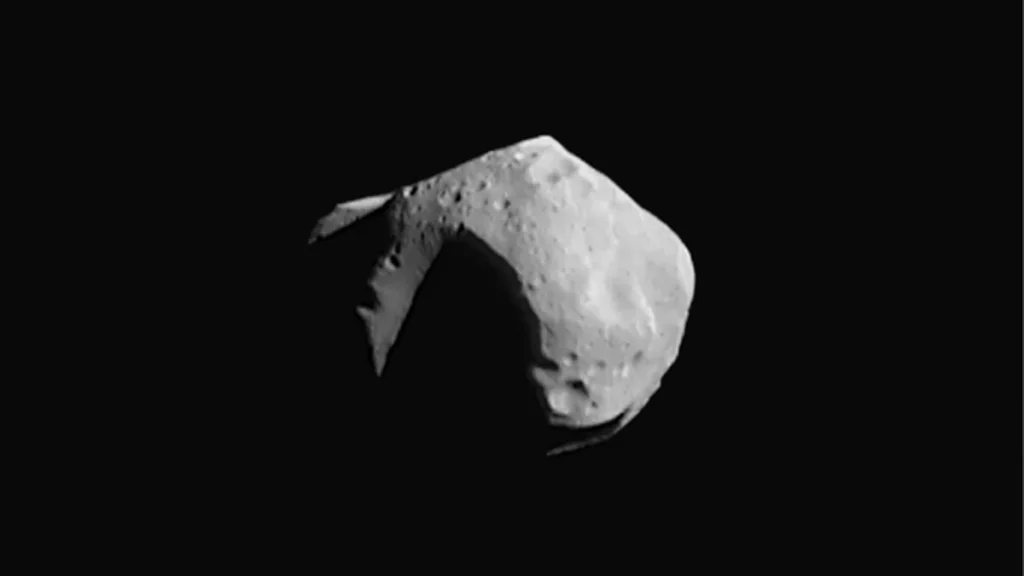
Lucy already logged flybys before reaching the Trojans. Its November 2023 pass of main-belt asteroid Dinkinesh found a moon now named Selam. Selam is a contact binary, two objects touching each other, so three bodies occupied that site rather than one. Dinkinesh orbits in the main asteroid belt between Mars and Jupiter.
In 2022, the team adjusted Lucy’s course to pass closer to Dinkinesh once they realized the original route would bring the spacecraft nearby, using the encounter as an added systems test.
During an April 2025 flyby of Donaldjohanson, Lucy observed a peanut-shaped contact binary consisting of two lobes connected by a smooth neck. Donaldjohanson tumbles end over end and rotates around its side, cycling over spans of 10.5 Earth days and 26.5 days. Lucy deputy principal investigator Simone Marchi said the flyby turned up many surprises, including changes to the asteroid’s spin and surface features caused by the Sun’s radiation.
Earth gravity assists in October 2022, when Lucy passed 220 miles above the surface, and in December 2024, when it gained over 16,000 mph relative to the Sun, set the spacecraft on course for its first Trojan encounter in August 2027. Shortly after liftoff, one of the spacecraft’s two large solar panels did not deploy correctly, yet engineers identified the issue and extended the panel sufficiently to preserve the mission.
The spacecraft has also observed events beyond its own targets. In September 2022, Lucy observed NASA’s DART spacecraft striking a near-Earth asteroid system as part of a planetary defense technology test, and in September 2025 it watched interstellar comet 3I/ATLAS pass through the solar system.



Join the discussion