
Key facts
- The DIA's 2026 Challenges to Space Security report, released Monday, states that China's intelligence, surveillance and reconnaissance satellite fleet is three times larger than it was in 2018.
- The DIA report says China's ISR satellite fleet keeps growing and improving technically, especially through Beijing's increasing number of satellites in low Earth orbit.
- The DIA report states that China's count of intelligence, surveillance and reconnaissance satellites exceeded 510 as of July, and includes spacecraft owned by the People's Republic of China and Chinese commercial firms.
- The DIA report says many of these intelligence, surveillance and reconnaissance satellites are nominally tied to commercial and civil missions.
The Defense Intelligence Agency’s third unclassified space-threats report, released Monday, states that China’s intelligence, surveillance and reconnaissance satellite fleet has tripled since 2018, Breaking Defense reported.
The report says China’s ISR satellite fleet exceeded 510 satellites as of July, counting spacecraft owned by the People’s Republic of China and Chinese commercial firms. The fleet keeps growing and improving technically, especially through Beijing’s increasing number of satellites in low Earth orbit, the region of space close to Earth. Many of these satellites are nominally tied to commercial and civil missions, and the report discusses their ostensibly commercial and civil affiliations, according to Breaking Defense.
The DIA says the dual-use nature of these satellites and possible Chinese military-civil fusion policies mean the People’s Liberation Army can use collected data or imagery. Chinese commercial companies also provide imagery to states that Western providers have banned for supporting weapons proliferation, as part of the report’s discussion of Chinese commercial imagery suppliers, Breaking Defense reported.
Todd Harrison, a senior fellow at the American Enterprise Institute, said the DIA’s data does not make clear which satellites are part of its count and is missing key context. Harrison said China’s operational surveillance and weather satellite fleet went from 141 in 2018 to 541 in the latest count, while its surveillance-only fleet went from 124 to 453. He said the trend line has flattened in recent years, meaning satellite numbers are not rising as quickly.
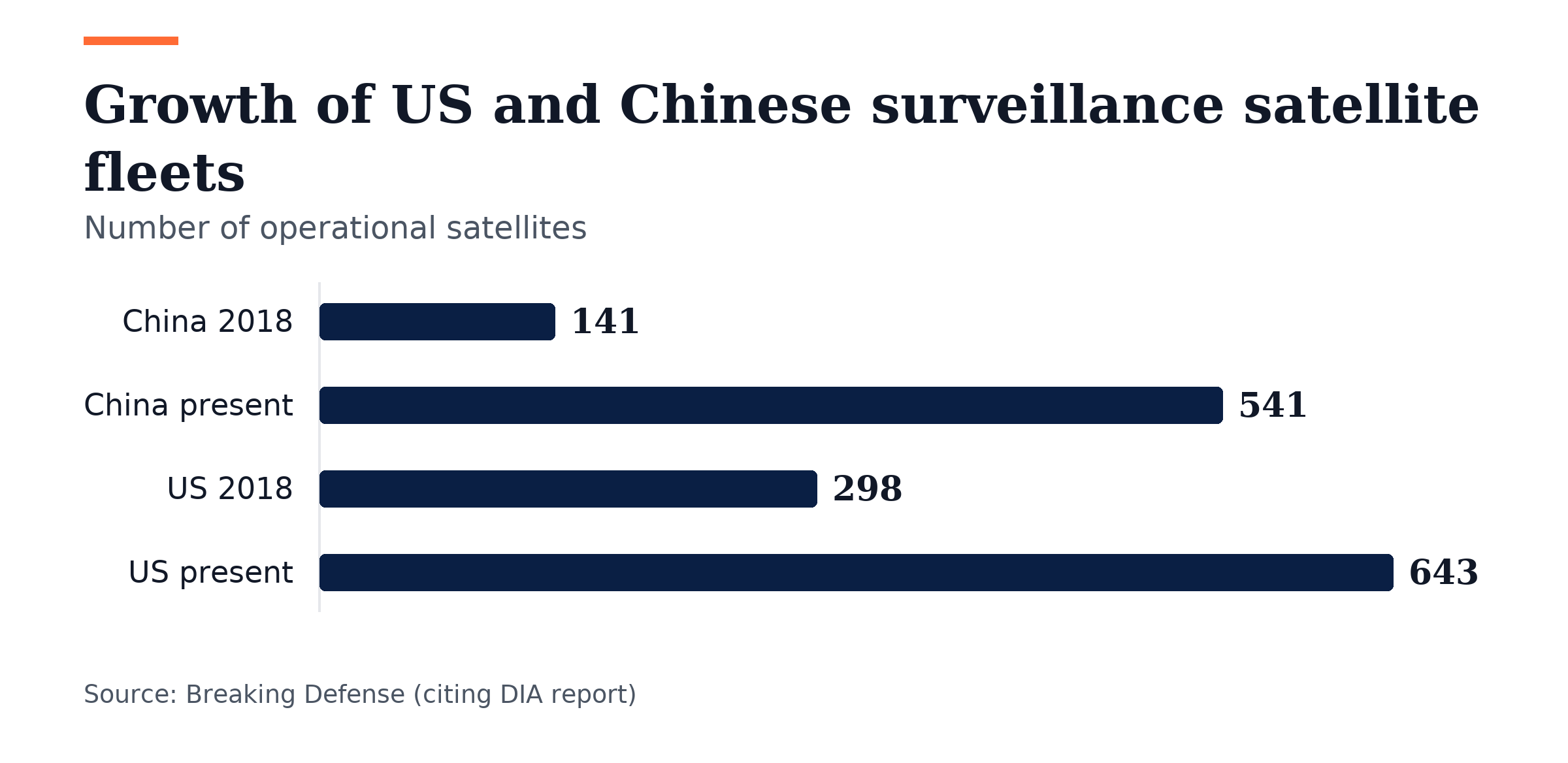
Harrison said the United States fields 643 surveillance and weather satellites, up from 298 in 2018, and is growing its ISR fleet more quickly than China. The comparison uses data from AEI’s Space Data Navigator, which underpinned a chart created for Breaking Defense.
The DIA report contains an image of China’s reusable spaceplane, a spacecraft designed to return to orbit multiple times, that appears to be the first made public; the spaceplane flew most recently in February. Victoria Samson, chief director of space security and stability at the Secure World Foundation, said the image backs up the view that China’s reusable spaceplane is modeled after the US X-37B. Samson told Breaking Defense that the spaceplane resembles the X-37B. “It looks a lot like the X-37B!”
The report states China’s ISR satellite network can help the PLA watch and target American and allied forces around the world. The network matters most across the Indo-Pacific, including the Korean Peninsula, Taiwan, the Philippines, the Indian Ocean and the South China Sea. China’s space-based intelligence, surveillance and reconnaissance capability is intended to sharpen global situational awareness and back long-range strikes, according to the DIA, Breaking Defense reported.

Electro-optical and synthetic aperture radar imagery satellites count among the systems delivering electronic and signals intelligence data, the DIA report says, Breaking Defense reported. Clayton Swope, deputy director of the Center for Strategic and International Studies’ Aerospace Security Project, said China is investing heavily in space-based sensors to watch Earth and identify, track and target objects in the Indo-Pacific.
The DIA predicts space will become more crowded and competitive as capabilities advance and more nations expand their activity there. The report cites growing counterspace abilities from China, Russia, Iran and North Korea, more objects in orbit and rising demand for space-enabled services as factors that will complicate space operations in the coming decade.
The report identifies reusable space vehicles, including rockets and spaceplanes, among developments likely to worsen future challenges for US interests in space. It also points to the growing use of artificial intelligence, orbital congestion, the collision risk from non-maneuverable spacecraft that remain on orbit after becoming inoperable, and rising interest in satellites based in very low Earth orbit as developments likely to worsen those challenges, Breaking Defense reported.
The DIA’s 2026 report is the third installment in a series of unclassified studies about US concerns over adversary military space advances, and the initial edition appeared in 2019. The latest assessment addresses space threats from China, Russia and “emerging” space powers, Breaking Defense reported.

Join the discussion