Key facts
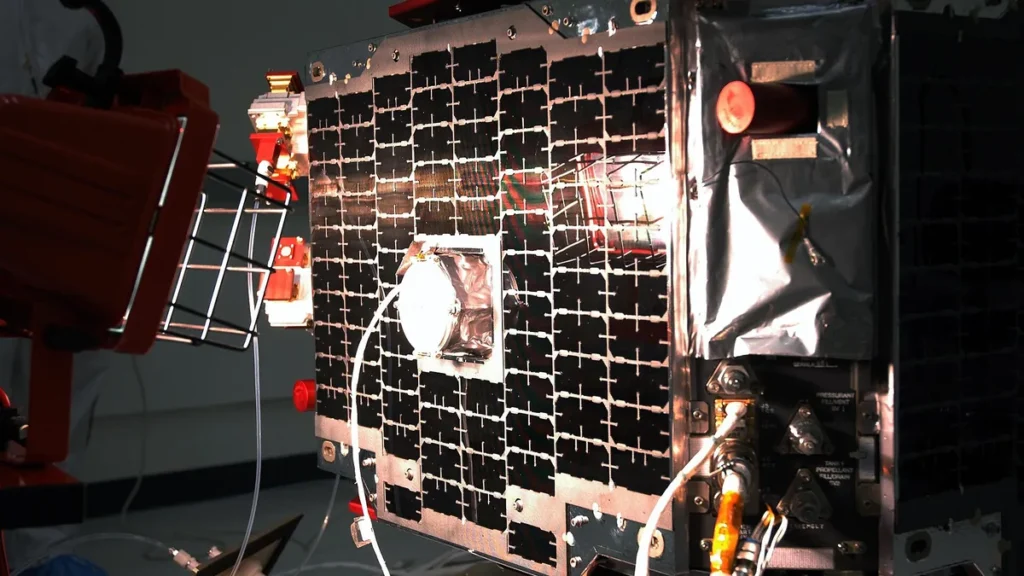
- MP Space raised an AUD $23 million ($16.1 million) seed round led by Blackbird to expand satellite battery manufacturing and begin building other satellite power-system components, the company announced on Monday.
- MP Space's two batteries each weigh under 5 kg, but CEO Jay Manley said Starship power products must be about 10 times bigger and more powerful as industry demand rises.
- MP Space has resided at the NSW Government-backed National Defence and Aerospace Hub at Cicada Innovations for over two years and presented at Cicada x Tech23 in Sydney on 9 September 2026.
- Co-founder Sam Paterson worked on Tesla Model S, X and 3 battery packs before technical programme roles at Apple, Zoox and biotech manufacturer Vow.
MP Space closed a seed round of AUD $23 million ($16.1 million) led by Blackbird on Oct. 26, 2026. The company announced the funding Monday to expand battery manufacturing for satellites at its Sydney facility and start building power-system hardware for spacecraft. The cash will back local manufacturing growth, broader power-system platforms and a bigger engineering team in Australia.
MP Space’s batteries reached orbit for the first time in October 2026 on SpaceX’s Bandwagon-5 rideshare mission, flying with an unnamed customer. The company has orders covering more than 500 spacecraft, and space services and missions involving more than 500 spacecraft incorporate its products. The hardware was operating in orbit in October 2026 across spacecraft.
The company began in January 2024 when former Tesla engineers Jay Manley and Sam Paterson started it to create affordable, high-performance power systems for space use. Manley serves as chief executive, and Paterson is chief commercial officer. Manley worked eight years for Tesla’s powertrain and energy divisions, contributing to Powerwall 2 and Powerwall 3, before moving to Sydney in 2021. Paterson worked on battery packs for the Tesla Model S, X and 3 before taking technical program roles at Apple, Zoox and biotech manufacturer Vow.
MP Space aims to increase manufacturing capacity and grow its engineering team at the Sydney facility, with a goal of building 5,000 space widgets per year by the end of next year. The target connects to present demand. The company will direct the money toward low-cost satellite power components located between solar panels and payloads, such as maximum power point trackers, chargers, power-conditioning and distribution units, and solar-array drive assemblies.
Blackbird led the funding alongside Seraphim Space, Systemiq Capital, Speedinvest and MFV Partners. Seraphim’s backing marks its first investment in an Australian company, and MP Space described the firm as the most prolific investor in space. Wong, a Blackbird partner, said the fund backs the founding team because Jay and Sam built Tesla’s Powerwall into a $10 billion business line.
Wong said, “MP Space is well-placed to seize the opportunity with an indisputable hardware advantage and deep software capabilities.” Bishop said, “Power is a fundamental constraint on spacecraft capability, and we are seeing power requirements scale rapidly across almost every mission type.”
Paterson said at the Cicada Tech 23 conference on Sept. 9, 2026, that MP Space entered space because it identified a $10 billion opportunity, and the founders want to apply Tesla battery lessons to satellites rather than having manufacturers develop bespoke systems in-house. He told Tech23 that the company might only be building batteries at present, adding, “but that’s not where we land,” and that it begins with batteries, advances into powertrain and surrounding parts, and seeks to sit at the core of power infrastructure for space industrialization. Paterson also said MP Space has two constellation customers with more in the pipeline, ships globally with millions of dollars of revenue, and is on an exponential curve that is just getting started.

Manley said MP Space gives satellite operators a third choice other than purchasing from a costly, slow-moving supply chain or developing power systems internally, with prices about a fifth to a third below the market average. He said his company’s view is that future spacecraft will need much more power and that the industry requires better ways to generate, store and manage energy.
MP Space’s power systems support all five national priorities in the Federal Government’s Statement on Space: Trusted Space Services, Spaceflight Ecosystem, Space Platforms, Microgravity Ecosystem and Exploration Technologies. The company provides dependable power for satellites, launch vehicles and lunar missions across those five areas. The scale of the investment points to stronger investor confidence in Australia following the Federal Government’s release of its space industry strategy.
MP Space has been based at the NSW Government-backed National Defence and Aerospace Hub at Cicada Innovations for more than two years and appeared at Cicada x Tech23 in Sydney on Sept. 9, 2026, with that year’s deep-tech cohort. Liza Noonan, chief executive of Cicada Innovations, said the milestone shows what Australia’s space industry can do and highlights the hub’s worth in offering specialist support and facilities. Dan Lloyd, chief executive of the Space Industry Association of Australia, said economic resilience and Future Made in Australia rely on constructing, sustaining and replacing critical inputs such as dependable power systems.
MP Space’s two batteries each weigh less than 5 kg, yet Manley said power hardware for Starship must be roughly 10 times larger and stronger as demand for power increases. “We’re trying to go engineer a power backbone that would bring Starlink satellite-unit economics to everyone who’s not Starlink,” Manley said.
The funding ranks among the largest seed rounds for an Australian deep technology firm. Paterson promised the company would become to space power what NVIDIA is to data centers.




Join the discussion