Key facts
- TOI-561 b is a scorching lava planet approximately 280 light-years from Earth that still holds a thick atmosphere even though strong stellar radiation ought to have removed it long ago.
- Using JWST, researchers monitored TOI-561 b over 37 hours and observed nearly four full circuits around its host star.
- Scientists do not yet know exactly which gases compose the atmosphere of TOI-561 b.
- Earlier measurements found TOI-561 b's dayside significantly cooler than predicted for a dark, rocky planet orbiting near its star.
An international team including Dr. Anjali Piette of the University of Birmingham reported Oct. 27, 2026 that JWST observations show TOI-561 b, a scorching lava planet about 280 light-years from Earth, still holds a thick atmosphere although intense stellar radiation ought to have removed it long ago.
The result surprised researchers because current theories expect a heavily irradiated rocky planet such as TOI-561 b to lose its atmosphere billions of years ago, and scientists had believed atmospheric survival nearly impossible under such extreme conditions. Dr. Anjali Piette said, “We would expect a heavily irradiated rocky planet like TOI-561 b to have lost its atmosphere billions of years ago.” The University of Birmingham announced the findings Oct. 27, 2026, with materials summarizing research published in The Astronomical Journal, and ScienceDaily reported the research.
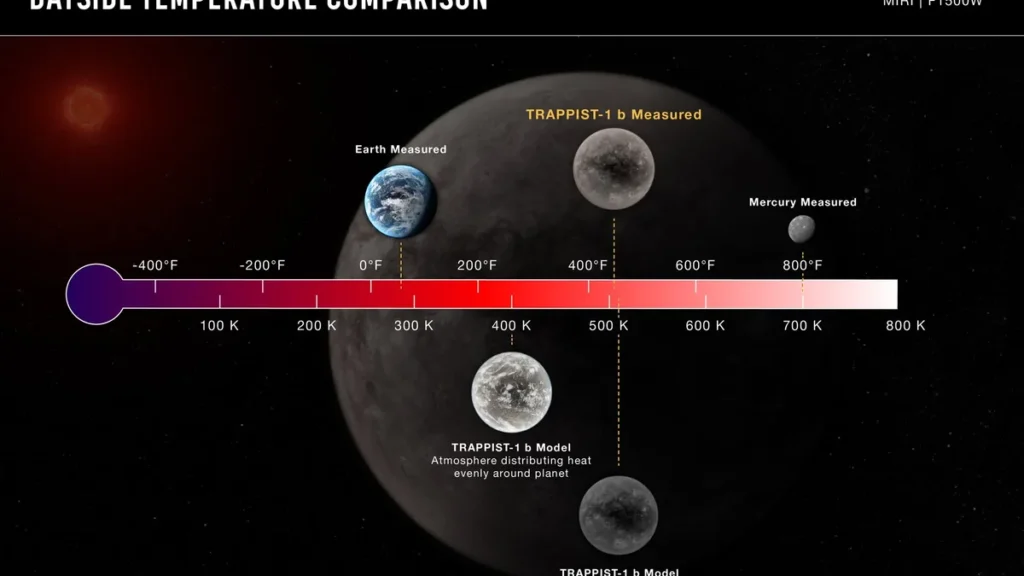
Using JWST, researchers monitored TOI-561 b over 37 hours and observed nearly four full circuits around its host star. Because one side of the planet always faces its star, the nightside receives no direct starlight, so the team tracked the planet across its entire orbit to examine the dark nightside for the first time. Earlier measurements had found the dayside significantly cooler than predicted for a dark, rocky planet orbiting near its star, a puzzle that motivated the researchers to observe the full circuit and see how heat moves around the world. JWST phase-curve measurements tracked changes in brightness and heat throughout the orbit.
Professor Lisa Dang, who led the project at the University of Waterloo in Ontario, Canada, said the team tracked changes in the planet’s brightness and heat across its orbit using a method called a phase curve. She described the phase-curve technique as tracking changes in the planet’s brightness and heat around the orbit, providing evidence for an atmosphere. The measurements showed significant reflected starlight and heat moving around the whole planet rather than staying on the sunlit side, together indicating an atmosphere.
JWST observations suggest TOI-561 b reflects about 75% of the starlight reaching it, a proportion comparable to Venus. The dayside was cooler than expected for a dark rocky planet so close to its star, suggesting energy was either moved to the nightside or reflected. Measurements of the unlit nightside showed it was not warm enough to account for all the missing heat, leading the team to conclude that most starlight is reflected away.
The atmosphere appears to transport heat from the permanently illuminated dayside toward the nightside, lowering temperatures on the star-facing side. Because the nightside was not warm enough to explain all the missing heat from the dayside, researchers determined that reflection, not just heat transport, accounts for much of the missing energy. The detected heat flow suggests an atmosphere is circulating energy around the planet rather than leaving it confined to the sunlit hemisphere.
Climate simulations indicate clouds made of silicate minerals, including silicon dioxide (SiO2) and magnesium silicate (MgSiO3), may develop above the dayside. A layer of highly reflective silicate clouds could explain the planet’s brightness by stopping the surface from becoming as hot as expected on an exposed rocky planet. Such clouds would bounce incoming stellar radiation back before it reaches the surface, acting like a natural sunscreen and helping the planet send much of the star’s radiation back into space.
The finding runs counter to the expectation that intense irradiation strips atmospheres from close-in rocky worlds over billions of years. Scientists previously believed the planet’s extreme conditions made atmospheric survival nearly impossible, but new JWST observations indicate otherwise. The planet’s extreme proximity to its star means even a Venus-like atmosphere would face severe heat, yet the world retains a substantial envelope. Researchers say the evidence indicates the planet still holds a significant atmosphere today, contrary to those long-standing expectations.
The planet may continually replenish its atmosphere through gases released from a global ocean of molten rock. Researchers propose that instead of losing gases to space, TOI-561 b’s reservoir of molten rock constantly releases new material into the atmosphere, which could explain how the world has kept an atmosphere while enduring intense stellar radiation for billions of years. Dr. Anjali Piette asked whether the planet began with an unusually large gas supply or whether its ocean of molten rock works like a planet-wide volcano constantly feeding the atmosphere.

Professor Lisa Dang, Dr. Anjali Piette, and their collaborators had gathered evidence that TOI-561 b holds a thick atmosphere, and the new findings strengthen that earlier work. The idea builds on earlier evidence from the same research group, and the University of Birmingham issued materials for the story on Oct. 27, 2026.
Scientists do not yet know exactly which gases compose the atmosphere of TOI-561 b. One possibility is a thick carbon dioxide layer resembling the atmosphere of Venus but under much hotter conditions, and even that Venus-like atmosphere would face extreme heat because of the planet’s proximity to its star. Another possibility is an atmosphere dominated by sulfur dioxide, a gas tied to volcanism on Jupiter’s moon Io, which fits the picture of a planet covered in molten rock. Researchers want to know whether TOI-561 b resembles an extremely hot Venus or a much more intense volcanic moon Io.
Dr. Anjali Piette is Assistant Professor in Astronomy at the University of Birmingham and part of the international team that reported the findings in The Astronomical Journal. She said the evidence indicates the planet still holds a substantial atmosphere today. Professor Dang said the next big question is whether TOI-561 b’s atmosphere resembles Venus or an extreme version of Io, and that longer-wavelength JWST observations could reveal how the planet kept its atmosphere for billions of years.
Additional JWST observations at longer wavelengths could reveal details about the atmosphere’s chemical composition and help explain its long-term survival. The team hopes observations at longer wavelengths will show whether the planet is more like an extremely hot Venus or a far more intense volcanic moon Io, which is the central uncertainty the team aims to resolve.
The research paper appeared in The Astronomical Journal, 2026; 172 (4): 239, under DOI 10.3847/1538-3881/ae9763. Its author list includes Samuel Boucher, Lisa Dang, Alex McGinty, Johanna K. Teske, Raymond Pierrehumbert, Anjali A. A. Piette, Nicole L. Wallack, Angharad Weeks, Neil T. Lewis, Tim Lichtenberg, Mykhaylo Plotnykov, Emma Postolec, Daniel Huber, Timothy R. Bedding, Harrison Nicholls, Bo Peng, Mark Hammond, and Diana Valencia, and University of Birmingham materials say the content was edited for style and length.
TOI-561 b may have a substantial atmosphere, yet conditions there would be far too hostile for life as we know it. The atmosphere appears to help the planet send much of the star’s radiation back into space.




Join the discussion