Key facts
- The FCC's approval of SpaceX's 15,000-satellite constellation for direct-to-device service in very low Earth orbit came weeks before the carriers' petition.
- The commission approved SpaceX's plan to launch 15,000 satellites for an upgraded mobile service called Starlink Mobile Gen2.
- AT&T, T-Mobile, and Verizon jointly petitioned the FCC to exclude mid-band frequencies from the proposed Supplemental Coverage from Space framework ahead of the October 29, 2026 open commission meeting.
- The carriers urged the FCC in regulatory filings and commissioner meetings organized through CTIA to keep mid-band frequencies out of satellite operations.
AT&T, T-Mobile, and Verizon jointly petitioned the Federal Communications Commission to exclude mid-band frequencies from the proposed Supplemental Coverage from Space framework ahead of the Thursday, Oct. 29, 2026 open commission meeting.
Earlier this month, the three carriers created a joint venture to set standards for satellite direct-to-device connectivity as an open-access neutral layer. Through the wireless association CTIA, they pursued regulatory filings and commissioner meetings to keep mid-band frequencies out of satellite operations, pressing their case through private sessions rather than a single public action. The campaign is part of an escalating battle over orbital spectrum that could affect SpaceX’s Starlink Mobile expansion. The carriers coordinated the effort through CTIA as the FCC prepared to vote on the proposed Supplemental Coverage from Space rules.
The petition asks regulators to strip 290 megahertz spanning the 2.5 GHz and 3.45 GHz bands from a mid-band pool the FCC wants to open to space-based cellular services. That proposal would make 482 megahertz available, and removing the requested block would cut about 60 percent of the total allocation. The carriers want to preserve the frequencies for terrestrial use while satellite access would create high-capacity channels for direct-to-cell constellations.
According to the carriers, allowing satellite constellations to send signals over mid-band frequencies creates serious interference risks for land-based 5G networks. They asked the FCC to apply tighter power flux density limits so satellite downlinks cannot overwhelm terrestrial cell towers. The companies say the frequencies should remain for terrestrial network construction only. CTIA warned that satellite operations in orbit could harm commercial mobile networks used by hundreds of millions of consumers.
The FCC approved SpaceX’s plan to launch 15,000 satellites for an upgraded mobile service called Starlink Mobile Gen2 on Oct. 9, 2026. That clearance for a direct-to-device constellation in low Earth orbit came weeks before the carriers’ petition and heightened carrier urgency to protect core licensed airwaves. The approval came the same week as SpaceX’s low-band spectrum deal.
SpaceX reached a deal to purchase up to 14 megahertz of 800 MHz spectrum from Grain Management for a terrestrial mobile network complementing its space-based Starlink cellular service.
T-Mobile obtained the spectrum when it bought Sprint in 2020 under a government merger condition and had to divest the licenses as a result. The Federal Communications Commission approved Grain’s purchase of the T-Mobile licenses in an order issued July 1, 2026, covering the swap that gave Grain the 800 MHz licenses T-Mobile had obtained from Sprint.
On August 11, T-Mobile finalized its sale of the 800 MHz portfolio to Grain, receiving $2.9 billion in cash along with Grain’s 600 MHz licenses. SpaceX agreed to purchase Grain’s nationwide 800 MHz holdings less than two months after the T-Mobile sale closed. The rapid resale of the spectrum followed Grain’s acquisition of the airwaves from T-Mobile.
The FCC said the 800 MHz licenses reach roughly all Americans and vary from 4.85 megahertz up to 14 megahertz based on the county. The commission stated the spectrum may serve terrestrial service, satellite-to-mobile service, or both.

SpaceX is also acquiring 65 megahertz of nationwide mid-band spectrum from EchoStar in a $17 billion transaction. The FCC approved the EchoStar transaction in May 2026. SpaceX said its 2 GHz mid-band spectrum would provide high-bandwidth capacity in the United States, while the low-band spectrum would create a coverage layer that reaches devices inside buildings.
The company also said most current mobile devices already work with the underused 800 MHz band, presenting device support as a critical advantage. SpaceX presented the low-band spectrum as filling a technical gap for Starlink Mobile to become a major US carrier. Mobile operators across all US carriers hold about 1.1 GHz of licensed spectrum, and the largest three hold dominant spectrum portfolios.
The three largest carriers spent roughly $110 billion over ten years acquiring most of the low-band spectrum in the United States. That cumulative spending contrasts with SpaceX’s single-transaction purchase of a nationwide low-band portfolio.
The Rural Wireless Association objected to EchoStar’s sales of spectrum to AT&T and SpaceX, arguing they continue a troubling pattern of aggregation that harms rural wireless providers.
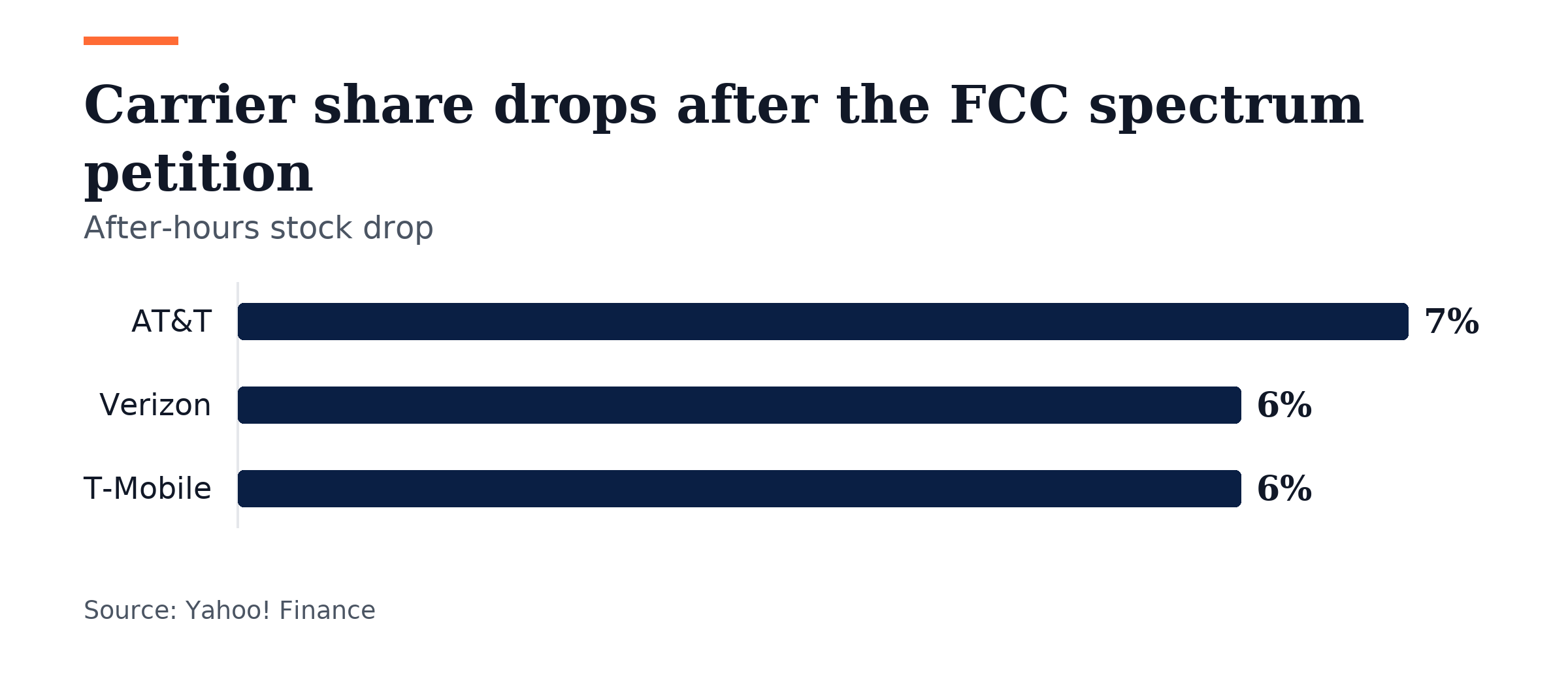
Shares of Verizon, AT&T, and T-Mobile each dropped roughly 6 percent after hours on Thursday, Oct. 9, 2026, following SpaceX’s announcement of the nationwide low-band spectrum purchase. The stock declines occurred alongside a broader reaction in carrier shares. AT&T fell almost 7 percent in after-hours trading, while Verizon lost more than 6 percent and T-Mobile fell 6 percent.
T-Mobile currently offers Starlink-powered satellite-to-phone service under the brand name T-Satellite.
AT&T CEO John Stankey downplayed Starlink’s ambitions in July 2026, saying the company entered the market late after the industry was already established. Carrier shares fell 4 percent that month. “The reality is that they’re coming to the game very late after this industry has been established,” Stankey said.

Join the discussion