Key facts
- Astronomers identified AGC 322753 as a candidate dark galaxy containing roughly 2 billion solar masses of neutral hydrogen with no detectable starlight in deep optical images, located about 310 million light-years away.
- Both observations of AGC 322753 contained two peaks consistent with gas rotating in a disk, suggesting an organized system that sharper radio observations could confirm.
- To check for faint stars the images might hide, the researchers inserted artificial galaxies of various sizes and stellar masses into the optical images around AGC 322753.
- Current models of galaxy formation predict less hydrogen for a system with no stars than AGC 322753 actually possesses.
Astronomers Identify AGC 322753 as Candidate Dark Galaxy
The researchers report AGC 322753 holds roughly 2 billion solar masses of neutral hydrogen with no detectable starlight in deep optical images.
Marco Monaci and colleagues at Swinburne University of Technology have identified AGC 322753, a dark-galaxy candidate with a neutral-hydrogen mass of roughly 2 billion solar masses and no detectable starlight in deep optical images, situated about 310 million light-years away, in research published in 2026. The paper, titled AGC 322753: A dark galaxy candidate detected by ALFALFA and FASHI, appeared in Monthly Notices of the Royal Astronomical Society and carries DOI 10.1093/mnras/stag1874. The system is classed as a promising dark-galaxy candidate, meaning a system with hardly any stars or possibly no stars at all, and its huge gas reserve makes the lack of visible light especially hard to account for.
Two radio surveys searching for neutral hydrogen provided the detection. The ALFALFA survey, which used the now-decommissioned Arecibo radio telescope, and a separate FAST telescope survey both detected radio emission from neutral hydrogen at the same sky position. The researchers cross-matched the ALFALFA and FAST catalogs and found 13 coincident sources before settling on AGC 322753, vetting each match by examining adjacent galaxies, image quality, and possible optical counterparts.

AGC 322753 showed up in both surveys with closely matching velocity and signal shape, and because the two telescopes observed at different times, the team could rule out radio interference as the source. Each dataset showed a pair of peaks matching the pattern expected from gas in a rotating disk, hinting at an organized system that sharper radio observations could confirm, though the disk itself remains unresolved. Because the telescope footprints overlapped, the team could pinpoint a smaller region of the sky and focus its search for stars there.
To search for stars the optical images might be hiding, the team placed artificial galaxies of various sizes and stellar masses into the images around AGC 322753. The test implied a ceiling of about 50 million solar masses for any stellar content, though the precise ceiling depends on how dispersed the stars are and on how much foreground light obscures them. The same experiments showed that detectability varies with the spatial distribution of stars and with contamination from foreground light. The ratio of neutral hydrogen to stellar mass works out to at least 40 to one.
The authors wrote that AGC 322753 “could have a stellar mass too low to be detectable in the Legacy Surveys.”
AGC 322753 contains more neutral hydrogen than current galaxy-formation models allow for a system with no stars. The two peaks in the radio data fit the pattern expected from gas in a rotating disk, yet the current observations do not resolve the disk itself. The nearest known bright galaxy sits roughly 950,000 light-years from AGC 322753. The object’s distance, its large gas mass, and its apparent rotation all weigh against a tidal origin, though they cannot rule it out.
An alternative explanation is that AGC 322753 is gas pulled from neighboring galaxies by gravitational interactions, but the separation, gas mass, and rotation tell against that origin.
As the world’s largest single-dish radio telescope, FAST’s enormous collecting area enables it to detect faint, diffuse hydrogen signals that smaller instruments cannot. One recently flagged candidate is J1351+0039, an isolated compact hydrogen cloud that FAST detected with no stars and no visible galaxy around it. DESI imaging showed that J1351+0039 emits essentially no starlight, a crucial negative result. The team led by Jin-Long Xu posted the J1351+0039 paper to arXiv on Sept. 24 (DOI 10.48550/arXiv.2609.29852), and news of the find broke on Oct. 17-18, 2026.
Deeper observations revealed about 500,000 solar masses of neutral hydrogen compressed into this compact, isolated blob. The gas shows a rotation speed of 4.2 km/s and random internal motions of about 11.6 km/s, pointing to a mass far exceeding the visible hydrogen. The researchers estimate J1351+0039’s total mass at roughly 130 million solar masses, with nearly all its mass in dark matter.
The researchers described the visible hydrogen as just the glowing tip of an invisible iceberg. Because J1351+0039 sits in isolation with no parent galaxy, the tidal-debris explanation is harder to sustain. The detection relied on the 21-cm emission line of neutral hydrogen, the standard radio signature of cold gas that can reveal gas even when stars are too faint for optical surveys.
J1351+0039 matches the description of a RELHIC, or reionization-limited hydrogen cloud. According to standard cosmology, the universe should contain many small dark-matter halos too lightweight to ignite stars, because reionization heated their gas so thoroughly it could never cool and collapse. Such halos would persist into the present day as pure dark matter wrapped in a thin layer of atomic hydrogen, constituting the elusive dark galaxies. Researchers have confirmed only one RELHIC so far, with two more promising candidates under consideration.
Confirming a new RELHIC would directly test the Lambda-CDM cosmological model, which predicts these objects should be abundant. Some of the missing satellites may never have turned their lights on, which would partly resolve the long-standing missing-satellite problem. The discrepancy holds that theory predicts many more dwarf galaxies around Milky Way-sized galaxies than astronomers actually see. AGC 322753 is a candidate dark galaxy with roughly 2 billion solar masses of neutral hydrogen and no detectable starlight.
In a study posted to arXiv, researchers presented a catalog of 142 dark galaxy candidates drawn from an ALFALFA survey region. The team started with 344 ALFALFA HI sources that lacked optical counterparts and discarded those that did not seem to have a dark-galaxy origin.
They removed 83 sources identified as HI clouds probably produced by tidal interactions between galaxies, they discarded 13 sources with optical counterparts, they dropped 56 sources situated near other HI sources, they excluded 10 sources with nearby HI sources lying within the ALFALFA beam, and they excluded 40 sources potentially linked to nearby galaxies. The team visually inspected DESI Legacy Imaging Survey optical images, which reach an r-band surface brightness limit of about 28.5 mag arcsec^-2, along with GALEX NUV images, to confirm the absence of stellar emission. They also examined infrared images from WISE and AKARI for dust emission.
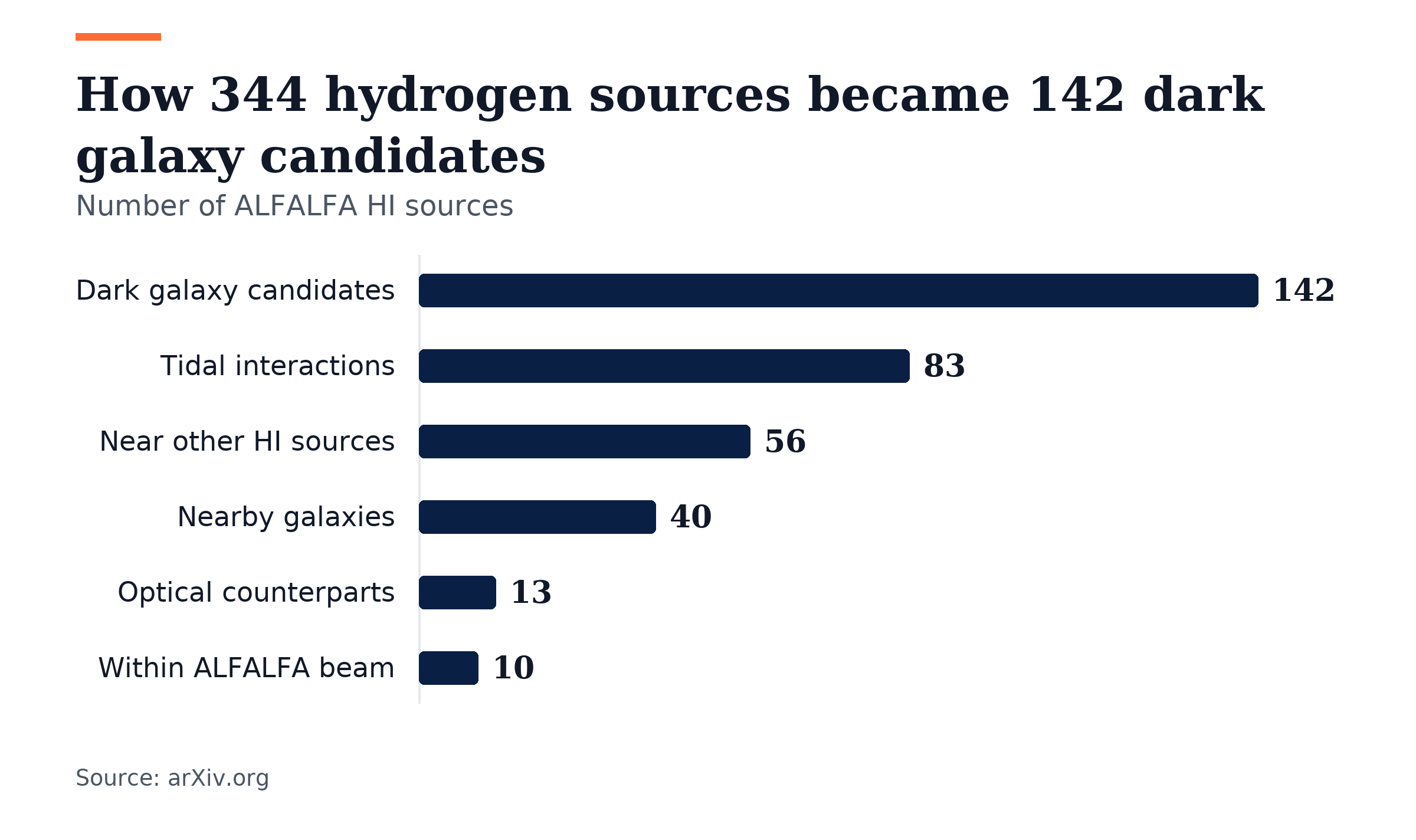
The 142 candidates that emerged tend to have smaller dynamical masses and higher HI-to-dynamical mass ratios than luminous galaxies, and they tend to occur in less dense regions, consistent with cosmological simulations. This sample of 142 candidates offers a valuable testbed for examining how dark matter shapes galaxy formation and evolution.
In January 2026, Cloud-9, a candidate near the M94 galaxy, became the leading RELHIC candidate after follow-up observations with the Green Bank Telescope and the Very Large Array confirmed the initial FAST detection. In September 2026, FAST announced two candidates near the M51 galaxy pair, called Cloud N and Cloud S, though those may prove to be tidal debris. Only higher-resolution radio follow-up can tell a genuine starless halo from an ultra-faint galaxy or a fragment of gas from an ancient collision. An ultra-faint dwarf galaxy can look like a dark cloud because its surface brightness falls below detection limits, meaning no detection does not prove a galaxy is absent.
Sharper radio studies could confirm whether the gas in AGC 322753 forms a genuine rotating disk, and deeper optical imaging might reveal any stars hidden there. Even if researchers find stars, the system would remain puzzling because it holds a large gas reserve while showing little light. One proposed dark galaxy lost its status when deeper observations revealed a faint group of stars associated with its gas reservoir, a precedent showing that deep follow-up can uncover faint stellar populations linked to gas once thought to be starless.
Interferometers like the VLA could follow up on J1351+0039 by mapping its gas structure, testing whether it is gravitationally bound, and pinning down the rotation curve that reveals the dark-matter halo. Deeper optical imaging with Hubble-class telescopes or next-generation sky surveys might uncover a trace of starlight or reinforce the case that the object is genuinely dark. If J1351+0039 survives scrutiny, it will serve as a laboratory for dark-matter physics on small scales, precisely the regime where competing dark-matter theories diverge most sharply.


Join the discussion