
This is a new development in a story we reported earlier: NASA schedules Artemis III for 2027 as Moon landing rehearsal.
Key facts
- On Oct. 23, 2026, NASA Administrator Jared Isaacman and agency leaders presented an accelerated plan to bring Americans back to the Moon by 2028.
- The Artemis III mission will launch in mid-2027 with four crew members aboard Orion for a 14-day low Earth orbit test of systems needed for future Moon landings.
- The mission is no longer a Moon landing and will instead operate in low Earth orbit with the Blue Moon lander from Blue Origin and SpaceX's Starship.
- The Orion crew will dock with Blue Origin for three days, then spend about two hours with Starship without entering the spacecraft.
NASA Administrator Jared Isaacman and agency leaders presented an accelerated Artemis plan on Friday, Oct. 23, 2026, at Kennedy Space Center during a two-hour news conference, shifting Artemis III from a Moon landing to a mid-2027 low Earth orbit test before lunar landings return in 2028. The session served as a progress update on how Artemis plans have evolved and included acceleration efforts for Artemis IV.}{
The change came after teams prepared Artemis II to send four astronauts around the Moon, and Isaacman ordered the course correction a month before Artemis II lifted off. Under the revised schedule, Artemis III will launch in mid-2027 with four crew members aboard Orion on a 14-day low Earth orbit test of systems needed for future Moon landings. The mission will not land on the Moon. Instead, it will operate in low Earth orbit alongside the Blue Moon lander from Blue Origin and SpaceX’s Starship.}{
The Orion crew will dock with Blue Origin for three days, then the astronauts will spend about two hours with Starship without entering that spacecraft. Blue Origin comes first during the flight, followed by a brief Starship visit, and the crew will not board Starship.}{
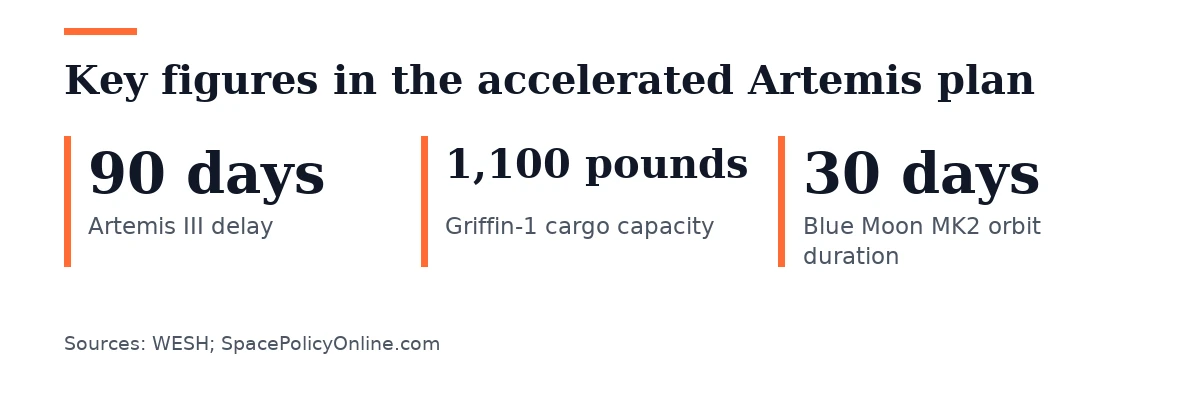
Under the revised schedule, Artemis IV and Artemis V will return astronauts to the lunar surface, with both missions targeted for 2028. The agency has described Artemis IV as the first program mission to reach the lunar surface. Artemis Program Manager Jeremy Parsons said Artemis III was about 90 days behind schedule, mainly because of supply chain issues, and the agency treats the schedule slippage as an internal signal to motivate the workforce.}{
In September, Isaacman wrote to NASA employees about the schedule, and he said the internal wording aimed to push employees to find solutions, according to SpacePolicyOnline.com. NASA now brings engineers in-house instead of using vendors. Amit Kshatriya says the change improves issue resolution and problem-solving speed across the agency.}{
Teams are now fixing issues within hours rather than weeks, Kshatriya said, contrasting the new pace with the previous vendor-dependent process. Crews are assembling Artemis III equipment inside the Vehicle Assembly Building, and planners have scheduled a tanking test before the end of 2026.}{
The agency plans to open the moon base effort with an end-of-2026 launch, relying on early cargo deliveries to the lunar surface. Griffin-1, described as a commercial lunar lander, is set to carry 1,100 pounds of cargo to the lunar south pole, with a rover aboard to test mobility technology. NASA says constructing facilities near the lunar south pole is essential to returning humans to the Moon, and officials view the cargo mission as supporting that long-term goal.}{
Before choosing the final South Pole landing location, NASA wants more information from robotic missions, and CLPS landings already completed and planned flights will supply that data. Compared with equatorial sites, the lunar South Pole features steep terrain, harsh lighting, severe temperatures, and limited abort options, presenting a harsher environment than the equatorial landing areas used by Apollo. Comets deposited water ice over eons in permanently shadowed regions, and NASA believes the ice could be mined for outposts or rocket fuel.}{
Axiom Space builds the spacesuits, and development has lagged behind other program elements, leaving the suits behind schedule. NASA approved a simpler, lighter sortie suit for early missions. The design restricts crews to two surface hours across two excursions, which the agency considers acceptable for the initial landings.}{
SpaceX and Blue Origin must both complete uncrewed landings to prove their systems can touch down safely before astronauts use them. Blue Moon MK2 can stay in orbit for 30 days. The vehicle will launch before Orion and dock on Day 3 for two days of testing.}{
Because the mission stays in Earth orbit, Orion will fly on the Space Launch System with a spacer instead of the Interim Cryogenic Propulsion Stage that Artemis II used to leave Earth orbit. Starship will launch on Day 6 carrying a nose docking adapter. Orion will remain docked for two hours, with the crew staying aboard Orion.}{
No orbital fuel depots exist yet, and Starship cannot reach the Moon without moving propellant between vehicles in orbit. Any depot would have to collect and top off cryogenic propellant to offset boil-off, though teams have not yet demonstrated orbital transfer technology. SpaceX plans to conduct its first cryogenic fuel transfer early in 2027, followed by an uncrewed Moon landing test late in 2027.}{
Under the 2028 plan, a fully fueled Starship will link up with Orion in Earth orbit and propel it toward the Moon rather than meeting in lunar orbit. A pair of astronauts will transfer to the lander for the descent, then return to Orion for the trip home. NASA expects both Starship and Blue Moon MK2 to land crews on the Moon by the end of 2028, even though the first provider remains undecided.}{
Blue Origin has dropped its original in-space propellant transfer plan. Instead, three Blue Moon MK1 vehicles will now serve as tugs for the MK2 lander as part of the revised approach.}{
The Aerospace Safety Advisory Panel raised concerns about lander readiness, the single uncrewed test for each provider, and first-time use of cryogenic propellants on the Moon.}{
The National Academies, at NASA’s request, identified four sites away from the poles that offer valuable scientific potential. Kshatriya said officials will keep debating the best landing site because unknowns remain about the South Pole. Isaacman called the South Pole the best area, and he said CLPS missions will provide a strong understanding of the environment.}{



Join the discussion