Key facts
- NASA ended science operations on the Neil Gehrels Swift Observatory because the spacecraft now orbits below 171 miles (275 kilometers) above Earth, where greater atmospheric drag prevents steady telescope pointing.
- Swift completed its final astronomical observation on Oct. 20.
- NASA expects Swift to re-enter Earth's atmosphere within the next few weeks.
- Swift studied more than 1,400 supernova explosions.
NASA called an end to science operations for the Neil Gehrels Swift Observatory on Oct. 23, 2026, citing the spacecraft’s orbit below 171 miles (275 kilometers) above Earth and the atmospheric drag that blocks steady telescope pointing.
Swift’s last astronomical observation took place on Oct. 20. NASA anticipates that the spacecraft will re-enter Earth’s atmosphere over the next few weeks, though NASA provided no specific day.
NASA and Katalyst Space Technologies said on Wednesday that the robotic rescue mission for Swift was over. The rescue satellite Link had launched on July 3 to catch up with Swift, capture it using three robotic arms, and raise its orbit high enough to escape a looming re-entry.
Link, roughly the size of a refrigerator, carries two solar arrays plus three xenon-fueled electric thrusters, and lost attitude control in late July when two of its three reaction wheels failed. After cold gas thruster problems affected fine pointing, three low-impulse plasma thrusters became the only way to control the satellite’s orientation as it orbited Earth at nearly five miles per second.
NASA provided a $30 million contract for Link’s construction and launch. The agreement came together less than twelve months before the announcement, and NASA set a summer 2026 launch deadline so Link could reach Swift before re-entry. Katalyst assembled the satellite for launch in nine months, far less than the typical development time for a new satellite. The compressed timeline forced engineers to accept technical risks they would not normally take, and everything went well during Link’s first few weeks in orbit.
Katalyst attributed the rescue’s failure to continuing attitude control problems with Link, and the company has not identified the cause of the malfunction. Link is still alive, Katalyst said, and might fly near Swift to demonstrate its close-in navigation system. NASA and Katalyst are reviewing remaining milestones and plan to keep drawing technical and operational value from the spacecraft.
Jared Isaacman, NASA’s administrator, said the rescue attempt was worth making despite failing to achieve its intended outcome. “NASA should be willing to move quickly and take smart risks when the potential return is worth it,” Isaacman said.
The observatory began its work in December 2004 after launching on Nov. 20, 2004. NASA gave the mission Neil Gehrels’ name in 2018 after he died; Gehrels served as the mission’s first principal investigator, and the observatory began as a multiwavelength project with co-aligned Optical/Ultraviolet and X-ray telescopes.
The satellite was built to study gamma-ray bursts that appear and vanish too fast for big telescopes to target. Swift usually found, pinpointed and photographed burst positions in about one minute, catching the bursts, sending their positions to other observatories, and recording the sites before the afterglows disappeared.
Before Swift, there was no way to quickly locate short gamma-ray bursts and observe their afterglows, partly because the bursts hit peak brightness in under two seconds. During May 2005, Swift observed GRB 050509B, a burst that lasted 0.03 seconds, and detected 11 X-ray photons, yielding the initial afterglow detection for a short burst.
The detection backed the idea that short gamma-ray bursts arise from mergers of two neutron stars. Swift’s scheduling system could manage as many as 75 independent targets per day, and its flexible planning allowed ground controllers to request target-of-opportunity observations within just a few minutes.
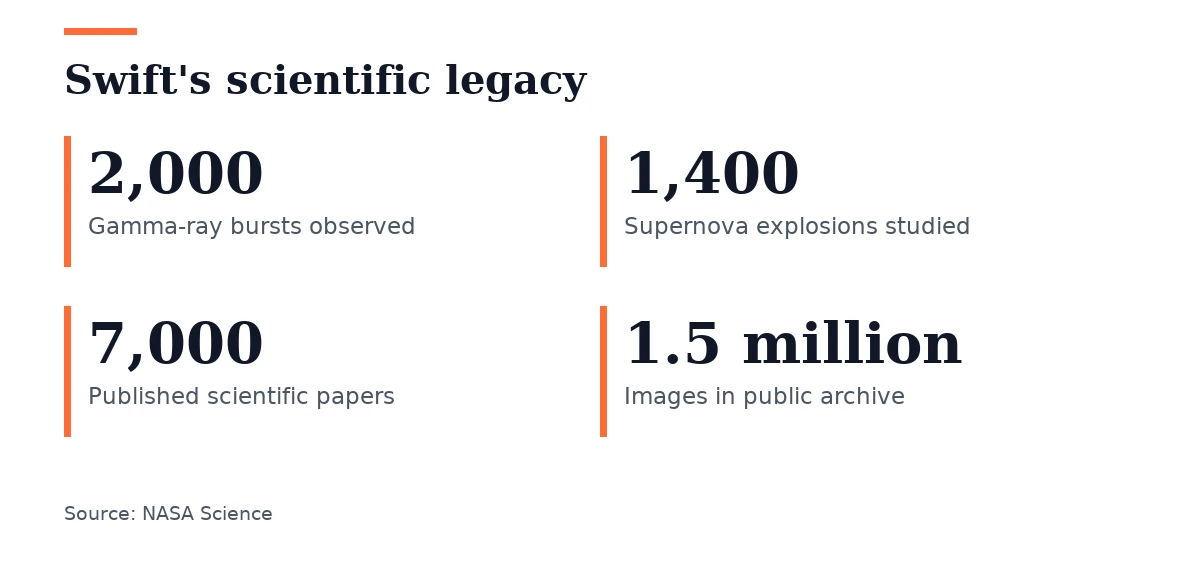
Over the course of the mission, Swift tracked more than 2,000 gamma-ray bursts and studied more than 1,400 supernova explosions, while its data fed about 7,000 published scientific papers.
Besides gamma-ray bursts, Swift observed stars torn apart by black holes, watched active galaxies, carried out an all-sky X-ray survey, and examined asteroids and comets. It also helped study long gamma-ray bursts tied to collapsing massive stars and observed exoplanet transits.
Swift played a role in multi-messenger astronomy by helping study light from gravitational-wave events such as GW170817. Its instrument set included the Burst Alert Telescope, the X-ray Telescope and the Ultraviolet/Optical Telescope, which let Swift observe across gamma-ray, X-ray and optical-ultraviolet wavelengths.
The archive stores more than 1.5 million images captured by the Ultraviolet/Optical Telescope and spans nearly 22 years of brightness measurements and spectra. The complete public dataset amounts to approximately 12 terabytes.
Shawn Domagal-Goldman, who directs NASA’s Astrophysics Division, said Swift was built for a two-year primary mission yet kept working productively for more than 10 times that length. John Nousek, Swift’s operations director and a professor at Penn State, credited hardware speed, rapid operations and teamwork for putting the mission at the intersection of emerging research fields. The agency is looking at ways to use and add to its current telescope fleet, including commercial capabilities that reach orbit quickly, to maintain rapid response after Swift.
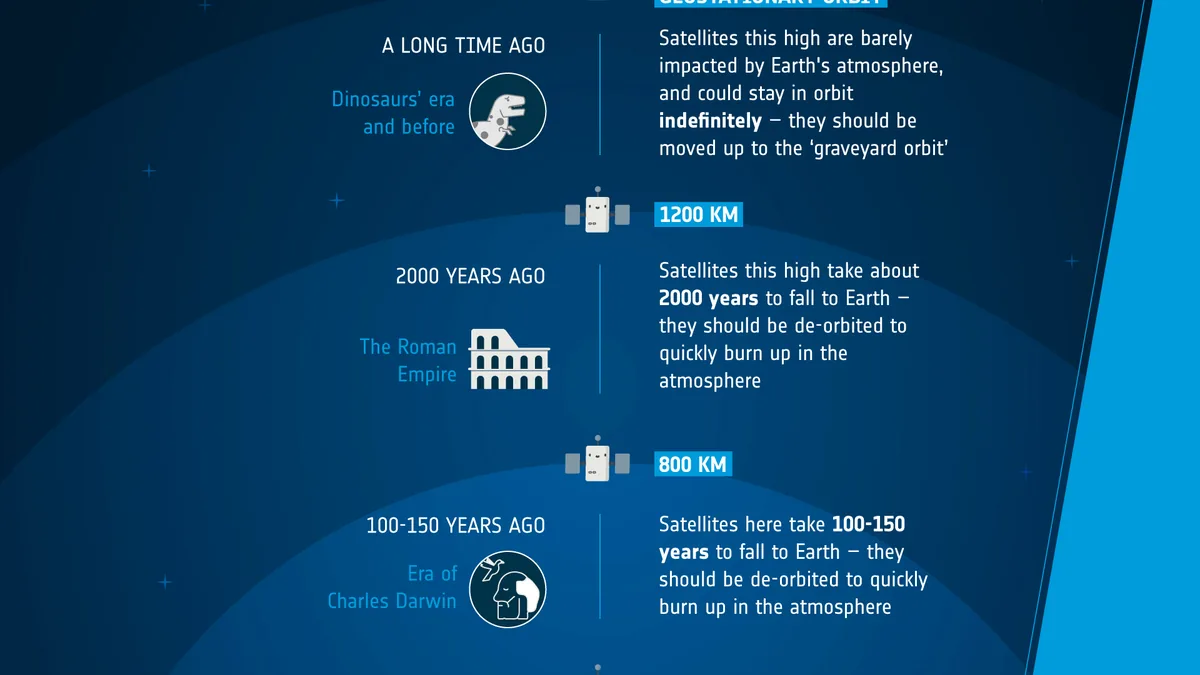
The observatory’s mass is 1,470 kilograms. Solar activity in 2026 made the observatory’s orbit contract faster than expected, and before decay it flew in an orbit roughly 200 miles above Earth. Engineers had worked out a natural re-entry path, but the solar maximum moved the timeline earlier. NASA anticipates Swift will burn up mostly during re-entry but has not confirmed whether any debris could reach the ground.
Russia’s Mir space station, a 130-ton complex, was de-orbited in a controlled fashion in 2001, and its remnants fell into the Pacific Ocean. China’s Tiangong-1 space station re-entered uncontrollably in 2018, and most of its debris burned up or landed without harm.
The Advanced Multi-Messenger Gamma-ray Explorer, or AMEGO-X, is a proposed mission meant to extend Swift’s legacy with higher sensitivity and a broader field of view. NASA says it will keep giving priority to fresh ways to react rapidly to cosmic events, while current missions help fill the gap left by Swift.



Join the discussion