Key facts
- An international team led by the University of Queensland compiled a dataset of 2,884 Type Ia supernovae, the largest internally consistent collection of such exploding stars, to study cosmic expansion.
- The standard cosmological model, ΛCDM, assumes dark energy is a constant (cosmological constant) with a fixed density, represented by the equation-of-state parameter w = -1.
- When combined with BAO and CMB data, the Unite dataset produces a preferred model where dark energy evolves, with w0 = -0.861 and wa = -0.60, indicating a potential weakening of dark energy over time.
- The Pantheon+ dataset and the Dark Energy Survey 5-year sample (DES-SN5YR) were combined and reanalyzed to create the Unite catalog, resolving overlaps and applying consistent corrections.
An international team led by the University of Queensland compiled 2,884 Type Ia supernovae into Unite, the largest internally consistent collection of such exploding stars, and posted the preprint on Sept. 4, 2026. | cite_ids: [“ScienceDaily”, “The Brighter Side of News”, “Space Daily”, “Zendar Universe News”]
When combined with measurements of baryon acoustic oscillations and the cosmic microwave background, the Unite data prefer a model in which dark energy changes over time. The statistical significance is 3.1 to 3.3 sigma. The University of Queensland issued a press release on Oct. 22, 2026, describing the compilation as the largest collection of exploding white dwarf stars ever assembled, and ScienceDaily reported the research on Oct. 23, 2026. | cite_ids: [“ScienceDaily”, “The Brighter Side of News”, “Space Daily”, “Zendar Universe News”]
The standard cosmological model, Lambda-CDM, assumes dark energy is a cosmological constant with a fixed density, represented by w = -1. That assumption has been the foundation for understanding cosmic acceleration since the late 1990s. Under the model, dark energy keeps the same energy density even as the universe expands. | cite_ids: [“The Brighter Side of News”, “Space Daily”, “Zendar Universe News”]
Type Ia supernovae act as standard candles because they explode at a consistent mass, the Chandrasekhar limit, giving them predictable peak brightness. Astronomers plot apparent brightness against redshift in a Hubble diagram to measure cosmic distances and trace expansion history. Their light curves and redshifts let astronomers trace the universe’s expansion history. These explosions revealed in the late 1990s that expansion is accelerating, motivating the name dark energy for whatever drives it. | cite_ids: [“The Brighter Side of News”, “Zendar Universe News”]
Baryon acoustic oscillations are fossil spacings in the distribution of galaxies, left by sound waves in the early universe. The cosmic microwave background is a snapshot of the young universe, and combining it with BAO and supernova data helps constrain cosmological parameters. | cite_ids: [“The Brighter Side of News”, “Space Daily”]
The Unite catalog merges Pantheon+ and the Dark Energy Survey 5-year sample, resolving overlaps and applying consistent corrections across telescopes, filters, calibration, dust, lensing, and host galaxies. Pantheon+ uses 1,550 distinct Type Ia supernovae and appeared in The Astrophysical Journal in 2022, while the Dark Energy Survey five-year sample appeared in The Astrophysical Journal Letters in 2024. | cite_ids: [“The Brighter Side of News”, “Space Daily”]
Using Unite alone, researchers found a present-day value w0 = -0.764, placing the result roughly two standard deviations from -1. The supernova-only test allowed w to differ from the cosmological constant while remaining fixed through time, and the preferred value stayed about two sigma away. That is suggestive but not conclusive. | cite_ids: [“The Brighter Side of News”]
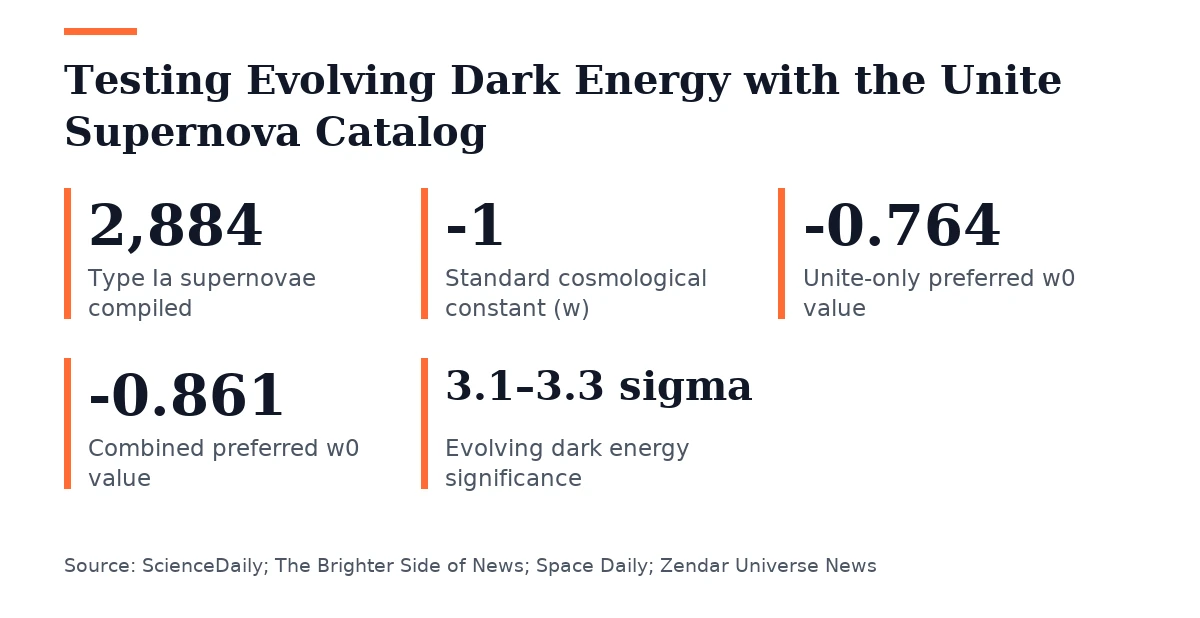
When BAO and CMB are added, the evolving w0waCDM model gives w0 = -0.861 plus 0.044 minus 0.042 and wa = -0.60 plus 0.17 minus 0.19. In this extension, w0 describes dark energy’s present behavior and wa controls smooth evolution with the universe’s scale factor. It also gives Omega-m = 0.305 plus or minus 0.004, versus 0.310 plus 0.012 minus 0.011 for flat Lambda-CDM. The Dark Energy Figure of Merit reached 315. | cite_ids: [“The Brighter Side of News”, “Space Daily”, “Zendar Universe News”]
Frequentist tests prefer evolving dark energy over flat Lambda-CDM at about 3.3 sigma using maximum posterior probability and 3.1 sigma using maximum likelihood. Bayesian comparison averages across parameter space, penalizes extra freedom, and finds only weak support. A 5-sigma result means about a 1-in-3.5-million chance of a statistical fluke, while 3.1 sigma means roughly a 1-in-1,000 chance. | cite_ids: [“The Brighter Side of News”, “Zendar Universe News”]
Roughly half of the error budget in modern supernova analyses comes from systematic uncertainties, and different reasonable choices about calibration, modeling, and host galaxies can shift best-fitting parameters. The result should not be read as proof that Lambda-CDM has failed, but as another carefully constructed dataset awaiting further testing. | cite_ids: [“The Brighter Side of News”]
The Dark Energy Spectroscopic Instrument independently found hints of evolving dark energy at 2.8 to 4.2 sigma using baryon acoustic oscillations. DESI data release 1 came in 2024 and data release 2 in March 2025, and both align with the Unite supernova results. This independent confirmation strengthens the case for further investigation into dark energy’s evolution. | cite_ids: [“The Brighter Side of News”, “Zendar Universe News”]
Professor Tamara Davis said the research might contain a clue about linking gravity with quantum mechanics. The team says understanding whether dark energy evolves could provide insights into reconciling gravity with quantum physics, one of the greatest unresolved problems in theoretical physics. | cite_ids: [“ScienceDaily”, “Zendar Universe News”]
Ryan Camilleri, a PhD candidate at the University of Queensland, said, “We’ve rebuilt three decades of astronomical observations into a single, consistent framework,” and described the work as rebuilding three decades of observations into one framework rather than merely combining separate spreadsheets. | cite_ids: [“ScienceDaily”, “The Brighter Side of News”] Professor Tamara Davis said the Dark Energy Survey supernova data published in 2024 first showed hints of time-varying dark energy, while the new compilation sees a deviation from the standard model in a slightly different direction. | cite_ids: [“ScienceDaily”]
The universe is still expanding at an accelerating rate, but a time-varying dark energy equation of state suggests the rate of acceleration is changing differently than Lambda-CDM predicts. The evolving model does not imply the universe will stop expanding; it means dark energy’s influence shifts over cosmic time. | cite_ids: [“The Brighter Side of News”, “Zendar Universe News”]
Unite is the first major supernova compilation to include a gravitational lensing correction by default, reducing Hubble-diagram scatter by about 5 percent for supernovae above redshift 0.5. The recalibration also accounts for cosmic dust and host-galaxy properties, and older observations were recalibrated using updated methods to handle different telescopes, filters, and selection effects. | cite_ids: [“ScienceDaily”, “The Brighter Side of News”, “Space Daily”]
The immediate next step is the release of the Unite Hubble diagram and likelihood data once the paper is formally accepted. The preprint, Supernovae Unite: Combining Pantheon+ and DES-SN5YR (arXiv:2609.05053), is awaiting formal acceptance before those data are released. | cite_ids: [“Zendar Universe News”]
The Dark Energy Bedrock All-Sky Supernova program is expected to add hundreds of nearby supernovae to the dataset, improving the low-redshift foundation of the cosmic distance scale. DEBASS aims to refine the low-redshift measurements critical for detecting time variations in dark energy. | cite_ids: [“ScienceDaily”, “Space Daily”, “Zendar Universe News”]
Future surveys from the Roman Space Telescope, ESA Euclid, and Rubin Observatory will map galaxies and supernovae, providing precision data to test whether dark energy evolves over time. These missions will map billions of galaxies and hunt high-redshift supernovae. | cite_ids: [“Space Daily”, “Zendar Universe News”]
The team says understanding whether dark energy evolves could provide insights into reconciling gravity with quantum physics, one of the greatest unresolved problems in theoretical physics. The University of Queensland says the combined approach yields evidence that dark energy may change over time instead of confirming it is fixed and unchanging. | cite_ids: [“ScienceDaily”, “Zendar Universe News”]



Join the discussion