
Key facts
- The cold, geometrically thin accretion disk around 3C 120's supermassive black hole is truncated at about 20 gravitational radii, and the zone within that limit is a hot, geometrically thick flow.
- Jet production is widely credited to the Blandford-Znajek process, which draws black hole rotational energy through large-scale magnetic fields maintained by an accretion flow.
- Hirofumi Noda of Tohoku University and Kazuhiro Hada of Nagoya City University co-led the research reported in The Astrophysical Journal Letters.
- Black holes turn on powerful jets at the same critical feeding point whether they are roughly ten solar masses or millions of solar masses, researchers say.
A team co-led by Hirofumi Noda of Tohoku University and Kazuhiro Hada of Nagoya City University reported Oct. 22, 2026, that the cold thin disk around the supermassive black hole in 3C 120 ends at about 20 gravitational radii, with a hot, geometrically thick flow inside that limit.
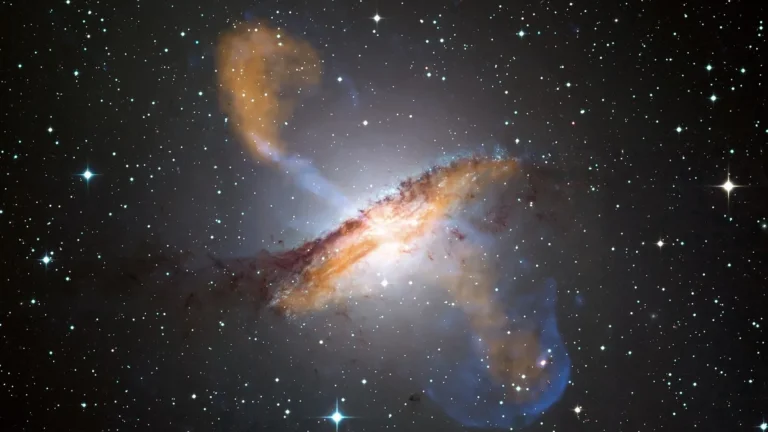
3C 120 is a broad-line radio galaxy at redshift z = 0.033, about 420 million light years away, with a black hole mass of roughly 6.3 × 10^7 solar masses. Researchers studied it using XRISM X-ray microcalorimeter spectroscopy together with GMVA, VLBA, and EAVN millimeter and radio interferometry aimed at the galaxy.
The finding resolves a paradox because jet production is widely credited to the Blandford-Znajek process, which draws black hole rotational energy through large-scale magnetic fields maintained by an accretion flow, while cold thin disks are normally unable to sustain those fields. The mechanism is observationally well-supported for hot, geometrically thick accretion flows, though the view that it is necessary for supermassive black hole jets rests partly on observations and partly on simulations.
Noda said the observations let researchers see both the hot plasma near the black hole and the emerging jet, directly connecting the extreme environment with jet formation. The paper is titled Disk Truncation Triggers Relativistic Jet Launching of a Highly Accreting Supermassive Black Hole. “we were able to see both the hot plasma surrounding the black hole and the jet emerging from it,” Noda said.
Radio imaging indicates that extrapolating the 3C 120 jet profile toward the black hole horizon gives a radius comparable to or even narrower than the disk truncation radius. The arXiv abstract pairs the X-ray truncation finding with radio evidence that the jet base lies at or inside the same radius where the thin disk ends.
XRISM measured the color of X-rays from near the 3C 120 black hole, with wavelengths stretched and colors altered by general relativity. The article describes a figure showing how X-ray spectroscopy and millimeter radio imaging reveal the environment around the rapidly feeding supermassive black hole.
3C 120 accretes at a relatively high rate while launching a powerful relativistic jet. Even at high accretion rates, jet launching is tied to a hot inner flow, potentially through the Blandford-Znajek process, supporting a universal link between disk and jet through geometric transition.
Researchers will use the combined X-ray and radio-imaging approach on more objects to study disk truncation further. Noda said the team wants to understand how matter, magnetic fields and spin combine in these settings to clarify how supermassive black holes shape galaxies and larger structures.
Black holes turn on powerful jets at the same critical feeding point whether they are roughly ten solar masses or millions of solar masses, researchers say. The universal jet-launching study was led by Dr. Adelle Goodwin of Curtin University’s International Center of Radio Astronomy Research and a Forrest Research Foundation fellow, with Dr. Andrew Mummery from the Institute for Advanced Study in Princeton.
“The physics does not seem to care how big they are,” Goodwin said. Astronomers have long suspected black holes follow the same basic physics whatever their size, but proof was difficult because supermassive black holes usually evolve over thousands of years.
A star torn apart by a supermassive black hole produces a feeding episode that plays out over years instead of millennia, letting astronomers watch it happen. The team studied 20 star-disruption events with optical, ultraviolet, X-ray and radio data, keeping 10 events that allowed reliable modeling of how fast the black hole fed and when radio outflows happened.
The finding resulted from years of telescope observations in Australia, the United States, India, South Africa and space, tracking stars torn apart by supermassive black holes. The researchers found two distinct jet-launching phases: one early when the black hole feeds at extreme rates, and another hundreds to thousands of days after disruption when feeding falls to about 2% of the Eddington limit.
In the Milky Way’s much smaller black holes, jet formation at 2% of the Eddington limit is already documented. Anticipating when a black hole is likely to launch a jet can improve targeting of observing campaigns, reduce wasted observations, and improve chances of catching rare events, Goodwin said.
Astronomers expect upcoming surveys to find far more tidal disruption events, so they will need clearer criteria for choosing which flares to follow and when to observe them. Western Australia will host the low-frequency component of the Square Kilometer Array Observatory.
The Australian government has invested $387 million and the total SKA cost exceeds $2 billion. The paper is “A universal critical accretion rate for black hole jet formation” by Adelle J. Goodwin et al., published in Nature Astronomy in 2026, DOI 10.1038/s41550-026-02951-1. The publication details appear at the end of the Phys.org article.
Narrow jets of extremely hot plasma from supermassive black holes ionize hydrogen gas along their paths, producing a strong directional H-alpha glow that is brightest along the radio jet axis. The study was led by Sanchayeeta Borthakur at Arizona State University and Namrata Roy at the Raman Research Institute, and it appeared in The Astrophysical Journal Letters with backing from NASA, STScI, and the NSF. “The jet carries the energy outward, and the gas lights up along its path,” Roy said.
Dated September 30, 2026, the Arizona State University release says jets can disrupt star-forming gas past a galaxy’s visible boundary, creating a bright trail that reaches hundreds of thousands of light-years. The circumgalactic medium reaches about 10 to 20 times beyond a galaxy’s visible portion.
Large galaxies including the Milky Way are surrounded by a circumgalactic medium reservoir, and some of that gas can cool, flow inward, gather into dense clouds, and eventually form new stars. A supermassive black hole is roughly comparable in scale to our solar system, while its host galaxy may contain about 100 billion solar systems.
By heating, stirring and disrupting circumgalactic gas, jets make it harder for that gas to cool and fall inward, leaving less fuel for star formation and pushing galaxies toward quiescence. The ionized hydrogen glow is brightest in two regions: one near the galaxy where the jet first meets the circumgalactic medium, and another near the outer edge of the CGM where the jet deposits much of its energy.
Because the ionized hydrogen signal is too weak to detect around a single galaxy, the team combined Dark Energy Spectroscopic Instrument survey data with LOFAR Two-meter Sky Survey radio jet measurements from hundreds of galaxies with active jets. The H-alpha signal stays weak when the team averages observations from every direction together, but becomes much stronger along the radio jets, showing the gas does not glow equally in all directions.
A magnesium absorption tracer of cooler gas spread isotropically with no tie to jet direction, unlike the jet-aligned hydrogen glow. Contributing co-authors include Timothy Heckman at Johns Hopkins University and Tanmay Singh at Arizona State University.
The paper is “Lighting Up the Circumgalactic Medium: Strong, Jet-aligned Hα Emission around Radio Galaxies” by Namrata Roy, Sanchayeeta Borthakur, Timothy Heckman, Tanmay Singh, in The Astrophysical Journal Letters, 2026; 1009(2): L34, DOI 10.3847/2041-8213/ae9cbd. The journal reference appears at the end of the ScienceDaily release.
Join the discussion