
Key facts
- Marble Imaging, Reflex Aerospace, and Odysseus Space revealed on October 21, 2026 that they would fly a joint mission carrying Odysseus laser communications on Marble Sat-1.
- Conventional radio-frequency downlink channels typically operate between 1 and 2 Gbps, which creates severe throughput constraints for high-resolution Earth observation payloads generating massive data volumes.
- Optical links bypass these spectral limits using narrow, interception-resistant beams that function outside international radio spectrum licensing regimes.
- Morgana is equipped with Odysseus Space's Cyclops-DTE terminal, which reaches transmission speeds up to 10 Gbps and delivers at least 1 terabyte per day of imagery.
Marble Imaging, Reflex Aerospace and Odysseus Space announced on Oct. 21, 2026 that they would fly a joint mission carrying Odysseus Space laser communications equipment on the Marble Sat-1 spacecraft, according to satnews.com. The announcement identifies Marble Imaging as an Earth observation operator and Odysseus Space as an optical communications specialist.
The spacecraft carries the name Morgana, and the partners plan to launch it in the first quarter of 2027. Reflex Aerospace manufactures and integrates the Morgana platform, which recently passed flight qualification and vibration testing. The mission will use optical downlink technology to ease radio-frequency constraints and speed up European Earth observation data delivery.
Conventional radio-frequency downlink channels typically operate between 1 and 2 Gbps, creating severe throughput constraints for high-resolution Earth observation payloads that generate massive data volumes. Optical links bypass these spectral limits using narrow, interception-resistant beams that function outside international radio spectrum licensing regimes. The mechanism addresses the radio-frequency constraints described for Earth observation downlinks and supports Odysseus Space concepts for scalable space infrastructure and for solving orbital data transfer bottlenecks.
Morgana is equipped with Odysseus Space‘s Cyclops-DTE terminal, which reaches transmission speeds up to 10 Gbps and delivers at least 1 terabyte per day of imagery. Adopting the managed Laser Communication as a Service model, a subscription arrangement for optical downlink capacity, lets Marble Imaging cut data retrieval costs by a factor of ten while securing high-volume information flows used for civil monitoring and defense intelligence. Robert Hook, Chief Executive Officer of Marble Imaging, said laser communication provides the downlink speeds required for massive Earth observation data volumes and offers inherently more secure data transfer.
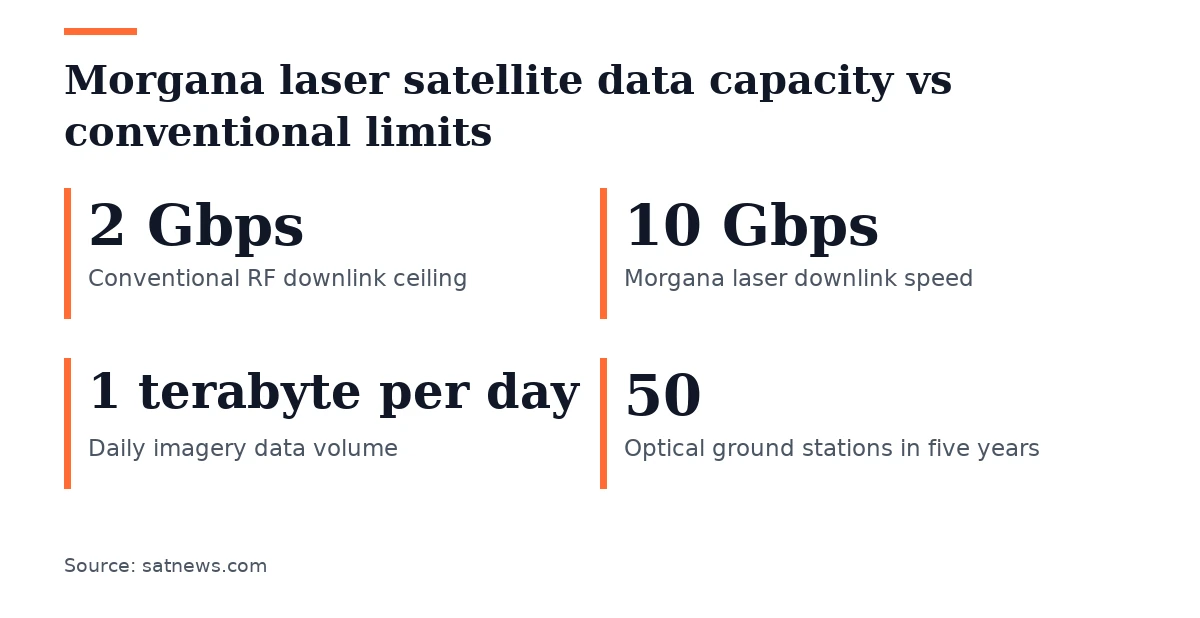
Plans to reach 50 optical ground stations inside a five-year window back the subscription. Reflex Aerospace manufactures and integrates the satellite platform while Odysseus Space provides the terminal and ground station access under the Laser Communication as a Service model. Marble Imaging operates the Earth observation mission.





Join the discussion