Key facts
- A research team led by Jesse T. Coburn reported in Nature Astronomy that Solar Orbiter traced a magnetic switchback back to where it originated in the solar corona, marking the first such tracing of this phenomenon.
- Because the plasma formed in a closed magnetic loop, the researchers concluded the switchback was launched by interchange reconnection.
- Interchange reconnection occurs when part of a closed magnetic loop meets an open field line, snapping the line, breaking the arc and slingshotting superheated gases into interplanetary space.
- After launch, waves and turbulence in the solar wind influence the switchback's motion, so interchange reconnection and wave dynamics operate at different stages of the structure's lifetime.
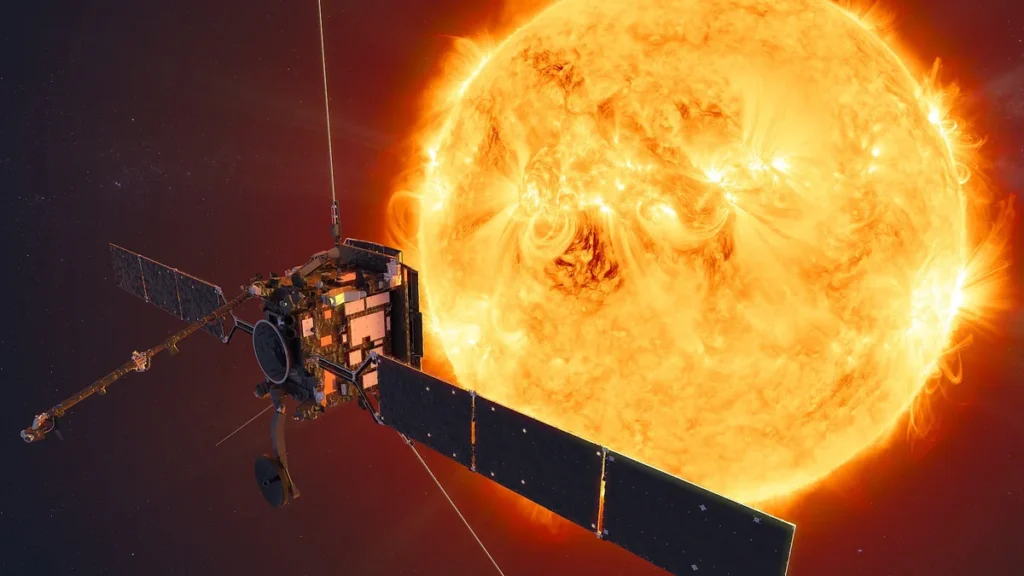
A European Space Agency spacecraft has traced a magnetic switchback directly to its birthplace in the Sun’s corona for the first time. Nature Astronomy published the research, led by Jesse T. Coburn of the French National Centre for Scientific Research, on Oct. 8, 2026. The team used data from the Solar Orbiter, a European Space Agency mission with Daniel Müller serving as its project scientist, which encountered the large switchback on March 2, 2022, while traveling roughly halfway between Earth and the Sun. This serendipitous crossing allowed scientists to link the structure to a specific solar phenomenon, resolving a long-standing debate about where these magnetic kinks originate.
A switchback looks like a sharp S-shaped kink in the solar wind’s magnetic field, and it can briefly double back on itself while traveling through space. These sudden folds in the magnetic field carried by the solar wind were first observed in the 1970s by the Helios 1 and Helios 2 spacecraft, and their origins have remained debated ever since. NASA’s Parker Solar Probe has since spotted massive numbers of switchbacks near the Sun, but scientists previously debated whether they form in the Sun’s corona or in deep space from turbulence.
The spacecraft carries a suite of scientific instruments, including the Solar Wind Analyser and the Heavy Ion sensor, which provided the critical data for this study. Daniel Müller serves as the project scientist for the mission. The ability to sample the solar wind in situ (at the spacecraft) while simultaneously observing the Sun’s surface from a distance allowed the team to make the connection between the switchback and its coronal origin, and the mission’s trajectory brought it to about half the Earth-Sun distance on March 2, 2022, where it encountered the switchback.
The breakthrough began on March 2, 2022, as Solar Orbiter cruised through the solar system at about half the Earth-Sun distance. The spacecraft’s magnetometers and particle sensors recorded elevated readings for around an hour and a half as it dove through the major switchback. Solar Orbiter moved at around 30 to 40 km/s while the switchback passed it at around 450 to 460 km/s, placing the switchback’s radial size at around 2.75 million kilometers. For scale, the switchback measured about six times the distance from Earth to the Moon and 3.5 times the radius of the Sun, and this serendipitous encounter provided a rare opportunity to study a switchback in detail, as the spacecraft passed directly through the structure.
Within the switchback, Solar Orbiter’s Solar Wind Analyser instrument sampled the plasma and found a mix of charged oxygen and carbon particles. The spacecraft’s Heavy Ion sensor detected increased oxygen and carbon ions stripped of electrons, along with reduced helium compared with expected levels. This particle evidence indicated that the plasma had been heated to over one million degrees Celsius, most likely in the Sun’s hot corona. Because heavy ions lose electrons in the hot lower atmosphere and preserve that ionization state as they move outward, the observed composition points to extreme heating at the source, and the specific mix of ions acts as a fingerprint, linking the switchback directly to the solar corona.
To trace the switchback back to the Sun, researchers compared Solar Orbiter data with simultaneous observations from NASA’s Solar Dynamics Observatory. They mapped the plasma to a closed magnetic loop near a coronal hole on the Sun. Coronal holes are darker, cooler regions where solar magnetic fields stretch into interplanetary space, while coronal loops are hot arcs of plasma anchored at both ends to the solar surface. The team built a new model linking Solar Orbiter measurements with Solar Dynamics Observatory observations and Sun disk images to identify the switchback’s source, and this multipoint approach, combining spacecraft data with solar disk imaging, allowed the researchers to trace the plasma back to its specific solar source region.
Because the plasma formed in a closed magnetic loop, the researchers concluded that interchange reconnection launched the switchback. This process occurs when part of a closed magnetic loop meets an open field line, snapping the line, breaking the arc, and slingshotting superheated gases into interplanetary space. Certain solar magnetic field lines stretch outward into space, and others close into loops that trap plasma, but when these different lines meet they can reconnect and let that trapped material escape. Jesse Coburn, the lead author, described the particle mix detected by Solar Orbiter as the smoking gun for interchange reconnection, and this process allows plasma confined in a loop to escape, potentially generating switchbacks.

However, the switchback’s journey does not end at its origin. After launch, waves and turbulence in the solar wind influence the switchback’s motion, so interchange reconnection and wave dynamics operate at different stages of the structure’s lifetime. Particles within the switchback behaved in sync with magnetic field lines like an Alfven wave, a magnetic wave traveling along field lines similar to mechanical waves down a guitar string. This wave-like behavior shows the switchback is governed by wave dynamics after launch, not simply shot out in a straight line, and Stephanie Yardley, a co-author at Northumbria University, said once the switchback has left the Sun, waves and turbulence take over and govern how it moves.
The solar wind consists of hot, electrically charged particles that flow away from the Sun, and this supersonic stream carries magnetic fields outward into interplanetary space. Understanding the solar wind is crucial because it shapes the space environment throughout the solar system. The solar wind also carries information about the Sun’s atmosphere, making it a key target for heliophysics research.
Understanding switchbacks matters because they tie into the solar wind and affect exposure across the solar system. Daniel Müller, ESA’s project scientist for Solar Orbiter, noted that understanding solar wind dynamics has key implications for protecting Earth from extreme space weather events. The finding shows the Sun’s atmosphere imprints its signature onto the particles making up the solar wind, offering a way to read the history of charged particles.
The detailed investigation concerns one large switchback and does not establish that every switchback follows the same history. While this single-case study provides strong evidence for the coronal origin of switchbacks, researchers need further observations to determine if the mechanism applies universally.


Join the discussion