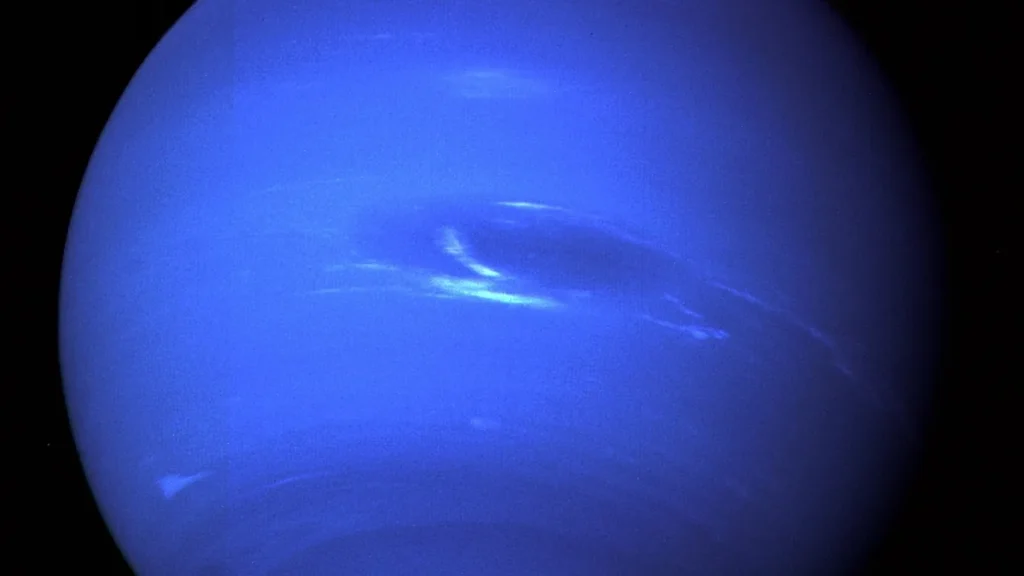
Key facts
- Neptune's deep atmosphere contains substantially more oxygen than Uranus's, according to atmospheric chemistry models and ALMA carbon monoxide observations.
- The research detailing Neptune's higher oxygen and distinct C/O ratios was published in Astronomy & Astrophysics (2026) by T. Briand et al., DOI:10.1051/0004-6361/202660770.
- Vertical circulation in the deep atmospheres of Uranus and Neptune remains a major source of uncertainty in reconstructing their formation histories.
- An international team of scientists revealed a significant contrast in the chemical composition of Uranus and Neptune's atmospheres.
Researchers found that Neptune’s deep atmosphere contains substantially more oxygen than Uranus’s, according to atmospheric chemistry models and ALMA carbon monoxide observations, as reported in a September 2026 Astronomy & Astrophysics study.
The differing oxygen levels yield lower carbon-to-oxygen ratios on Neptune, suggesting the ice giants formed in separate regions of the early solar system.
An international team revealed a significant contrast in the chemical composition of Uranus and Neptune’s atmospheres. They used numerical models of atmospheric chemistry and transport combined with recent ALMA observations of carbon monoxide to infer the deep atmospheric composition. Carbon monoxide acts as a tracer produced deep and transported upward, providing a window below visible clouds.
The team found Neptune’s deep atmosphere contains more oxygen than Uranus’s. Scientists seek to determine the composition of the deep layers of Uranus and Neptune, which are inaccessible to direct observation due to cloud layers. By combining oxygen abundances with carbon measurements, they calculated carbon-to-oxygen ratios, finding Neptune’s ratio lower but with overlapping uncertainty ranges.
The oxygen abundance difference is difficult to explain if Uranus and Neptune formed from materials of the same composition in a similar region of the solar disk. Researchers argue that if the planets had formed from the same material in the same region of the protoplanetary disk, their C/O ratios would be similar; the observed difference points to separate formation zones.
The distinct carbon-to-oxygen ratios suggest Uranus and Neptune may have formed in different regions of the early solar system rather than sharing a common origin. Models of primitive solar system chemical evolution show Uranus likely formed far from the Sun near its current orbit, while Neptune may have originated closer to the Sun in an oxygen-rich region before migrating outward.
Vertical circulation in the deep atmospheres of Uranus and Neptune remains a major source of uncertainty in reconstructing their formation histories. New observations are essential to better constrain the deep composition of Uranus and Neptune and test the proposed formation scenarios.
Voyager 2 is the only spacecraft to have flown by Uranus and Neptune, doing so in 1986 and 1989 respectively. The spacecraft was launched on August 20, 1977.
No return missions to Uranus and Neptune are officially scheduled. Mission planners have studied ideas for returning but have not funded any, focusing instead on concepts such as an orbiter and deep‑entry probes.
Planets comparable in size to Uranus and Neptune constitute more than half of the roughly 6,000 exoplanets discovered to date. Similarly sized planets are common around other stars, making Uranus and Neptune essential benchmarks for understanding how planets form and evolve throughout the galaxy.
Dr. Olivier Mousis of SwRI noted that Uranus and Neptune may look alike but their chemistry points to distinct histories.
According to new research, ice may not dominate the interiors of Uranus and Neptune after all; they could harbor large oceans of magma beneath their atmospheres. This revised internal structure could help explain the strange behavior of the planets’ magnetic fields and the differences in heat emission between Uranus and Neptune.
Using SwRI’s models, researchers showed how different volatile compounds in the protoplanetary disk condensed into solids at different distances, forming distinct reservoirs that later built the planets as the material cooled and came together. The simulations show where water, ammonia, and methane froze into ice as the disk cooled, determining the building blocks that later assembled into Uranus and Neptune.
The Uranus Orbiter and Probe (UOP) mission concept was designated in 2023 as the top priority mission for the coming decade by the U.S. National Academy of Sciences. The paper highlights that a dedicated ice‑giant mission, exemplified by the Uranus Orbiter and Probe concept, was already ranked as the highest priority for the next ten years by the U.S. National Academy of Sciences in 2023.
The research detailing Neptune’s higher oxygen and distinct C/O ratios was published in Astronomy & Astrophysics (2026) by T. Briand et al., DOI:10.1051/0004-6361/202660770. The paper presenting the new oxygen‑based C/O ratio measurements appeared in the September 2026 edition of the journal Astronomy & Astrophysics.
Uranus and Neptune do not have solid surfaces like Earth; they have gas blankets of water, ammonia, methane extending thousands of miles deep; a thin outer layer of lighter elements gives them a greenish‑blue appearance. Unlike terrestrial planets, the ice giants lack a firm surface; instead, deep layers of water‑rich gas extend far down, capped by a thin veneer of light gases that produce their characteristic color.


Join the discussion