Key facts
- The team ran simulations for the late Noachian and early Hesperian eras, approximately 3.8 to 3.6 billion years ago in the model, to map formaldehyde formation.
- The model indicated that mountainous regions such as Tharsis and Elysium received roughly ten times the global average amount of formaldehyde.
- The estimates describe formaldehyde delivery in the distant past rather than the amount currently present on the Martian surface.
- Dr. Koyama said comparing the map with rover results could test whether areas receiving more formaldehyde were more hospitable to early chemistry tied to life.
A research team led by Dr. Shungo Koyama published a study on Sept. 30, 2026, in The Planetary Science Journal modeling how ancient rainfall carried formaldehyde across Mars’s surface billions of years ago to help identify where life-related chemistry could have begun. Science news outlets reported the peer-reviewed results in early October after they appeared near the end of September 2026.
Koyama, an astrobiologist at the Institute of Science Tokyo and Tohoku University, directed simulations covering the late Noachian and early Hesperian eras, approximately 3.8 to 3.6 billion years ago. The team tested how temperature, water vapor, atmospheric pressure and ultraviolet light influenced formaldehyde production in the ancient Martian atmosphere. Ultraviolet radiation broke water apart in the atmosphere, freeing hydrogen atoms that combined to form formaldehyde before rain carried it downward. The researchers chose that interval because Mars is believed to have supported liquid water then.
The simulation predicted that wetter regions received more formaldehyde than drier areas because both production and delivery depended on water. Mountainous regions such as Tharsis and Elysium received roughly 10 times the global average amount of the molecule. Both Tharsis and Elysium feature towering volcanoes. The model indicated that terrain and precipitation concentrated formaldehyde in those areas well beyond the planetary mean.
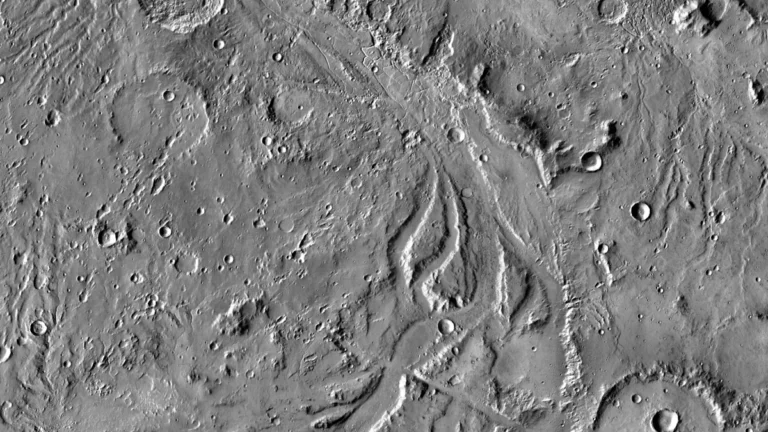
Experts broadly agree that Mars was warmer and wetter between 3.5 and 4.1 billion years ago during the Noachian and Hesperian periods. Early Mars possessed abundant surface water, including rain, rivers, lakes and probably an ocean. Signs of ancient water first appeared in data from early robotic probes, with stronger support from landers and surface rovers such as Viking 1 and 2, Curiosity and Perseverance. Those eras span a time when Mars had a much wetter climate than the cold, dry world seen today.
The compound formaldehyde, also written as H2CO, is considered prebiotic. Dissolved in water, it can drive reactions that build sugars, amino acids and other organic compounds tied to living processes. Asia Research News reported that earlier research showed that formaldehyde could form in the warm atmosphere of early Mars. The study builds on that earlier work.
Dr. Shungo Koyama said on Oct. 1, 2026, that comparing the formaldehyde map with rover results could test whether regions with higher formaldehyde levels were more favorable for chemistry tied to early life. Koyama explained that placing the map next to rover data would let researchers check whether formaldehyde-rich sites were also more favorable for prebiotic chemistry. That comparison helps determine whether the model matches conditions that could have supported life on ancient Mars. EarthSky reported that researchers announced on Oct. 1, 2026, that formaldehyde in the atmosphere might have mixed with rainwater long ago on Mars.
If future observations confirm the link, the map could help choose promising targets for upcoming Mars missions. Scientists plotted predicted formaldehyde hotspots next to the landing sites of earlier Mars missions. The authors say the map is meant to guide future robotic and crewed missions by identifying regions where evidence of past life might still be preserved. Apart from choosing landing sites, the authors say the map provides clues about how organic chemistry evolved on Mars and could sharpen the hunt for biosignatures.

The estimates describe formaldehyde delivery in the distant past instead of the amount currently present on the Martian surface. The study gives no indication of how much formaldehyde remains on Mars today. The writers emphasize that the map reconstructs ancient delivery instead of measuring modern surface abundance. Around Prague reported that the outcome comes from a computer model rather than a direct detection on Mars, and its predictions still need observational verification.
The paper does not address whether life ever existed on Mars.
The project included researchers from the University of Tokyo, the University of Washington and the Royal Belgian Institute for Space Aeronomy working with the team from the Institute of Science Tokyo and Tohoku University. The worldwide team included partners from Japan, the United States and Belgium working with the lead Japanese institutions. Koyama holds positions at both the Institute of Science Tokyo and Tohoku University, and colleagues from those institutions joined the effort.
A 2011 paper in Proceedings of the National Academy of Sciences suggested formaldehyde played a role in starting life on Earth. That finding said formaldehyde may have helped Earth retain carbon relevant to life’s origins.



Join the discussion