Key facts
- Democrats won control of both the House and Senate in the 2026 midterm elections held on Tuesday, according to Payload's post-election assessment published Nov. 4, 2026.
- Funding for Golden Dome faces uncertainty under Democratic control of Congress, Payload reports, because the program is Republican-backed and politically tied to President Donald Trump.
- Payload reports that Democrats are weighing an investigation into Elon Musk covering why SpaceX's Starlink service was slowed in Ukraine and personnel changes he directed at DOGE.
- Payload says control of the chambers remains unsettled because several races have not been called.
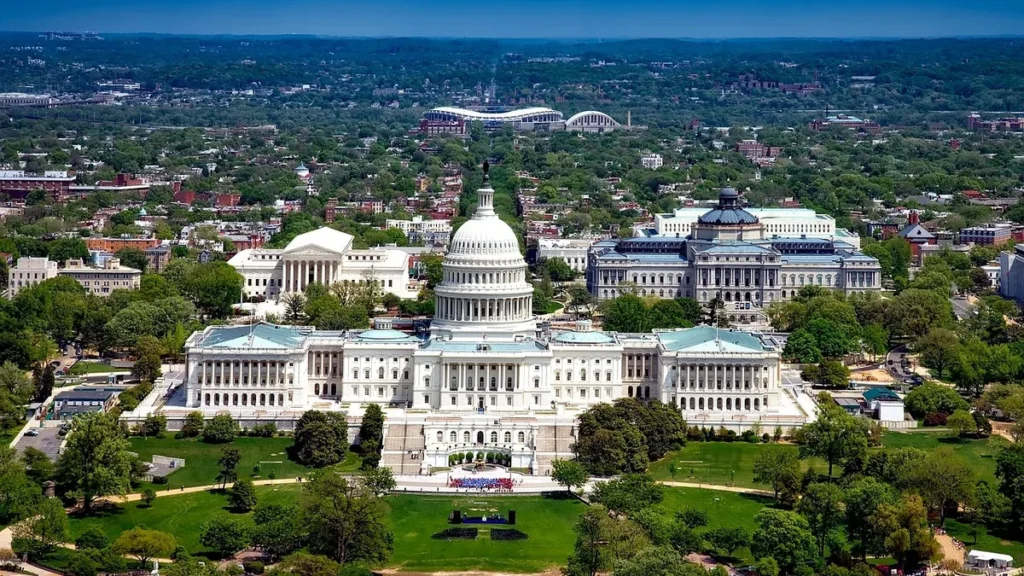
Democratic candidates took control of both chambers in the 2026 midterm elections held on Tuesday, Payload said in its Nov. 4, 2026 post-election assessment. The outlet called the outcome a blue supernova and said Democrats won big at all levels, though several races remain uncalled and the final composition of both chambers remains undecided. Payload said the Democratic margin’s size will determine how much of its agenda the party can put into practice, and noted that not all results were final when the assessment appeared.
Payload said new leaders on the relevant space committees are expected to prioritize STEM outreach and space science initiatives, which the outlet calls a long-standing Democratic priority, now that Democrats control both chambers. The outlet ties those expectations to the new committee leadership that will take shape after the 2026 midterm elections.
Funding for Golden Dome faces uncertainty under Democratic control of the House and Senate, Payload reports, because the program is Republican-backed and politically tied to President Donald Trump. Payload lists that uncertainty among the major consequences of the Democratic midterm victory.
Democrats are weighing an investigation into Elon Musk that would examine why SpaceX’s Starlink service was slowed in Ukraine and the personnel changes he directed at DOGE, Payload reports. The outlet includes the potential investigation in its postelection assessment of priorities Democrats may pursue now that they control both chambers, connecting the probe to Starlink service in Ukraine and DOGE staffing changes.
Payload says Rep. Mike Haridopolos (R-FL) will return in 2027 as the top Republican on the House space subcommittee for Florida’s space coast district, and Rep. Valerie Foushee (D-NC) will return in 2027 as the leading Democrat on that subcommittee. The outlet lists Haridopolos among the prominent space leaders on Capitol Hill coming back in 2027, and identifies Foushee as one of the prominent space leaders returning to the House.
Rep. Brian Babin (R-TX) will return in 2027 as chair of the House Science, Space, and Technology Committee, representing the Houston area that includes JSC, Payload reports. Rep. Zoe Lofgren (D-CA) will return in 2027 as the top Democrat on that committee. The outlet identifies Lofgren as a returning Democratic leader on the House Science, Space, and Technology Committee.
Rep. Dale Strong (R-AL) will return in 2027, representing Huntsville, AL, according to Payload. Rep. George Whitesides (D-CA), a former Virgin Galactic CEO, will return in 2027 serving on the House space subcommittee and the House Armed Services Strategic Forces Subcommittee, Payload reports. Payload lists Strong among the prominent space leaders on Capitol Hill returning in 2027.
Rep. Vicente Gonzalez (D-TX) defeated Republican Eric Flores to capture the district containing SpaceX’s Starbase in southern Texas, according to Payload. His win gives Democrats a seat covering the commercial space facility, and the outlet lists Gonzalez among the new or returning members whose districts touch major commercial space facilities.
Rep. Elaine Luria defeated Rep. Jen Kiggans (R-VA) in the district covering NASA’s Wallops launch facility, according to Payload. This shifts the House seat representing Wallops from Republican to Democrat, and the outlet lists Luria’s victory under “Who’s out” for Kiggans while noting the district’s connection to NASA’s Wallops launch facility.
Democratic Texas House Rep. James Talarico will become Texas’ new senator, taking the open seat left by Sen. John Cornyn (R-TX) after Cornyn lost the primary, according to Payload. The change moves Texas’ Senate representation from Republican to Democrat. Republican Byron Donalds will become Florida’s next governor after unveiling an August plan to expand Florida’s role in the space race, Payload reports.
Rep. Jeff Crank (R-CO) of Colorado Springs, who sits on the House Armed Services Strategic Forces Subcommittee, is locked in a tight race with Democrat Jessica Killin, Payload reports, citing the AP. Payload identifies the contest as too close to call and notes Crank’s committee assignment on the House Armed Services Strategic Forces Subcommittee, with the vote margin and counted percentage coming from the Associated Press.

On Oct. 20, 2026, SpaceX launched the Bandwagon-5 mission from SLC-40 at Cape Canaveral in Florida using a Falcon 9, The Aviationist reports, and the flight carried a Starfall capsule with cargo test hardware for an Air Force Research Laboratory trial. SpaceX describes the flight as using its partially reusable two-stage Falcon 9 rocket, with a booster able to land vertically for reuse. The Aviationist reports that AFRL is investigating commercial rockets for rapid military cargo deliveries, and that this launch served as part of that research effort.
AFRL says the trial used an agile pod mounted on a specially instrumented Starfall capsule from SpaceX to record temperature, shock, and vibration levels across the cargo setting, The Aviationist reports. The laboratory describes Rocket Cargo as an R&D effort to determine whether large commercial liquid-fueled rockets can rapidly transport supplies to any location on Earth under tactical timelines, according to The Aviationist. AFRL says further iterative testing will study the technology needed to transport essential cargo rapidly and at scale across the planet, with the October 2026 Starfall test serving as one step in that process.
AFRL has also partnered with Blue Origin, Rocket Lab, Sierra Space, Anduril, Varda Space Industries, Inversion Space, and Outpost Space to advance rocket cargo delivery and reentry capabilities through the Rocket Cargo Vanguard program, The Aviationist reports. AFRL says Rocket Cargo relies exclusively on commercial rockets provided as a leased service for worldwide logistics, aiming to reduce expense and accelerate delivery compared with current air cargo, within DAF Vanguard programs.
Brig. Gen. Douglas P. Wickert, AFRL’s chief and the DAF technology executive, said the launch demonstrated the lab working with industry to lower risk, collect information, and supply war-winning technology to the force, The Aviationist reports. The outlet presents the remark as an AFRL assessment of industry partnership value in connection with the Bandwagon-5 launch. Adam Remaly, director of AFRL’s Technology Transition Office, described the launch as a vital demonstration of Rocket Cargo’s potential for swift global mobility for the Future Force, according to The Aviationist.
“This was a critical achievement to demonstrate the potential of Rocket Cargo delivery for point-to-point rapid global mobility for the Future Force,”
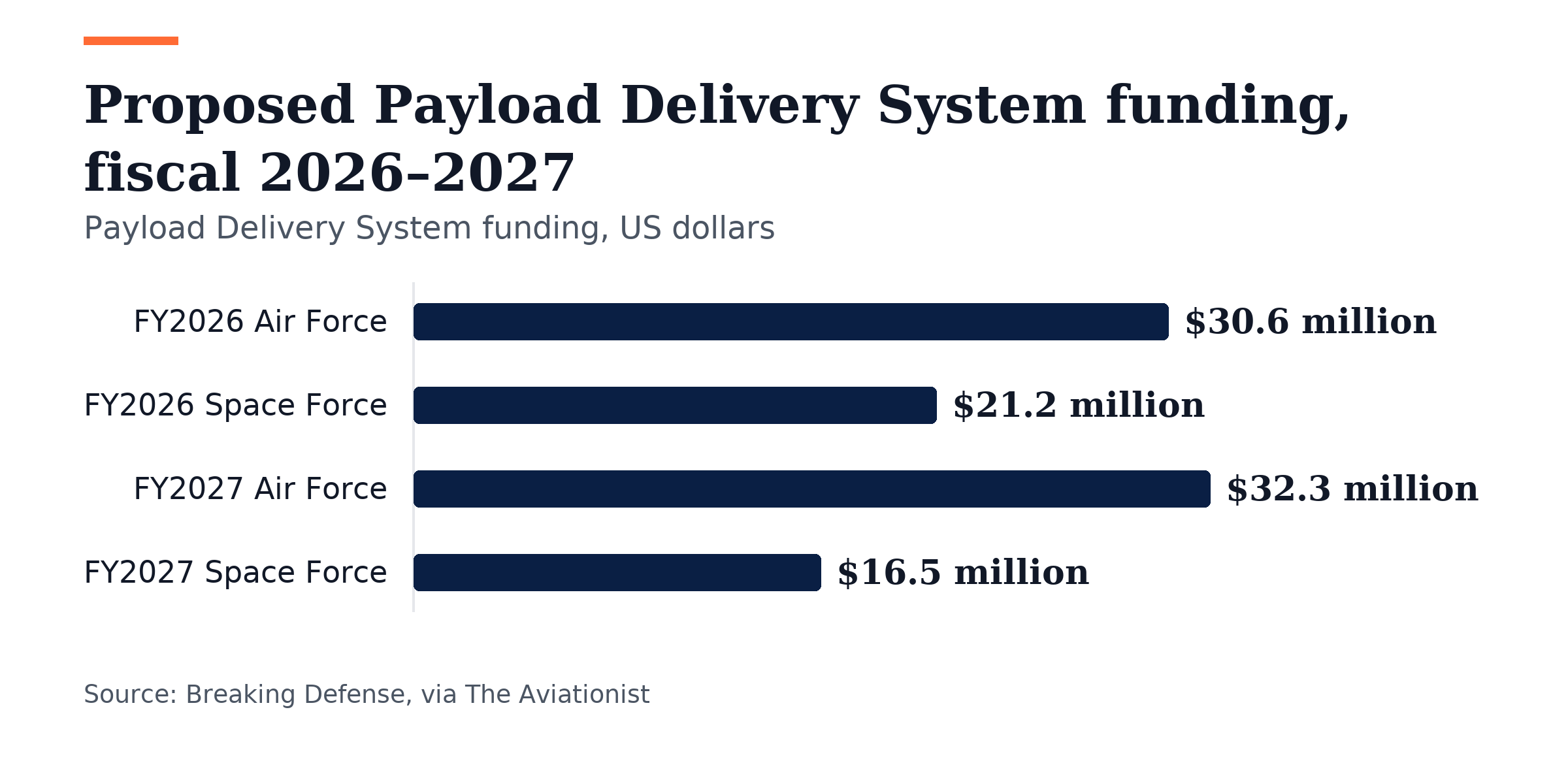
The Aviationist reports that the Air Force requested $48 million for Rocket Cargo in its proposed fiscal 2022 budget. The Aviationist cites Breaking Defense in reporting that the Air Force and Space Force together fund the Payload Delivery System program at $30.6 million and $21.2 million respectively for fiscal 2026. In fiscal 2027, the Air Force requested $32.3 million while the Space Force requested $16.5 million for the Payload Delivery System program, according to Breaking Defense as cited by The Aviationist, in figures the outlet presents alongside fiscal 2026 amounts as part of the changing Rocket Cargo and PDS budget picture.
The Aviationist reports that on March 3, 2025, the Department of the Air Force announced plans for an environmental assessment of a Rocket Cargo test site at Johnston Atoll in the North Pacific, roughly 860 miles from Hawaii toward the southwest. The department put that assessment on hold in July 2025 while AFRL studied other locations, placing the pause within the timeline of Rocket Cargo site selection after the March 2025 notice of intent for Johnston Atoll.
Spaceflight Now reports that SpaceX launched a classified U.S. Space Force payload on the USSF-481 mission using a Falcon 9 from Vandenberg Space Force Base on Oct. 15, 2026. The launch took place at 5:01 p.m. PDT (8:01 p.m. EDT / 0001 UTC), and the mission followed a southerly trajectory, with hazard warnings pointing to a low Earth orbit inclined roughly 80 degrees from the Equator. Spaceflight Now connects USSF-481 to a series of classified Space Force missions.
USSF-481 also goes by TH-2 in public notices and represents the second TH mission in two months, following USSF-259 or TH-1 on Sept. 16, Spaceflight Now reports. The outlet describes the droneship touchdown as part of the USSF-481 mission profile and notes it reached out to the Department of the Air Force regarding the mission’s nature.
According to Spaceflight Now, SpaceX flew booster B1081 on its 28th mission, a record that featured four NASA trips, three national security flights, two Transporter shared rides, two European flights, and 16 Starlink missions. Spaceflight Now states that the booster came down a little more than eight minutes after liftoff, and presents the landing figures as cumulative records for the droneship and Falcon booster fleet. B1081 set down on the droneship Of Course I Still Love You in the Pacific Ocean eight minutes after liftoff, marking the 228th landing for that vessel and the 671st Falcon booster landing overall, Spaceflight Now reports.



Join the discussion