Key facts
- Nuclear reactors are planned to power future moon bases during the two-week lunar night.
- A paper was presented at the American Nuclear Society's Nuclear and Emerging Technologies for Space conference in April 2026.
- NASA's Space Power and Reactor Capabilities program advances space nuclear power. It includes a reactor plan for the Moon targeting 40 kilowatts.
- Shielding is one of the heaviest reactor components. Shielding is vital for health and safety.
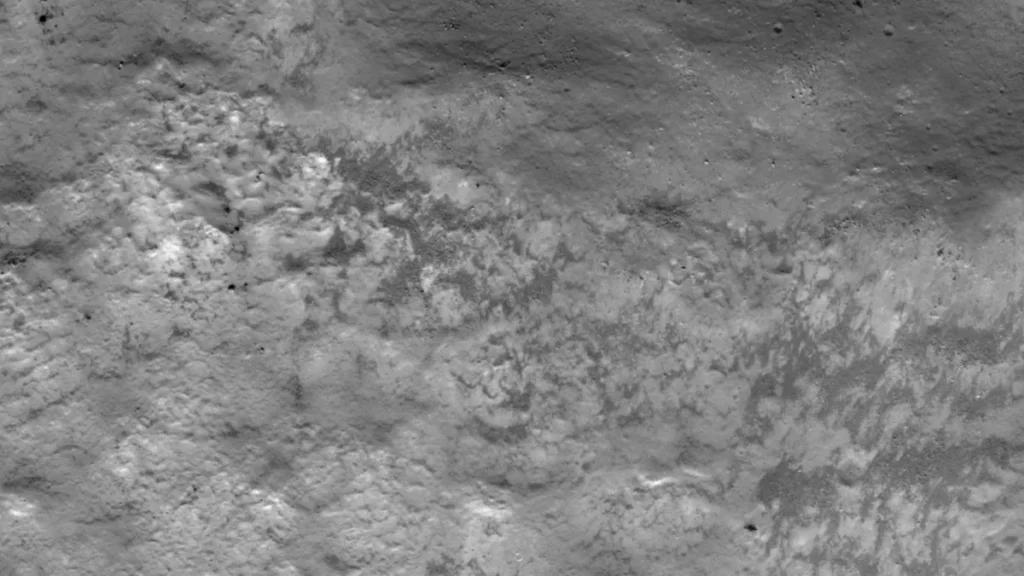
A research team from Los Alamos, NASA Glenn, Oak Ridge, Idaho National Lab and Lockheed Martin proposed in April 2026 using lunar craters and hills as natural radiation shields for nuclear reactors at future moon bases.
Alex Levinsky of Los Alamos led the team. The group presented a paper at the American Nuclear Society’s Nuclear and Emerging Technologies for Space conference in April 2026. The paper Impact of Terrain on Doses for Fission Surface Power lists A. Levinsky et al. as authors.
For decades, engineers have planned nuclear reactors for lunar settlements because solar-charged batteries may not survive freezing temperatures during the two-week lunar night. Solar panels function in the two-week lunar daylight but stop working at night, so reactors would provide continuous power through the long darkness.
NASA’s Space Power and Reactor Capabilities program advances space nuclear power and includes a reactor plan for the Moon targeting 40 kilowatts. The system has a 6,000-kilogram mass cap and fits aboard a wheeled rover.
Among the heaviest reactor components is shielding, which is vital for health and safety. Designers choose directional shields, while full enclosure uses lead or concrete.
In the past, designers relied on directional shadow shields built from lightweight hydrogen-rich materials like lithium hydride and paired them with dense metal to protect control electronics. Shadow shields protect components but do not cover the full area. Radiation would kill at a distance of one kilometer from an unprotected reactor site, and sending more shielding from Earth costs far too much.
The team simulated the reactor core using Monte Carlo N-Particle software, a radiation-transport code that modeled millions of subatomic particles. They modeled the reactor at 1.5 meters above the ground, as on a wheeled rover.
Simulations showed a three-meter-deep crater or a three-meter-high dirt hill blocked nearly all reactor radiation, lowering the dose to roughly one-tenth of a rem—a radiation-dose unit—annually. That dose falls below the five-rem yearly limit.
The researchers picked Connecting Ridge to model an actual reactor environment. This mountain ridge sits near Shackleton Crater at the lunar south pole, a site suited to crewed missions. Some ridges there are in sunlight 80 to 90 percent of the time and lie beside Permanently Shadowed Regions holding water ice nearby.
Slopes for rovers are limited to 18 degrees. The team found a depression with a 120-meter-high crater wall between it and a simulated base camp.
A 120-meter crater wall barrier cut radiation to near zero, with the dose reaching about four-hundredths of a rem per year. That arrangement lets the shield protect electronics. Because the Moon has no atmosphere, engineers do not deal with skyshine, radiation that bounces off air particles back to the habitat.
Regolith (lunar soil/dust) placed between a reactor and a habitat keeps the habitat shielded, but the crater interior turns into a death zone where astronauts entering during reactor operation would get radiation poisoning immediately. Regolith reflects neutrons well, sending many neutrons directly into space, so no spacecraft or landers can fly directly over the reactor site.
Using lunar material for shields could cut thousands of kilograms from launch mass, though it may create a no-fly exclusion zone over part of the Moon.
In March 2026, NASA announced a $20 billion program for a permanent lunar base aiming for nuclear and solar energy at the moon’s south pole by 2032. The program funds nuclear energy. NASA flew Artemis II around the moon in April 2026. The agency expects 25 launches and about four metric tonnes of cargo bound for the moon by 2029.
The United States wants astronauts on the moon before 2029, a goal marking 60 years since the first lunar landing. NASA hopes to use Blue Origin‘s Endurance lunar lander and Astrobotic’s Gryphon-1 lander for precise touchdowns on the moon. NASA wants semi-permanent moon housing by 2032, and ice at the south pole can make drinking water and oxygen.
A race to return humans to the moon pits the United States against China, which set a 2030 deadline for a human lunar landing. Simeon Barber of the United Kingdom’s Open University, a lunar scientist, said China might reach the moon first. “It would not surprise me at all if China gets there first.”
In May 2026, NASA announced plans for robotic landers, hopping drones, and vehicles to support U.S. lunar base development, working alongside Intuitive Machines, Astrobotic, Blue Origin, and SpaceX. Before sending humans, NASA aims to send robotic landers and hopping drones to assess lunar terrain and transport delivery vehicles carrying astronauts, communications gear, and scientific instruments.
Critics have suggested NASA’s timeline is likely unrealistic. Barber cited delays in acquiring a human landing spacecraft and said political drive shapes NASA’s plan announcements.
Chinese astronauts have flown to China’s space station nearly a dozen times. In May 2026, China launched Shenzhou-23 carrying three people to Tiangong, including one astronaut set to remain for a year, a national record. China recovered lunar samples from the moon’s far side using robots in June 2024, becoming the first country to do so. If it lands humans by 2030, China aims to build a permanent base with Russia by 2035.
Moon bases would support scientific research, test space technologies, mine resources including water ice, and serve as launch hubs for missions to Mars and beyond. Using current spacecraft, travel to the Moon takes about three days, and communication with Earth has a delay of about one to two seconds through lunar satellites. Water ice in polar craters can be converted into drinking water, oxygen and rocket fuel, and lunar regolith can build habitats.


Join the discussion