
Key facts
- A study in the International Journal of Astrobiology found that news media's reporting on the 2020 Venus phosphine claim often implied more certainty than the original scientific papers.
- Mass-market news outlets tended to use more sensational framing compared to specialist science outlets, which utilized more epistemic caution, according to the International Journal of Astrobiology study.
- The International Astronomical Union Commission F3 on Astrobiology issued a statement in 2020 criticizing the Greaves team for their media coverage, which was later retracted after internal condemnation.
- A 2024 review by William Bains found no demonstrated abiotic mechanism that could sustain the claimed phosphine levels on Venus.
A study published in the International Journal of Astrobiology examined English-language news coverage of the contested 2020 Venus phosphine claim from September 2020 to June 2025. The research found that coverage often implied more certainty than the original scientific papers.
Mass-market outlets tended to use more sensational framing, while specialist science outlets applied more epistemic caution (careful wording about what is known and uncertain). Clickbaiting strategies were rare across the news sample. Coverage followed the scientific debate as it developed across outlet types and over time, and the most prominent frame was consensus uncertainty, mirroring expert disagreement and potentially challenging public trust.
Jane Greaves and her team reported a phosphine absorption line in Venus’s atmosphere in September 2020, initially estimating an abundance of roughly 20 parts per billion. The detection drew on 2017 observations from JCMT and 2019 observations from ALMA, which the team attributed to the PH3 molecule, with a signal-to-noise ratio of approximately 15 sigma. On September 14, 2020, the Royal Astronomical Society issued an official statement and held a webinar announcing the discovery, and the reported level was 1000 times more than on Earth, prompting immediate media speculation about potential indicators of life.
The discovery paper described a 4.4-sigma absorption feature at 266.94 gigahertz tied to the J=1-0 rotational transition of phosphine. The Greaves team said the abundance could possibly result from biological processes and added that a statistically significant detection required backup observations to validate the spectral features and atmospheric conditions. The authors also noted that even if confirmed, the detection would not be robust evidence for life, only for anomalous and unexplained chemistry.
Geronimo Villanueva and Snellen et al. challenged the original detection, arguing the signal was either absent or a product of improper baseline calibration during data reduction. Villanueva’s analysis of ALMA data found no significant phosphine, while Snellen et al. suggested the calibration step over-subtracted structure to create a false feature.
Other researchers who reanalysed the data later recovered phosphine with ALMA at roughly 5-sigma confidence. As of April 2021, the original phosphine paper remained the only set of results to undergo peer review, and the discovery had taken almost three years from the first JCMT detection to publication. The claimed abundance has not been confirmed by independent observations at the originally reported level.
A 2024 review by William Bains found no demonstrated abiotic mechanism that could sustain the claimed phosphine levels on Venus. Bains considered lightning, volcanoes, and photochemistry, and suggested that if phosphine exceeds 0.001 parts per billion, it would require a new abiotic source or a biotic source. Bains and colleagues had concluded in 2021 that no chemical pathway involving lightning, volcanic outgassing, photolysis, or surface reactions can produce phosphine above approximately 0.001 parts per billion.
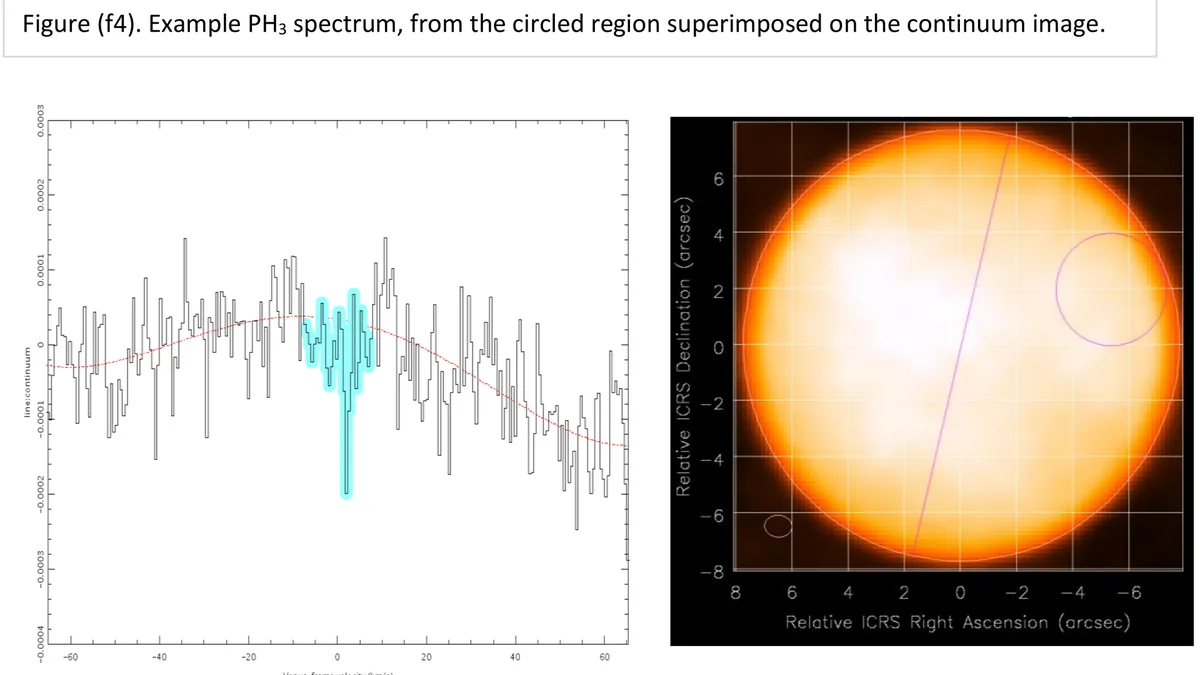
Follow-up observations have not replicated the original result at the reported abundance. SOFIA observations in 2021 using the EXES instrument reported no detection at a sensitivity of 0.8 parts per billion at cloud-deck altitudes. Venus presents a harsh environment, with a surface temperature of about 470 degrees Celsius and pressure 92 times higher than Earth’s surface. Its atmosphere consists of 96.5 percent carbon dioxide and 3.5 percent nitrogen, with clouds or droplets of sulfuric acid.
At 45 to 60 kilometers altitude, however, temperatures are about 30 degrees Celsius and pressure is one atmosphere, a region some researchers have considered potentially suitable for life as we know it. The Russian Venera program from 1961 to 1984 saw ten probes successfully land and thirteen enter the atmosphere, surviving only 23 minutes to two hours. On Earth, phosphine abundance is one part per trillion, and in an oxidizing environment it reacts with oxygen to form phosphorous acid or phosphoric acid. Phosphine has also been found on Jupiter and Saturn, where hydrogen-rich atmospheres and high temperature and pressure generate it, mixed by convection.
JCMT is a submillimetre-wavelength radio telescope near the summit of Mauna Kea at 4,092 meters, with a 15-meter primary mirror. It is the largest single-dish telescope operating at submillimetre wavelengths. ALMA is an interferometer of 66 radio telescopes in the Atacama Desert at 5,000 meters altitude, offering higher sensitivity and resolution than JCMT, the Submillimetre Array, or IRAM Plateau de Bure.
Shortly after the announcement, the International Astronomical Union Commission F3 on Astrobiology criticized the Greaves team for its press coverage, arguing that scientists have an ethical duty to communicate with rigor and avoid overstating interpretations to the press. The IAU executive retracted the commission’s statement after internal condemnation, including from the commission’s own members. Villanueva’s team later apologized: “We agree that the sentence calling for retraction was inappropriate and we apologise for harm caused to the Greaves et al. team.”
NASA’s DAVINCI mission aims to resolve the phosphine debate through direct atmospheric measurements. NASA’s DAVINCI descent probe will launch in 2029 and descend in 2030. The Venus Mass Spectrometer it carries will study atmospheric chemistry and phosphorus compounds in the cloud layer, with sensitivity expressed in parts per billion.




Join the discussion