Key facts
- Scientists hypothesize the Marius Hill Pit formed when the roof of an ancient lava tube collapsed, rather than from an impact, due to its location within a sinuous rille—a winding valley carved by ancient lava flows.
- Gareth Morgan of the Planetary Science Institute (PSI) explains that lunar pits like Marius Hill resemble volcanic collapse pits on Earth, such as those in Iceland or Hawaii, which often open into lava tubes.
- GIMLI is led by Than Putzig, PSI Associate Director and Senior Scientist, and its instruments will ride to the Moon on a lander and rover provided through the CLPS program.
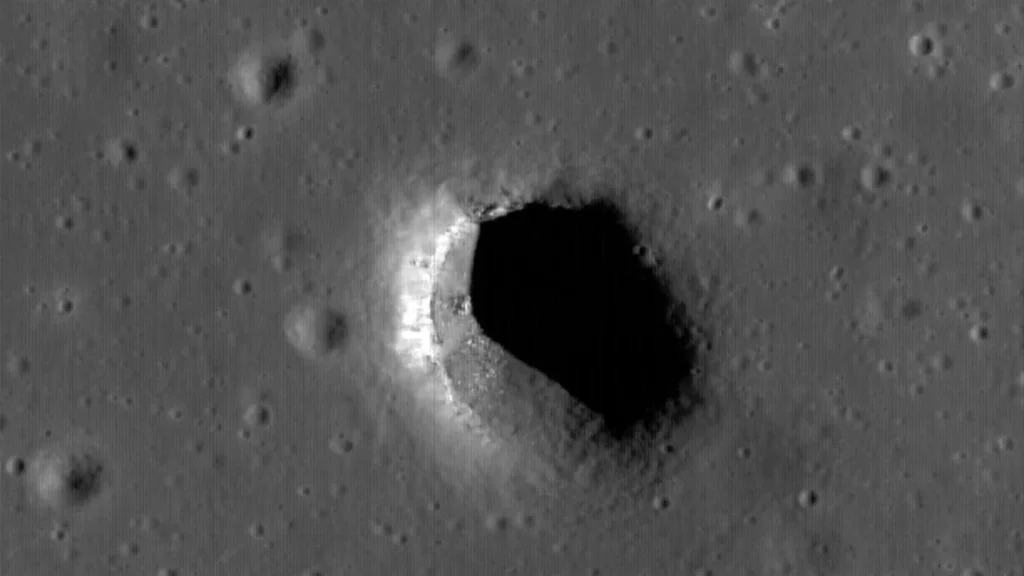
- The Marius Hill Pit is a large opening in a volcanic region that GIMLI will concentrate on for study.
NASA chose GIMLI in October 2026 to study whether Marius Hill Pit opens into an underground lava tube or cave.
A skylight is an opening in the Moon’s surface that can lead into an underground lava tube, a tunnel carved by ancient lava. Researchers suspect Marius Hill Pit formed when the roof of such a tube collapsed, not from an impact, because it lies inside a sinuous rille, a winding valley shaped by lava flows. If confirmed, the pit could serve as an entrance to an underground network offering shelter from radiation, micrometeoroids, and extreme temperature swings.
The Marius Hill Pit is up to 150 feet deep and spans 300 feet wide, about the width of a football pitch. GIMLI will concentrate on this large opening in a volcanic region.
GIMLI will carry ground-penetrating radar, seismic sensors, a gravimeter, and cameras to study beneath Marius Hill Pit. These tools will map underground structures and estimate how large any hidden void might be. Scientists hope the data will show if a lava tube exists beneath the pit.
If a lava tube exists beneath Marius Hill Pit, it could protect astronauts from radiation, micrometeoroids, and temperatures from 250°C in sunlight to -250°C in shadow. The Moon has no atmosphere, but underground lava tubes could stay thermally stable.
Studying Marius Hill Pit could show how lava tubes formed on the Moon and add to knowledge of its volcanic history. GIMLI will examine layers of lunar soil and lava rock in the pit walls to learn how lava moved across and below the surface.
PSI leads the GIMLI mission, with Than Putzig as associate director and senior scientist. Honeybee Robotics, a Blue Origin company, will build the seismic system, gravimeter, and cameras and share instrument operations leadership with PSI. Honeybee will integrate the instruments onto a CLPS lander and rover. The Norwegian Space Agency provides the ground-penetrating radar.
NASA funds GIMLI through PRISM, a program that flies instruments to the Moon on commercial landers and rovers. NASA picked PRISM as the funding path on Oct. 5, 2026, tying the pit work to its Commercial Lunar Payload Services delivery strategy.
On Oct. 5, 2026, Amanda Hendrix, PSI director and CEO, said GIMLI represents the kind of ambitious planetary science the institute pursues. She expressed excitement about working with NASA and Honeybee Robotics on lunar volcanic history.
Than Putzig said on Oct. 5, 2026 that active-source seismic surveys, a method that sends signals into the ground, have not happened since Apollo astronauts conducted the first lunar seismic studies. GIMLI combines seismic, radar, and gravity tools for a rare direct look below the lunar surface.
Gareth Morgan of PSI says lunar pits such as Marius Hill look like volcanic collapse pits on Earth, including ones in Iceland or Hawaii that often open into lava tubes. This could let scientists use Earth-based volcanic knowledge to study lunar history.
Scientists used to believe the Moon’s sinuous rilles came from water flowing across the surface, but now know they can form from lava moving through underground tubes. On Oct. 22, 2026, researchers explained that the pit’s location inside a rille offers a key clue to how it formed.
Gareth Morgan, a PSI senior scientist and deputy principal investigator, said a confirmed lava tube would reveal how Moon volcanism worked, using knowledge of basaltic caves on Earth.
Researchers counted about 300 lunar pits in a 2026 study published in the International Journal of Mining Science and Technology. Some are skylights, or openings into underground lava tubes created by meteor impacts or volcanic collapse. These pits provide access to hidden geological layers and could preserve evidence of the Moon’s volcanic processes.
On Oct. 25, 2026, scientists said lunar lava tubes could stretch for hundreds of miles and measure about as wide as Central Park, thanks to the Moon’s weak gravity.
NASA wants a permanent lunar base by 2032 and has set aside £15 billion for habitats shaped like Tic Tacs and powered by nuclear and solar energy. The agency might use lunar caves such as Marius Hill as ready-made shelters. Experts cited by Metro said on Oct. 25, 2026 that a lunar outpost might serve as practice for Mars missions.
Gareth Morgan said astronauts on long lunar stays will face high radiation, fast-moving micrometeorites, and extreme temperature swings. On Oct. 25, 2026, Morgan described these dangers as a reason to seek naturally shielded lava tube homes.
The Moon could have formed from rocks thrown into orbit when a Mars-sized planet named Theia hit young Earth, or from a magma ocean over Earth’s surface 4.46 billion years ago. Because the Moon has no atmosphere, its surface keeps a record of impacts and volcanism that Earth has erased.
On Oct. 25, 2026, the team said it would drive near but safely away from the pit edge and use a camera mast to photograph the pit wall, using the layers to study local geologic history.
If GIMLI finds no lava tube, the mission will still return useful data about how Marius Hill Pit formed and add to knowledge of lunar volcanic evolution. The instruments will analyze subsurface material and structural properties, offering new clues about the pit’s origin and the broader geological processes that shaped the Marius Hills region.



Join the discussion