Key facts
- Curiosity photographed drifting twilight clouds on Oct. 31, 2026, during mission sol 5,061, using navigation cameras above Gale Crater.
- The rover's navigation cameras image post-sunset clouds called twilight clouds over Gale Crater during short appearances each Martian fall.
- Curiosity has explored Gale Crater for more than 14 years.
- JPL directs the mission for NASA's Science Mission Directorate in Washington under the Mars Exploration Program portfolio.
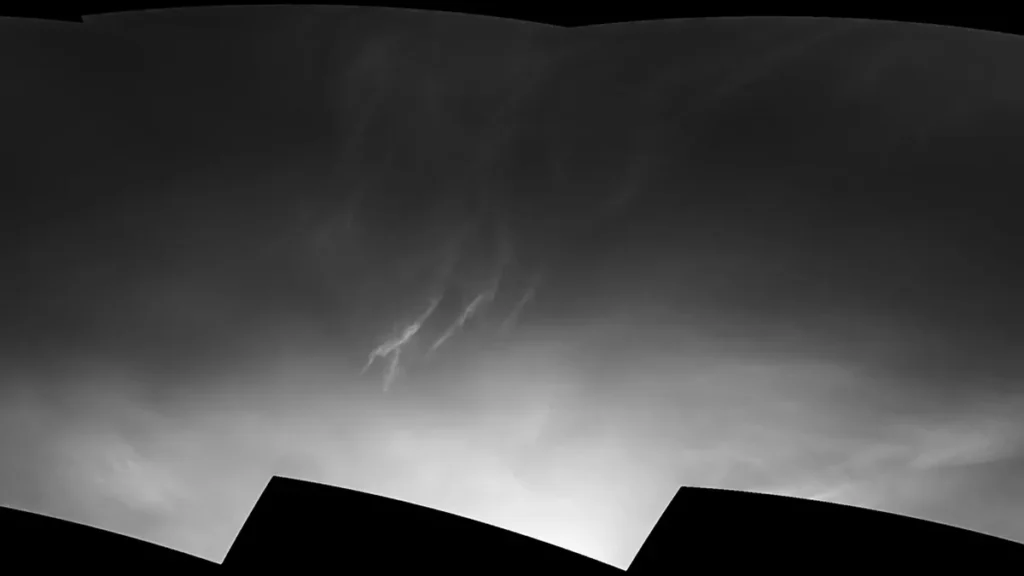
NASA’s Curiosity rover photographed drifting twilight clouds over Gale Crater on Oct. 31, 2026, during mission sol 5,061 (a Martian day), using its navigation cameras.
These post-sunset clouds appear for short periods each Martian fall over Gale Crater, and Curiosity has explored the crater for more than 14 years. NASA’s release explains that navigation cameras are used for these post-sunset observations and that the cloud season recurs annually over the rover’s location. The rover landed in 2012 on Mount Sharp just south of the Martian equator, and it captured its first iridescent cloud images in 2019. NASA’s reporting placed Curiosity in its fourth Mars year of observations during early fall in the southern hemisphere, building on Pathfinder’s first Martian twilight cloud sighting in 1997.
Twilight clouds are noctilucent, meaning night shining, and they appear tinged by scattered light from the setting Sun. They may contain frozen carbon dioxide, also called dry ice, which distinguishes them from terrestrial water clouds. NASA describes them as visually like Earth clouds despite this different composition.
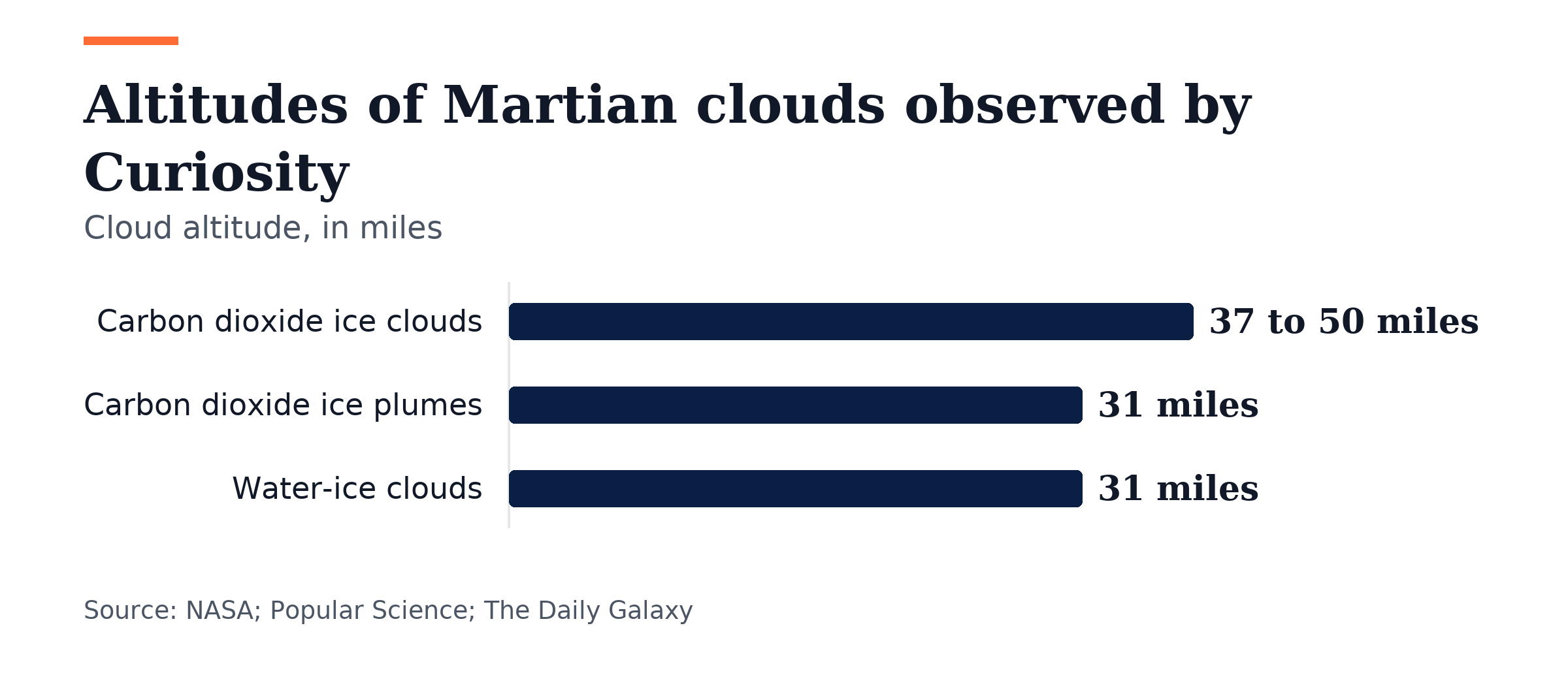
Iridescent or mother-of-pearl clouds sometimes show rainbow colors and remain too faint for daylight viewing. Carbon dioxide ice clouds are the only Martian clouds observed producing iridescence, occurring around 37 to 50 miles or 60 to 80 kilometers high at upper atmospheric heights. Mastcam captured red-and-green-tinted twilight clouds during a 16-minute sequence on Jan. 17, 2025, at sol 4,426, providing a previous detailed look using the rover’s main imaging system.
Every cloud sighting offers a chance to study particle size and growth rate, revealing more about Mars’ atmosphere. Mark Lemmon of the Space Science Institute in Boulder, Colorado, led research on Curiosity’s first two twilight cloud observation seasons that appeared in late 2024 in Geophysical Research Letters.
Mark Lemmon said his first impression of the iridescent clouds was that they were a color artifact.
Some regions of Mars are more likely to form twilight clouds, Lemmon and other researchers suspect, hypothesizing that regional atmospheric conditions favor cloud formation though the exact mechanism remains uncertain. Scientists have not documented carbon dioxide ice twilight clouds outside certain locations, including at Perseverance’s Jezero Crater site since 2021.
Scientists suggest gravity waves could cool the atmosphere enough for carbon dioxide ice to condense, though Martian gravity waves remain poorly understood. Carbon dioxide ice plumes fall as low as 31 miles or 50 kilometers before evaporating in rising temperatures. Water-ice clouds drift roughly 31 miles or 50 kilometers above the rover in the opposite direction. Carbon dioxide ice clouds sit around 37 to 50 miles or 60 to 80 kilometers high, where evening light scatters off ice particles to produce colors, and NASA places these clouds near the top of the images at that altitude range.
Curiosity reached 5,000 Martian days on Aug. 30, 2026, photographing morning and afternoon scenes from Chocolatal ridge, with a second panorama on Sep. 2, 2026 during sol 5,003. The combined postcard shows Mount Sharp rising 3 miles or 5 kilometers inside Gale Crater, with the rover on lower foothills looking downhill toward the crater floor and the distant crater rim barely visible. The image blends two panoramas taken weeks apart with artistic color added afterward. Visible rover parts include the UHF antenna sending data to orbiting spacecraft and the MMRTG nuclear power source at the rear.
JPL constructed Curiosity and Caltech manages it from Pasadena, California, identifying the implementing center and its management structure for the rover mission. JPL directs the mission for NASA’s Science Mission Directorate in Washington under the Mars Exploration Program portfolio, operating under Caltech management as part of that program. Curiosity finished studying Gediz Vallis channel and travels toward a boxwork site of groundwater fractures resembling spiderwebs from orbit.
The rover examined Rustic Canyon, a 67-foot or 20-meter crater that is shallow and heavily eroded and likely formed many millions of years ago. Crater studies can reach protected subsurface materials, and studying craters can expose buried materials with better preserved organic molecules than surface rocks, offering insight into ancient Mars and possible past microbial life. The left Mastcam’s 34-millimeter camera has a stuck filter wheel that frames images in a partially open circle, while both cameras remain usable for color imaging.



Join the discussion