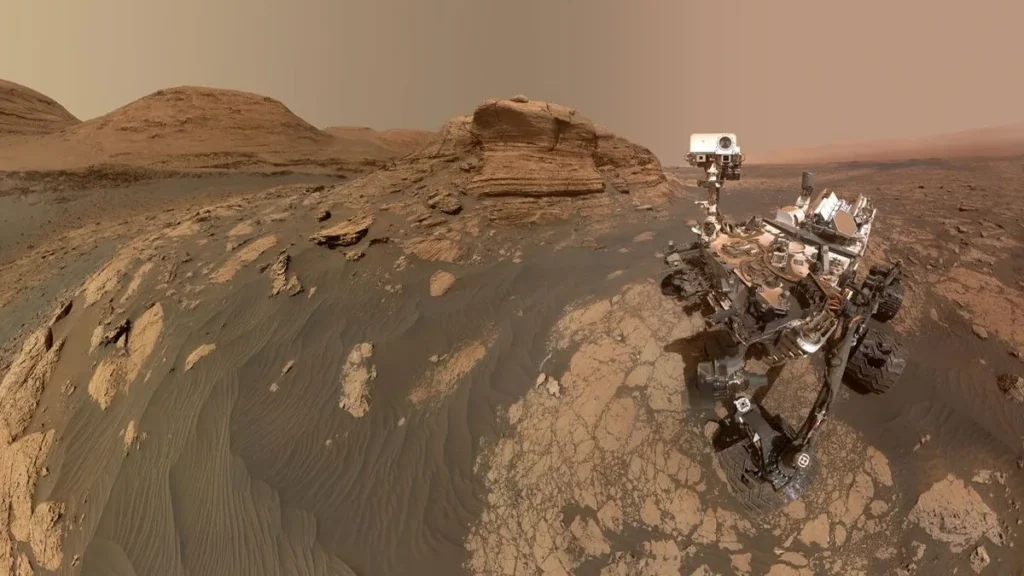
Key facts
- The mission team purposefully limited activities during sols 5060 through 5062 to produce power-positive sols, since drilling and related sample handling consume large amounts of rover power.
- On sol 5061, Curiosity ran the CheMin "Get Data" activity simultaneously with transmitting data to one of its orbiters as part of the parallelism test.
- Scientists plan to reach the base of the wind-carved yardang cliffs sometime in 2027, where Curiosity will use its robotic arm to collect unique measurements on how the mysterious formations formed.
NASA’s Curiosity rover paused normal science on Mars for a planned three-sol power-recovery window covering sols 5060, 5061 and 5062, Martian days, before returning to drilling activities, according to operations systems engineer Remington Free of NASA-JPL, writing Friday, Oct. 30, 2026.
The JPL update said the rover is midway through a drilling campaign at a target named Nazca. It has already drilled the hole, studied the tailings with ChemCam, and placed samples into the SAM and CheMin instruments inside the rover. Still to come: another SAM dropoff for a different analysis, the RAGE cleanup step—Rotate to Agitate for Granule Expulsion—to shake leftover sample from the drill, and extensive imaging of the hole and tailings.
The team limited activity during sols 5060 through 5062, so the rover could finish each sol power-positive, since drilling and sample handling consume large amounts of power, the JPL update said. Each recharge sol included a standard morning science block. Sol 5061 added a brand-new engineering activity testing parallelism during a downlink communications window.
Parallelism runs two activities at once, so the rover stays awake for less time, saving power, though the team must vet pairs in advance to confirm they are safe, JPL’s update explained. On sol 5061, Curiosity ran the CheMin Get Data activity, a high-CPU task that moves science data from the instrument to the flight computers, while transmitting data to an orbiter. The team said the test appeared to go well, but officials must analyze the results before reaching a final conclusion.
ScienceDaily and Phys.org reported that the rover is in the second year of its fifth extended mission, which began with a study of spiderweb-like boxwork ridges, and that over the coming year the rover will drive through sulfate- and carbonate-enriched layers that record ancient drying on Mars. Mission scientists aim to get to the foot of the wind-carved yardang cliffs in 2027 and use the robotic arm to take unique measurements of how the mysterious formations formed.
ScienceDaily and Phys.org reported that the yardangs span roughly 10 miles (16 kilometers) across northwestern Mount Sharp, the 3-mile-tall (5-kilometer-tall) mountain Curiosity has climbed since 2014, and that the rover added 0.6 miles (1 kilometer) of elevation there, more than any other rover on Mars has climbed. The sedimentary layers preserve evidence from different periods of Martian history, including billions of years ago when lakes and streams existed before the water vanished and left salty mineral deposits.
ScienceDaily and Phys.org reported that a yardang layer stands out: its color differs from terrain, its rock layers tilt at an unexpected angle, and it looks plastered on. It raises questions over whether ancient volcanic ash rather than wind erosion created it. Ashwin Vasavada, Curiosity’s project scientist, said the layer has the wrong color, sits at a strange angle, and looks almost plastered on. “No one is sure exactly what created this layer, but one idea is it may be ash deposited by ancient volcanic eruptions.”
Vasavada said.
ScienceDaily and Phys.org reported that Curiosity took a panorama of far-off yardangs on August 11, the 4,982nd sol, with its Mastcam camera. The image combines six photographs sent home to Earth and was processed without white balancing. At 8:30 a.m. local Mars time, it shows blue tones in morning light.




Join the discussion