Key facts
- The James Webb Space Telescope observed WISE 0855 for 11 hours, collecting a spectrum every 15 minutes.
- Its atmospheric temperature is about 265 kelvins (17 degrees Fahrenheit).
- High-altitude water cloud patches change thickness as WISE 0855 rotates.
The James Webb Space Telescope observed WISE 0855, a brown dwarf lying 7.5 light-years from Earth. The data confirmed that water clouds outside our solar system grow thicker and thinner over time.
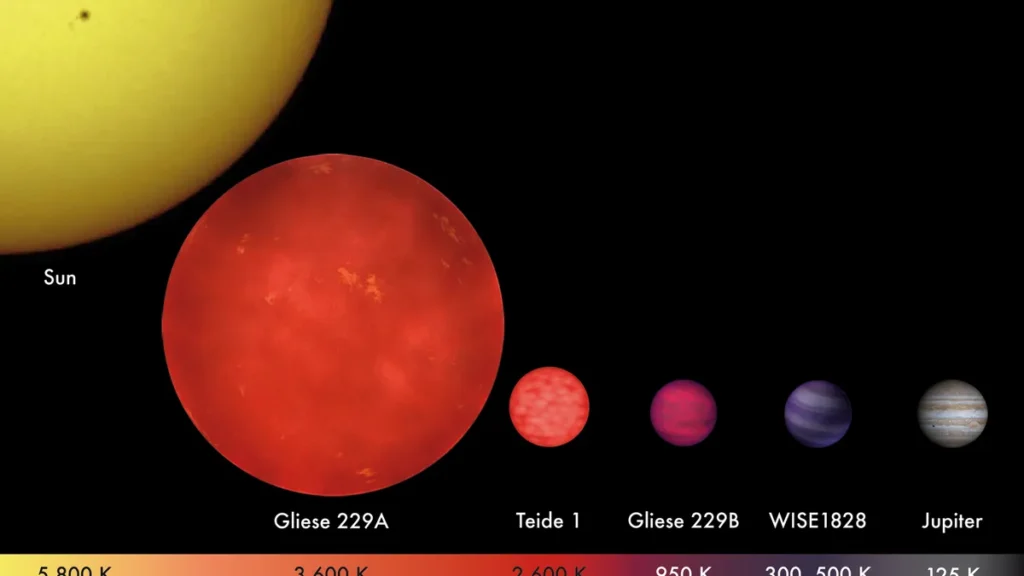
WISE 0855 is the coldest known brown dwarf, its atmosphere measuring roughly 265 kelvins (17 degrees Fahrenheit), while its mass is about double that of Jupiter and its diameter comparable to the giant planet. A brown dwarf is a celestial object that is more massive than a planet but lacks the mass needed to sustain nuclear fusion like a star, and unlike planets, it does not orbit a star but floats freely in space. Yet its atmospheric behavior closely resembles that of giant planets like Jupiter, researchers found.
Brittany Miles, a postdoctoral researcher at the University of Arizona’s Steward Observatory, led the observations. The telescope watched WISE 0855 for 11 hours. It collected a spectrum every 15 minutes. In astronomy, a spectrum breaks light into its component colors, revealing what molecules and atoms are present by the light they absorb or emit. Mark Marley, director of the Lunar and Planetary Laboratory at the University of Arizona, is a co‑author of the study.
High-altitude water cloud patches change thickness as WISE 0855 rotates, the data show. The signals from carbon monoxide and phosphine change in a distinct pattern, pointing to upward movement of material from hotter, lower layers through convective mixing. Because the data separate cloud and gas signals, shifts in water clouds happen above the variations seen in carbon monoxide and phosphine.
Researchers have accepted the paper for publication in The Astrophysical Journal and posted a preprint version on arXiv, a site where scholars circulate work ahead of peer review. The findings have likewise gained approval for inclusion in The Astronomical Journal. The Royal Society – Research Ireland University Research Fellowship, the European Research Council, and the Heising-Simons Foundation supported the research.
Extended observing time with Webb might allow scientists to determine WISE 0855’s spin rate and rotation and uncover its three‑dimensional airflow patterns. WISE 0855 shows atmospheric patterns like those of Jupiter and other giant planets, despite being a free‑floating brown dwarf that does not orbit a star.




Join the discussion