
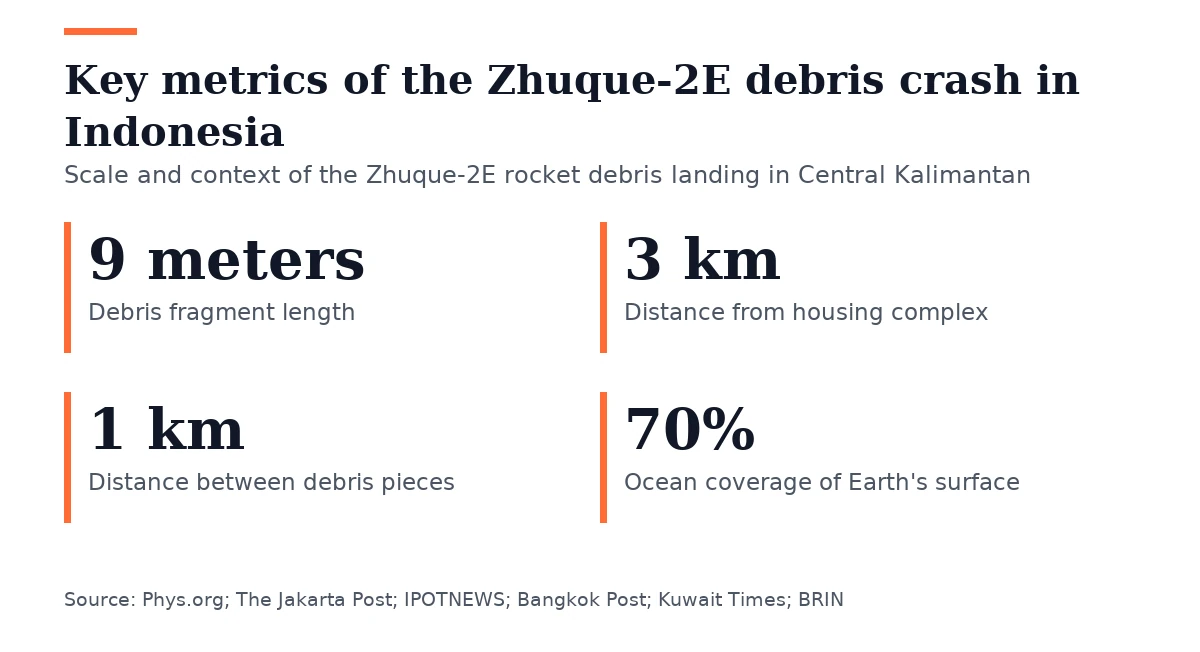
On Oct. 19, 2026, a large debris fragment landed in a palm oil plantation in Central Kalimantan, Indonesia, and investigators suspect it originated from a Chinese Zhuque-2E rocket, about 3 kilometers from the PT Agro Bukit housing complex. I Kadek Dwi Yoga Sidhimantra, the local police chief, said the fragment was a 9-meter aluminum plate with an irregular shape and burn marks, showing it withstood the heat of re-entry. People in Central Kalimantan said they heard a loud bang on the evening of Oct. 18, the night before the fragment was found. Zachrudien, an Indonesian civil aviation spokesman, said on Oct. 20 that the debris carried no radiation or toxicity risks for the nearby area.
BRIN, Indonesia’s National Research and Innovation Agency, concluded the fragment probably came from a Zhuque-2E rocket that had placed 10 satellites into orbit from a commercial launch facility in China’s northwest on Oct. 13, 2026. On Oct. 20, a second piece was found about 1 kilometer away from the first fragment. Zachrudien described it as round and said it appeared to be made of aluminum alloy, though further analysis was needed. As of Oct. 20, both fragments were being analyzed at a military airbase in Central Kalimantan, part of the effort to verify their origin and makeup.
The China National Space Administration did not provide comment by Oct. 20.
Tamroni, a 51-year-old worker at the PT Agro Bukit plantation, came across the main debris near Sampit on Oct. 19. He initially mistook it for aircraft wreckage given its size and shape. “Fortunately, all the workers had already gone home, so no one was left in the plantation,” Tamroni said, noting the plantation had been cleared of workers before the debris fell, so no one was hurt. Tamroni described the incidents as unpredictable, saying they depend on chance and that daily life in the area is vulnerable to debris that cannot be foreseen or stopped.
“We have to leave it to fate. What else can we do?”
Djamaluddin of BRIN said some spacecraft parts are heat-resistant enough to survive re-entry and reach the ground, which matches the debris found near Sampit. He added that most debris ends up in oceans, which cover roughly 70% of Earth’s surface, so the odds of it hitting populated areas are low.
The European Space Agency says the probability of injury to a person from an uncontrolled re-entry is still lower than a lightning strike or shark attack. But the agency noted the risk has grown from 2019 to 2024 as space activities have expanded. The ESA’s Space Debris Office blamed the increase on a surge in launches, pointing to the growing challenge of managing debris in Earth’s orbit. The crash makes clear that countries need international coordination on space debris mitigation, because uncontrolled re-entries increasingly threaten populated areas even though the individual risk is low.




Join the discussion