Key facts
- The study experimentally investigates coupled sulfur, carbon, and nitrogen reactivity in temperate nitrogen-dominated exoplanet atmospheres to characterize volatile products and discuss their observability.
- Researchers explored SO2 and H2S reactivity in plasma discharges using pure nitrogen or nitrogen-methane mixtures, then analyzed and quantified volatile products with in situ mass spectrometry.
- SO2 reactivity in pure nitrogen or nitrogen-methane mixtures produced six detected sulfur species: H2S, NHSO, S2O, CS2, OCS, and CH3SH.
- Under identical conditions, H2S reactivity resulted in the observation of CS2, CS, and CH3SH.
Six researchers — Louis Maratrat, Adam Yassin Jaziri, Ludovic Vettier, Audrey Chatain, Maeva Millan and Nathalie Carrasco — ran laboratory experiments on coupled sulfur, carbon and nitrogen reactivity in simulated temperate, nitrogen-dominated exoplanet atmospheres, submitting the paper to the arXiv preprint server on Nov. 24, 2026; Astrobiology Web reported the work on Nov. 27, 2026. The study set out to characterize volatile products, gases that readily evaporate, and discuss their observability. The work examines how sulfur, carbon and nitrogen interact in simulated atmospheres dominated by nitrogen under temperate conditions. The research couples three reactive elements rather than studying sulfur chemistry in isolation. By focusing on nitrogen-dominated conditions, the study addresses the chemistry of atmospheres where nitrogen is the primary gas. The characterization of volatile products informs the discussion of their observability by space telescopes.
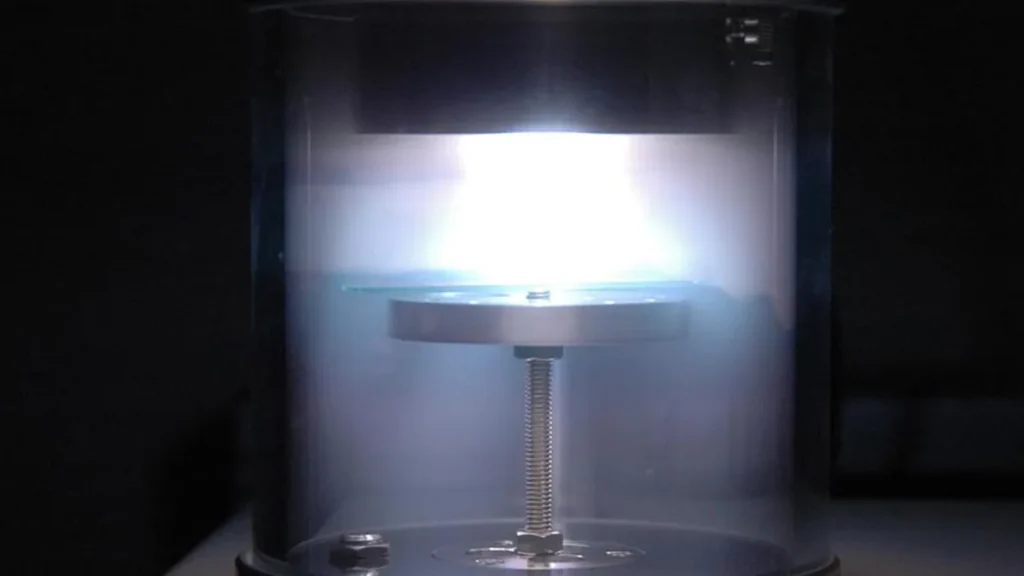
The team exposed sulfur dioxide and hydrogen sulfide to plasma discharges, or electrified gas, in pure nitrogen or nitrogen-methane mixtures. As the gases reacted, the researchers identified and quantified the volatile products as they formed using in situ mass spectrometry, which measures chemical compounds directly inside the reaction chamber. The methods section ties this setup directly to the reported chemical measurements. Both starting gases were tested in pure nitrogen and nitrogen-methane combinations under plasma discharge conditions. The experimental design allowed comparison of sulfur chemistry across different gas mixtures. Plasma discharges provided the reaction environment for the sulfur-bearing gases in the nitrogen-based mixtures. In situ mass spectrometry captured chemical output directly from the reaction chamber as reactions proceeded. The methods section states that volatile species produced under these plasma conditions were analyzed and quantified in situ.
Sulfur dioxide reactivity produced six detected sulfur species: hydrogen sulfide (H2S), NHSO, S2O, carbon disulfide (CS2), carbonyl sulfide (OCS) and methanethiol (CH3SH). The results section reports these detections as the outcome of sulfur dioxide reactivity under the stated gas mixtures. The six products include hydrogen-sulfur compounds, nitrogen-sulfur-oxygen species, sulfur-oxygen compounds and carbon-sulfur molecules. Three of the six detected species contain carbon bonded to sulfur. All six appeared under the plasma discharge conditions used for the sulfur dioxide experiments. The detected species span multiple chemical families based on their elemental composition. NHSO represents a nitrogen-sulfur-oxygen species among the six detected products.
Under identical conditions, hydrogen sulfide reactivity yielded carbon disulfide, carbon monosulfide (CS) and methanethiol. The overlapping but different product sets show that pure-nitrogen and methane-containing mixtures produce related sulfur volatiles under the same discharge conditions. The results section reports these overlapping product sets from the two starting gases. Carbon disulfide and methanethiol appeared in both sets of results. Carbon monosulfide was observed with hydrogen sulfide as the starting gas. The paired experiments demonstrate different volatile inventories from different starting gases under otherwise identical conditions. The comparison shows how starting gas composition affects the sulfur volatile inventory under matched conditions. CS represents carbon monosulfide observed only with hydrogen sulfide as the starting gas.
Detecting these sulfur species means researchers must build a consistent photochemical network – a model of how light-driven reactions connect chemicals – describing sulfur chemistry, the authors state. The experimental measurements provide data that a photochemical network would need to explain. The modeling requirement follows directly from having measured multiple sulfur volatiles under controlled conditions. A consistent network would describe how light-driven reactions connect the sulfur chemicals observed in the laboratory.
Through transit spectroscopy, which studies starlight filtered through a planet’s atmosphere as it passes in front of its star, space telescopes can study sulfur-active chemistry using carbonyl sulfide and carbon disulfide. Mid-infrared bands give instruments spectral features to detect when starlight passes through an exoplanet atmosphere during a transit. Carbonyl sulfide and carbon disulfide offer several such measurable bands for detection. The two compounds stand out from other observed volatiles for their mid-infrared spectral features. Several mid-infrared bands in each compound provide multiple detection opportunities for instruments.
The other observed sulfur volatiles are harder to detect at low spectral resolution than carbonyl sulfide and carbon disulfide. Hydrogen sulfide, NHSO, S2O, methanethiol and carbon monosulfide face the steeper detection challenge at low resolution. Low spectral resolution limits which of the measured sulfur volatiles instruments can realistically observe in transit spectra. The detection challenge varies across the observed sulfur volatiles based on their spectral properties.
The paper carries the journal reference A&A 19/11/2026 and was accepted for publication. It is categorized under Earth and Planetary Astrophysics (astro-ph.EP). Astrobiology Web tags the research with Astrobiology, Astrochemistry and Astrogeology. The paper carries arXiv identifier 2611.32250 [astro-ph.EP] and a DOI link of https://doi.org/10.48550/arXiv.2611.32250. Version v1 was submitted to arXiv on Nov. 24, 2026.

Join the discussion