Key facts
- The Korean delegation won gold medals for all five team members at the 2026 19th International Astronomy and Astrophysics Olympiad.
- The Ministry of Science and ICT and the Korea Foundation for the Advancement of Science and Creativity announced the results on the 6th.
- The competition includes a theoretical exam weighted 50%, a data analysis exam weighted 25%, and an observational exam weighted 25%, administered over four days.
On the 6th, the Ministry of Science and ICT and the Korea Foundation for the Advancement of Science and Creativity announced that all five Korean team members earned gold medals at the 2026 19th International Astronomy and Astrophysics Olympiad held in Hanoi, Vietnam. Kim Geon-ho and Kim Hyeong-geon are from Seoul Science High School, Park Ha-yoon from Daejeon Science High School, Yeo Eun-su from Sejong Academy of Science and Arts for the Gifted, and Yoon Ye-jun from Gwangju Science High School. All are third‑year students.
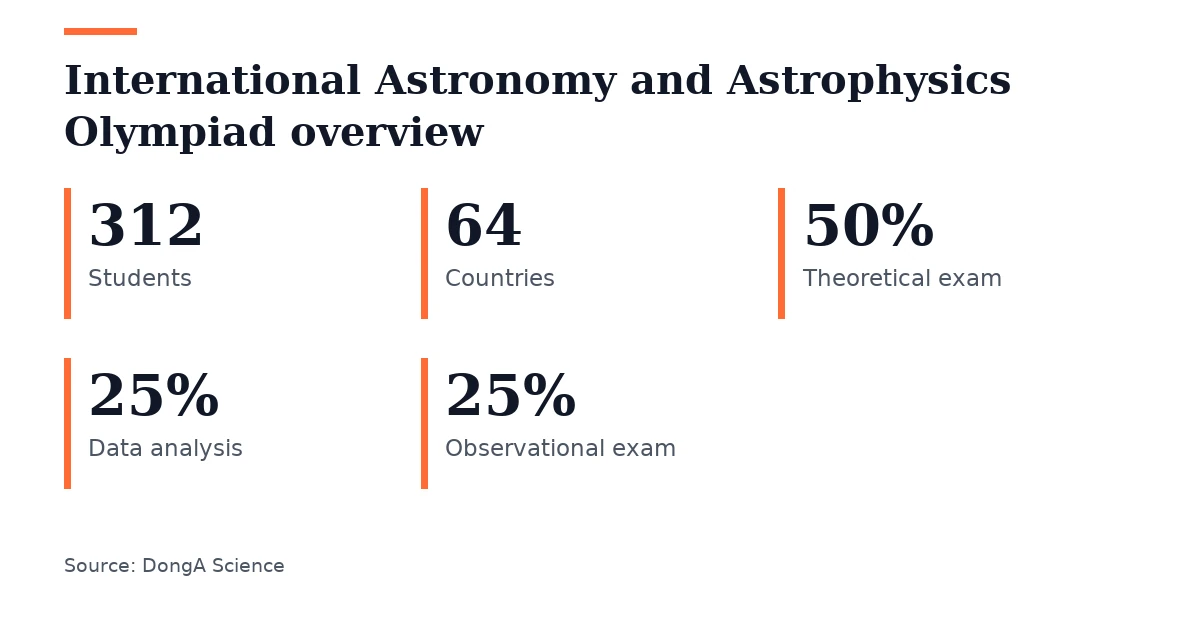
The 19th International Astronomy and Astrophysics Olympiad occurred in Hanoi, Vietnam, from the 25th of last month to the 5th of this month. The event drew 312 students representing 64 countries.
The competition included a five‑hour theoretical exam weighted at 50%, a four‑hour data analysis exam weighted at 25%, and a two‑day observational exam weighted at the remaining 25%. The exams took place over four days.
In the five‑hour theoretical test, students tackled basic astrophysics ideas, time‑keeping and coordinate frameworks, planetary and stellar bodies, interstellar material, cosmological topics and the tools used for observation. The test contained 12 questions, such as one examining the spiral shape of stellar winds from aging stars and another probing ultra‑bright galaxies in the early cosmos.
The four‑hour data analysis exam required participants to calculate and interpret astronomical data from three problems based on James Webb Space Telescope observations. One question asked about the characteristics of the Little Red Dot (an unusually red object seen in the early universe), while another required calculating the neutron‑star equation of state (the relationship between pressure and density in neutron‑star matter).
Observational tasks unfolded across two separate days. During the first night, observers used a reflecting telescope to view Saturn and the open cluster M29, tackling three problems that included measuring hour angles (the angular distance of a celestial object west of the local meridian, used to determine local time); the following day, participants entered a 16‑meter dome planetarium at Fenika University and calculated the Sun’s location in a simulated sky as seen from the Moon’s far side.
Lee Hee‑won, who leads the Korean Astronomy Olympiad Committee, described the competition as a key global meeting where talented young astronomers share innovative ideas and passion for the cosmos. He noted that he wishes the students to become valuable contributors to Korea’s future space efforts.
With this victory, Korean squads have now achieved top placements in eight global Olympiads spanning subjects like mathematics and physics. The International Junior Science Olympiad scheduled for December remains forthcoming.




Join the discussion