Key facts
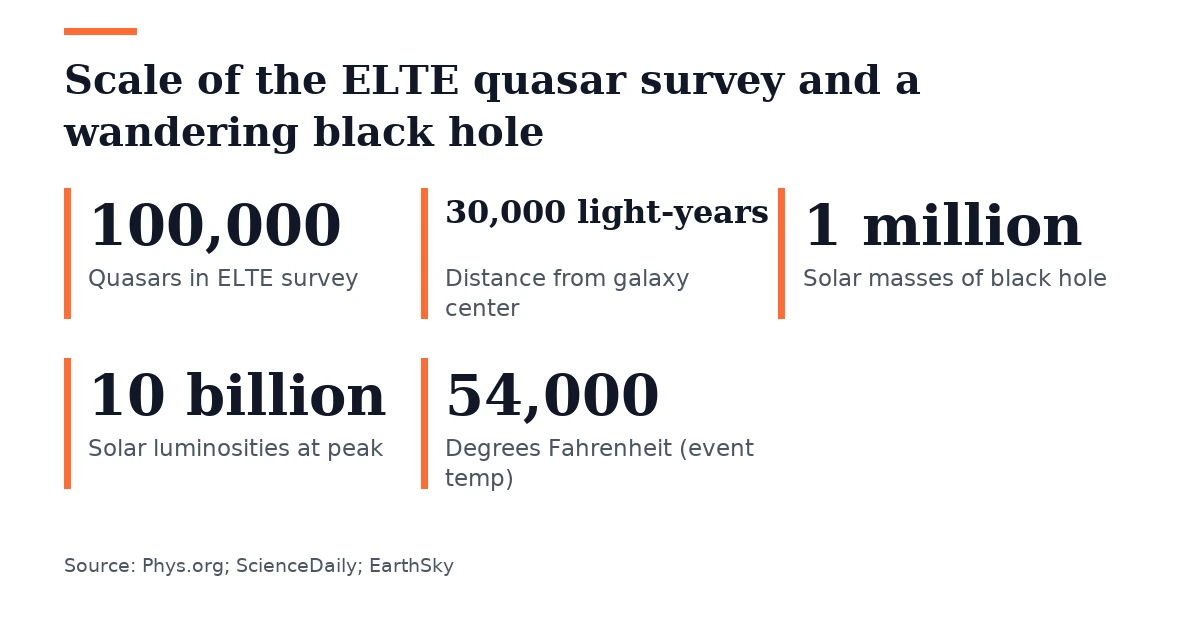
- University of Maryland astronomers identified a dormant supermassive black hole about 30,000 light-years, or 9.3 kiloparsecs, from its galaxy's center, revealed when it shredded a passing star.
- The relationship identified in the quasar data was predicted ten years earlier by Peter Raffai, Zsolt Frei, and Zoltán Haiman, members of the same research group.
- Among the dustiest quasars, heavily dust-obscured objects are three times more common among those with the fastest-moving black holes than among those with the slowest-moving black holes.
- The wandering black hole has a mass comparable to the supermassive black hole at the center of the Milky Way, and researchers observe no visible galaxy surrounding it.
Researchers at Eötvös Loránd University reported on Oct. 22, 2026, that a statistical survey of around 100,000 quasars provides evidence that supermassive black holes can be ejected from the centers of their host galaxies.
The finding tests a prediction made ten years earlier by Peter Raffai, Zsolt Frei, and Zoltán Haiman, members of the same research group. In 2016 they used computer models to forecast that ejected black holes swinging around galactic nuclei would travel fastest at the center, where dust is thickest, so faster-moving black holes should on average be more hidden by dust. The prediction linked black hole velocity to dust obscuration.
The study was led by Bence Bécsy, who graduated from Eötvös Loránd University and now works at the University of Birmingham as an assistant professor. The results appeared in Monthly Notices of the Royal Astronomical Society under DOI 10.1093/mnras/stag1367.
The team drew on roughly 100,000 quasars from the Sloan Digital Sky Survey quasar catalog, keeping only objects with data of sufficient quality. The team recorded each black hole’s speed and each quasar’s color, then looked for a connection between them. The study did not look for one unusual object but searched for a statistical signature across tens of thousands of quasars.
The data showed that quasars with faster-moving black holes are, on average, redder, meaning they sit behind more dust. Among the dustiest quasars, heavily obscured objects occur three times as often among the fastest-moving black holes as among the slowest-moving ones. The pattern appeared consistently across different data-selection and measurement procedures.
Bence Bécsy said confirming that a single black hole was ejected is difficult because other effects can produce similar signatures. The study’s novelty, he said, is using statistics to find traces of a whole population rather than hunting individual candidates. Bécsy is the lead author of the study.
The positive correlation disappeared when researchers compared only light from gas clouds that do not follow the black hole’s motion. This test helped isolate the signal tied to the black hole itself rather than to surrounding gas.
The authors suggest the most natural explanation is that some quasars contain supermassive black holes thrown out after an earlier merger. The strength of the signal points to relatively recent mergers in about half of the quasars studied, though the authors call that estimate uncertain. They caution that other physical processes cannot be ruled out.
If later work confirms the interpretation, the method could study how often supermassive black holes merge, how fast they are ejected, and what environments surround them. The approach would connect optical quasar observations with gravitational-wave physics.
The result is the first observational test using a large sample of a prediction formulated at Eötvös Loránd University ten years ago.
We have now detected in real observational data the relationship we predicted years ago.
Peter Raffai, Phys.org
Peter Raffai, an associate professor at Eötvös Loránd University, called the confirmation of their decade-old prediction difficult to think of a better example of why being a researcher is so rewarding. He said the work may help explain processes in galactic nuclei and the role of gravitational waves.
Zsolt Frei, head of the HUN-REN–ELTE Extragalactic Astrophysics Research Group, said the continuity of research at ELTE from the 2016 prediction to the 2026 confirmation is rare. He highlighted the potential of the findings to inform future gravitational-wave observations by LISA. Frei is a member of the same research group that made the original prediction.
The research supports preparations for the LISA space observatory, which the European Space Agency plans to launch in 2035. LISA will use three spacecraft orbiting 2.5 million kilometers apart, or 1.6 million miles, to directly detect gravitational waves from supermassive black hole mergers. Confirmed ejections would help determine how common these mergers are and shape expectations for how many events LISA may detect.
Eötvös Loránd University researchers have worked on LISA scientific preparations since 2006 and will continue from 2026 inside the four-year Kármán Tódor Space Science Mission-Driven National Laboratory. Zsolt Frei leads the laboratory as principal investigator. Its gravitational-wave research will focus on waveform models needed to pull information about black hole masses, distances, and fates from LISA signals. An August decision by the National Research, Development and Innovation Office established the new national laboratory at Eötvös Loránd University.
Supermassive black holes are generally found at galactic centers, where they form from the gravitational collapse of dense material. Astronomers usually infer their presence from the behavior of surrounding gas and stars and from radiation given off by accretion disks. Tidal disruption events occur when a star passes too close to a black hole and its gravity shreds it, producing a bright flare of radiation that telescopes can detect. Such events appear at galactic centers, but astronomers are increasingly identifying them in galactic outskirts.
University of Maryland astronomers identified a dormant supermassive black hole about 30,000 light-years, or 9.3 kiloparsecs, from its galaxy’s center. The black hole was revealed when it shredded a passing star. This discovery provides an individual observational case that complements the ELTE statistical survey.
The tidal disruption event was first detected in November 2025 by the Zwicky Transient Facility at Palomar Observatory. An artificial intelligence program trained to recognize the light pattern of a star being pulled apart by a black hole made the identification. The AI program was developed by the University of Maryland team to search for this distinctive signature in Zwicky Transient Facility data.
The Zwicky Transient Facility detects hundreds of thousands of changing celestial events each night, making it impractical to check every one by hand. That is why the University of Maryland team developed an artificial intelligence program to automate the search. The program had not previously been used to systematically look for tidal disruption events outside galactic centers.
Robert David Stein, lead author of the wandering black hole study, described the discovery as novel. He said it validates a new technique for finding dormant black holes by looking for tidal disruption events in galactic outskirts. Stein said the find challenges the assumption that supermassive black holes always sit at galactic centers.
The wandering black hole has a mass of about a million times that of the sun, comparable to the supermassive black hole at the center of the Milky Way. During the tidal disruption event it briefly shone with the light of about 10 billion suns. NASA’s Neil Gehrels Swift Observatory measured the event’s temperature at 54,000 degrees Fahrenheit, or 30,000 degrees Celsius.
The bright flare lasted for months, giving multiple observatories time to confirm it as a tidal disruption event. The prolonged visibility allowed detailed observations and cross-verification, ensuring the accuracy of the discovery. The study appeared in The Astrophysical Journal Letters on Jul. 27, 2026, with co-authors from the University of Maryland, NASA’s Goddard Space Flight Center, and other institutions.
Researchers offered two explanations for how the black hole reached the outskirts. A merger of three or more galaxies could have flung the lightest black hole outward. A dwarf galaxy merging could have carried its black hole close to the larger galaxy’s center. Robert Stein and Sylvain Veilleux proposed these scenarios.
No visible galaxy surrounds the wandering black hole, a fact researchers find puzzling. They suggest it may be the remnant of a devoured galaxy or a black hole thrown outward during a chaotic encounter. The absence of a visible galaxy challenges existing models of galactic structure.
It must have originated in a galaxy's center, but not the one it's in the outskirts of now.
Robert Stein, EarthSky | Updates on your cosmos and world
In 2024, scientists spotted the first tidal disruption event away from a galaxy’s center, at about 2,600 light-years from the center. Previously, such events had been seen at galactic centers. The 2024 event showed that off-center tidal disruption events could occur before the 2025 discovery.
The Vera C. Rubin Observatory and the Nancy Grace Roman Space Telescope will greatly increase the detection of tidal disruption events, including those far from galactic centers. The Lowell Discovery Telescope’s Rapid infrared IMAger-Spectrometer, which debuted in June 2025, could allow detections at much greater distances. These tools should expand the search for wandering black holes.
Scientists do not yet know whether wandering black holes exist in the outer regions of the Milky Way. Robert David Stein said there is no reason to worry about encountering one. He said such encounters are unlikely in a human lifetime.
We're very unlikely to meet one, at least in our lifetime.
Robert David Stein, ScienceDaily
Taken together, the ELTE statistical survey and the University of Maryland case show multiple lines of evidence that supermassive black holes can exist far from galactic centers. The survey looks at a population signature while the Maryland study documents a single object. Both support the broader idea that black holes are not always trapped at the center.

Join the discussion