Key facts
- The UK Space Agency is investing £4.5 million in the latest ESERO-UK programme in partnership with the European Space Agency.
- UKSA is inviting proposals to deliver ESERO-UK, which sits within its wider Education and Future Workforce programme.
- ESERO-UK's third objective is to build the capability and confidence of teachers and other influencers so they can use space to support learning and careers-related activity.
- UKSA wants a consortium to run ESERO-UK across the United Kingdom as a space education and engagement programme.
The UK Space Agency is investing £4.5 million in the latest ESERO-UK programme in partnership with the European Space Agency, the agency said on November 13, 2026. UKSA says the programme uses space as a context to support learning and to help young people explore space science, technology and careers in the space sector.sources
The European Space Agency anticipates contributing up to €750,000, or roughly £638,700, toward the programme. That amount comes in addition to the UK Space Agency’s £4.5 million investment, and the source presents it as part of the partnership between the two agencies.
UKSA is inviting proposals to deliver ESERO-UK, which sits within its wider Education and Future Workforce programme. The agency wants proposals that are strongly focused on improving equitable access for young people under-represented in STEM and space careers and that deliver clear value for public funding.
The agency wants a consortium to run ESERO-UK across the United Kingdom as a space education and engagement programme. UKSA said a consortium approach brings together the expertise, networks and delivery capacity needed for a coherent programme across schools, colleges, cultural, community and social settings.
ESERO-UK’s first objective is to support the space sector skills pipeline by helping young people aged 4–19 develop interest, confidence, skills and understanding of space. This objective sits alongside two others focused on equity and educator capability, and UKSA presents the skills pipeline goal as a response to reported recruitment and retention challenges in the UK space sector.sources
The programme’s second objective is to boost equity, inclusion and diversity within the future space workforce by widening access to space education and enrichment activities for young people underrepresented in STEM and space careers. Its third objective is to build the capability and confidence of teachers and other influencers so they can use space to support learning and careers-related activity.
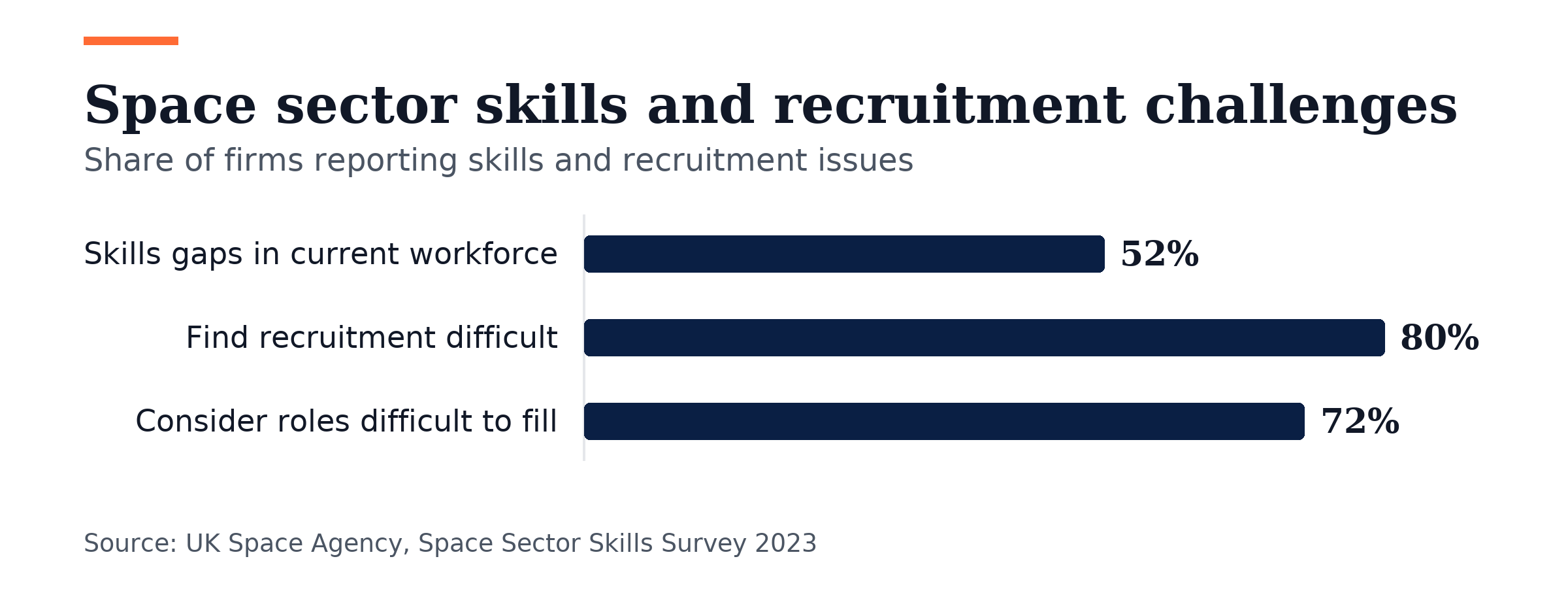
The agency cites the Space Sector Skills Survey 2023, under which 52% of space sector businesses say they have skills gaps in their current workforce. UKSA reports that 80% of firms find recruitment difficult according to the survey, and that 72% of firms consider their roles difficult or very difficult to fill. UKSA links these figures to skills gaps and recruitment and retention challenges facing the sector.
The survey also found that staffing skills and capacity are a key constraint to growth for a quarter of firms, with mid-level and senior posts facing the sharpest recruitment problems, UKSA said. Around 75% of roles in the space sector require a STEM background, leaving the sector to compete with other industries for a limited pool of STEM candidates, according to the agency. UKSA links these findings to skills gaps and recruitment and retention challenges facing the sector. These findings form part of the backdrop of long-standing UK STEM skills gaps.
UKSA notes the space workforce under-represents women, people from lower socio-economic backgrounds and Black people. UKSA presents this lack of diversity as part of the sector’s challenges, which ESERO-UK aims to address through its equity objective. The agency cites the Modern Industrial Strategy’s Advanced Manufacturing Sector Plan for the point that the United Kingdom space sector earned £18.6 billion in income and had 55,550 employees in 2022/23. UKSA describes space as a frontier industry with growing demand in that plan.

Proposals for ESERO-UK must be submitted by January 20, 2027. UKSA will tell successful applicants whether they have won by February 24, 2027, and grant payments will begin on April 1, 2027. The ESERO-UK programme began in 2009, well before this latest £4.5 million funding round.sources
In a separate announcement, King Charles III launched the Space and Defence Gateway on July 10 beside ESA’s UK site at the Harwell campus in Oxfordshire. The gateway provides co-working and events space for cooperation among governments, space agencies, academia and industry. RAL Space, the UK Space Agency, the Satellite Applications Catapult and ESA are named as anchor organisations behind the Harwell campus cluster. The continued growth of the cluster is supported by these organisations, according to ESA.sources
The European Centre for Space Applications and Telecommunications at Harwell houses ESA teams covering telecommunications, commercialisation, Earth observation, exploration and technology development. The facility hosts ESA’s 5G/6G Hub and ESA’s climate team, and supports the Business Incubation Centre UK.
We warmly welcome the UK Space and Defence Gateway as a new neighbour for ESA
Josef Aschbacher, esa.int
Sources S1 Electronics Weekly — “STEM for space – UK Space Agency invests £4.5m for ESERO-UK” — November 13, 2026 esa.int esa.int — “ESA welcomes new UK space and defence gateway” — July 13, 2026





Join the discussion