Key facts
- The Canadian Space Agency posted an RFP titled Enabling Technologies for Future Missions on Oct. 15 under its Space Technology Development Program.
- The CSA will award one contract per technology, with total funding capped at $4 million across all three.
- Every contract seeks to increase a technology's position on the nine-step readiness scale, with a target level set for each.
- In February, the agency released a draft request for information naming four priority technologies.
The Canadian Space Agency posted a request for proposals (RFP) titled Enabling Technologies for Future Missions on Oct. 15 under its Space Technology Development Program. The request is the agency’s mechanism for soliciting industry work on three priority space technologies within that program. Proposals are due Nov. 26 at 2 p.m. ET. SpaceQ Media Inc. reported the posting and its purpose.
The agency will award one contract for each technology, with total funding capped at $4 million across all three awards. The cap applies collectively to the three separate contracts under the request for proposals. Each contract aims to raise a technology’s position on the nine-step readiness scale the agency uses to rate how close a technology is to flight, with a target level set for every award. SpaceQ Media Inc. reported the funding cap and the readiness-scale target for each award.
Together the three items form a portfolio spanning orbital astronomy and Earth observation rather than a single standalone announcement. The package grew out of a February draft request for information that named four priority technologies, one more than the current three. That earlier draft preceded the final RFP. SpaceQ Media Inc. reported the portfolio framing and the February draft’s additional technology.
The fourth item was a spectrometer costing $1.6 million for the Atmospheric Data Continuity and Improvement program, for separate purchase. This spectrometer is not part of the three contracts in the current RFP package. In July, the agency issued an advance contract award notice indicating it intends to award the spectrometer contract non-competitively unless another company demonstrates capability. SpaceQ Media Inc. reported the spectrometer’s price and the notice’s competitive terms.
The notice named Quebec City-based ABB as the builder of the ACE-FTS spectrometer flown on Canada’s SCISAT satellite. According to the notice, the spectrometer work depends fundamentally on ABB owning the original design data. That dependency is the stated basis for the non-competitive award approach. SpaceQ Media Inc. reported ABB’s prior work and the design-data condition.
Turning to the first technology, the request says most CubeSats (small, standardized satellites) rely on lens telescopes, restricting the detail they can capture. That lens limitation motivates the CSA’s request for a mirror-based alternative. The agency is seeking a lightweight mirror telescope that maintains focus while orbital temperatures fluctuate, with thermal stability in orbit a key performance requirement. SpaceQ Media Inc. reported the lens limitation and the mirror alternative.
Mirrors compact the optical path and allow a longer focal length within the same volume, enabling greater detail inside a small satellite. Mirror telescopes have flown on CubeSats before, typically as bespoke one-off projects run by large organizations. The new design aims to work across satellites of different sizes rather than tying it to a specific spacecraft bus. SpaceQ Media Inc. reported the optical advantage and the shift away from bespoke approaches.
Size limits require the telescope to fit within two CubeSat units while detecting ground features smaller than seven metres. These volume and resolution constraints define the technical scope of the first contract. The primary application is Earth observation, but the telescope could also support astronomy and orbital object tracking. SpaceQ Media Inc. reported the size and resolution limits and the possible uses beyond Earth observation.
Contract two would fund readout electronics for Teledyne e2v CIS 301/302 detectors, the circuitry that powers an image sensor and extracts its data. The electronics are a necessary interface between the detectors and a functioning camera system. The RFP states that no existing camera is compatible with those sensors, a gap the contract is intended to close. SpaceQ Media Inc. reported the detector model, the interface role, and the compatibility gap.
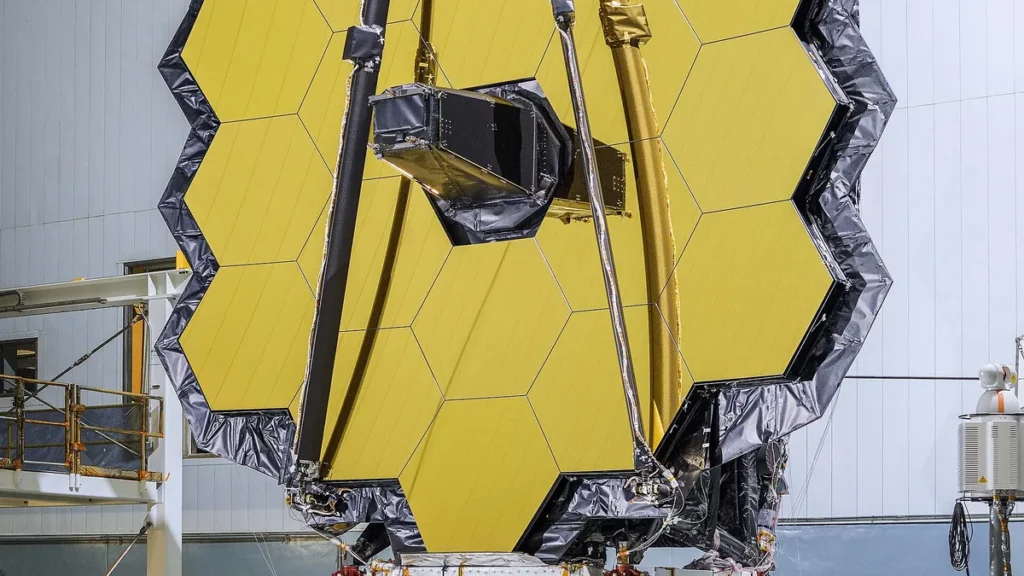
CASTOR, formally the Canadian Cosmological Advanced Survey Telescope for Optical and UV Research, would use four of these detectors per colour channel. The telescope’s detector needs are driving the electronics development. NASA’s Habitable Worlds Observatory is a potential target, with any Canadian contribution currently at a preliminary definition stage within the agency. SpaceQ Media Inc. reported the detector count and the NASA link.
The readout electronics work could support a future Canadian role in a NASA astrophysics mission. In a September newsletter, the Canadian Astronomical Society reported that the Coalition for Canadian Astronomy is working to secure approval and funding for CASTOR. The newsletter noted that an 18- to 24-month study plan was part of the effort to mature the CASTOR mission concept. SpaceQ Media Inc. reported the advocacy effort and the study plan.
SpaceQ asked in January whether 2026 would mark the telescope’s approval, and the outlet has questioned the timing of that approval. SpaceQ Media Inc. reported the January inquiry into CASTOR’s approval timing.
The third contract funds the transmit-receive module, the electronics behind each antenna element that amplify the outgoing pulse and returning echo. This component is central to the radar’s transmit and receive functions for the Terrestrial Snow Mass Mission. Environment and Climate Change Canada and the CSA are jointly developing the mission to gauge snow water equivalent nationwide. SpaceQ Media Inc. reported the module’s role and the joint development arrangement.
Snow water equivalent is the amount of water stored in the snowpack. The RFP states that seasonal snow is central to Canada’s water cycle, but its water equivalent remains inadequately monitored. The planned satellite would host a Ku-band synthetic aperture radar operating at two frequencies, capable of imaging through cloud and darkness. SpaceQ Media Inc. reported the monitoring gap and the radar’s two-frequency capability.
Because this would be the first Ku-band SAR mission of its kind, a lower-cost pathfinder would launch first to prove the hardware and science. The pathfinder reduces risk before the full mission launches. The agency solicited scientific input in 2024 on potential uses for this radar, and community input helped shape the radar mission concept before the RFP was issued. SpaceQ Media Inc. reported the pathfinder plan and the 2024 solicitation.
A feasibility study finished last year confirmed the mission is viable, supporting the move into hardware development for the snow mission. The pathfinder satellite would require approximately 100 transmit-receive modules, indicating the scale of production required for the test satellite. The agency omitted full systems-level design of the module’s fit with the antenna and radar due to the RFP’s financial limits, though it considered the design valuable. SpaceQ Media Inc. reported the feasibility study, the module count, and the budget-driven omission.
Industry must submit proposals by Nov. 26 at 2 p.m. ET. The deadline sets the timeline for industry responses to the request for proposals. SpaceQ Media Inc. reported the submission deadline.




Join the discussion