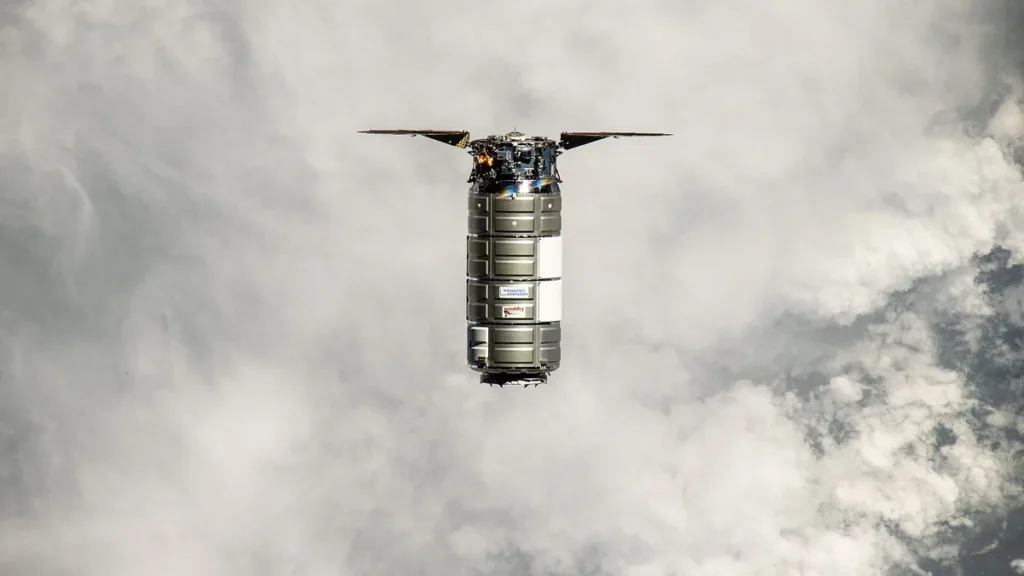
This is a new development in a story we reported earlier: NASA announces space crops experiment for Northrop Grumman's NG-25 flight. Earlier in this story: NASA Sets media coverage for Northrop Grumman CRS-25 launch.
Key facts
- Liftoff is targeted for 10:47 a.m. Eastern time on Sunday, Nov. 29, 2026, from Space Launch Complex 40 at Cape Canaveral Space Force Station in Florida.
- The flight is NASA's Northrop Grumman Commercial Resupply Services 25, also called Northrop Grumman CRS-25, and marks the 25th Cygnus cargo flight to the station under the CRS contract.
- Cygnus XL will transport approximately 11,000 pounds of research, crew provisions, and hardware, totaling about 5,000 kilograms, to the orbiting laboratory.
- An on-time launch would put Cygnus XL at the station at 2:35 a.m. Eastern time on Tuesday, Dec. 1, 2026.
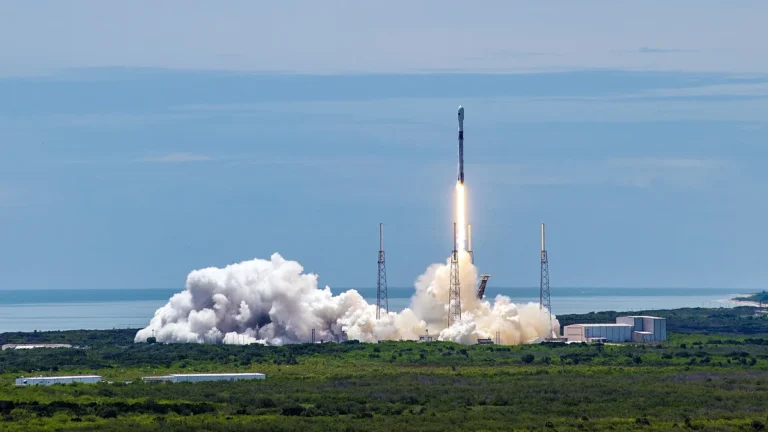
A Northrop Grumman Cygnus XL spacecraft and a SpaceX Falcon 9 rocket reached Space Launch Complex 40 at Cape Canaveral Space Force Station in Florida on Nov. 28, 2026, ahead of the NG-25 cargo flight to the International Space Station.
Liftoff is targeted for 10:47 a.m. Eastern time on Nov. 29, 2026, from the same launch complex, NASA said. If the Nov. 29 attempt slips, a backup window opens at 10:24 a.m. on Nov. 30, 2026. NASA will begin live launch coverage at 10:25 a.m. on Nov. 29 across multiple platforms.
NASA’s latest forecast, issued Nov. 28, 2026, puts the chance of favorable launch weather at 75 percent, with the thick cloud layer rule listed as the main concern. The agency had estimated the odds at 60 percent on Nov. 27, 2026, citing thick clouds expected at launch time. NASA issued the earlier estimate before the updated weekend forecast.
NASA designates the mission as Northrop Grumman Commercial Resupply Services 25, also called CRS-25, and it marks the 25th Cygnus cargo flight to the station under the CRS contract. The Cygnus XL spacecraft is set to carry 11,000 pounds of research gear, crew provisions, and hardware, or about 5,000 kilograms, to the orbiting laboratory. Northrop Grumman named the vehicle S.S. James “Jim” A. Lovell for the astronaut who flew Gemini VII, Gemini XII, Apollo 8, and Apollo 13.
Gaurang Patel of NASA said the spacecraft carries 42 standard menu Bulk Overwrap Bags and 65 crew-specific Bulk Overwrap Bags for coffee or tea preferences, plus four fluid loading kits. Patel itemized the food and supply bags in his prelaunch comments about what Cygnus carries for the crew.
If launch occurs on time, Cygnus XL will reach the station at 2:35 a.m. Eastern time on Dec. 1, 2026. NASA astronauts Jessica Watkins and Luke Delaney, who live and work aboard the station, will capture the spacecraft using Canadarm2, and ground controllers will berth it to Unity’s Earth-facing port.
Patel said the spacecraft will stay at the station until May and depart in May 2027 carrying several thousand pounds of cargo set for disposal and re-entry burn-up. The departure timeline and disposal plan are part of the mission profile after cargo unloading.
The Falcon 9 first stage, designated B1096, will fly its ninth mission. It previously supported Kuiper Falcon 1, NASA’s IMAP, NROL-77, GPS III-9, NASA’s SpaceX CRS-34, CRS-35, NROL-95, and Starlink 6-87. About eight minutes after liftoff, the booster will try to land at Landing Zone 40 beside the pad, marking the ninth landing there and the third for this vehicle.
Jared Metter, SpaceX director of flight reliability, said during a prelaunch news teleconference that this will be the fifth Falcon 9 launch for Northrop Grumman. Metter called the missions critical for providing science, food, supplies, and equipment to maintain the ISS.
The Falcon 9 upper stage will separate roughly 14.5 minutes after launch. That separation starts the spacecraft’s two-day trip to the station.
The payloads aim to advance muscle loss treatments, strengthen radiation sensing, boost food production for long-duration missions, improve drug delivery for osteoarthritis and cancer, and forecast cancer spread. NASA is flying Lockheed Martin’s JOINS experiment to test two microgravity welding techniques, Utah State University’s Ohalo 3 plant water delivery and crop production module, and the University of Connecticut’s DNA Nano B medicine delivery particle system. More than 35 Cygnus payloads have ISS National Laboratory sponsorship, including Rendezvous Robotics autonomous assembly, a Dunlop Tires rubber radiation study, and a Malagen Labs radiation shielding demonstration.
The NASA Biological and Physical Sciences Division is flying Ohalo III, a prototype chamber for growing space crops, to test water delivery and volume optimization on the station. Another investigation will validate a fluid-handling system that keeps lab-grown human brain tissue models called miBrains alive, building on previous station research. NASA said findings from the brain tissue study might reveal spaceflight neurological risks and further tissue research and neurological disease modeling on Earth.
Dave Schiller, Northrop Grumman vice president of civil space and sciences, said Cygnus could help reboost the station to maintain orbit, while NASA and international partners decide the frequency and timing. Schiller discussed the potential reboost role while the spacecraft is on orbit.
NASA held a prelaunch media teleconference on Nov. 23, 2026, at noon with Gaurang Patel and Jennifer Buchli of NASA, Dave Schiller of Northrop Grumman, and Jared Metter of SpaceX. The teleconference schedule and participant list were published ahead of the NG-25 launch.

Join the discussion