Key facts
- Wei said sustaining a long-term moon presence will require rethinking how local resources are used.
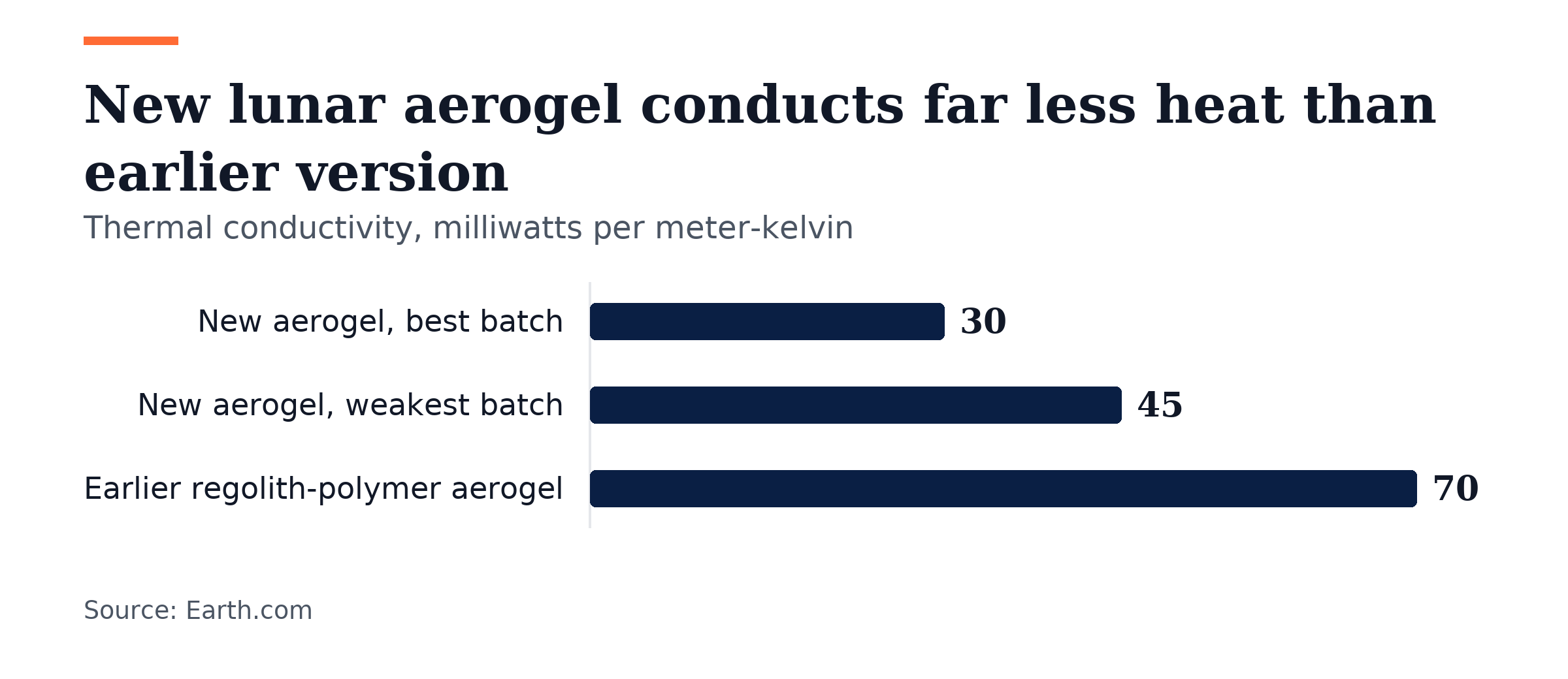
- The batches tested in air registered thermal conductivity from 30 to 45 milliwatts per meter-kelvin, and the best batches beat an earlier regolith-and-polymer aerogel whose lowest reported value was 70 in the same units.
- On the space station, astronauts bag trash and load it onto a cargo ship that either returns it to Earth or burns up in the atmosphere, but on the moon some of that waste could become insulation.
- The dust-only bricks are more porous and weaker than binder-made objects and cannot yet support other loads, and the team must still test how printing performs in lunar gravity and vacuum.
Purdue University researchers Alexander Wei and Jacob Staker have developed an insulating aerogel that blends shredded cardboard and paper fibers with simulated lunar regolith, work detailed in a September study as NASA aims for a long-term, sustainable moon base by 2032.
Lunar surface temperatures can reach 260 degrees Fahrenheit in daylight and fall to minus 280 degrees Fahrenheit at night, making insulation critical for any habitat. Shipping cargo to the moon costs about $544,000 per pound or $1.2 million per kilogram, and NASA describes local resource use as a way to avoid relying on Earth for everything needed to keep habitats safe and livable.
The Purdue team puts lunar regolith simulant, shredded paper fibers, water, and heavy ceramic balls into a planetary ball mill, where the regolith minerals fracture the cellulose into nanofibrillated strands under one micron wide that bind the aerogel and keep it from crumbling. The dust is made mostly of orthosilicates and aluminosilicates, the minerals that form much of the lunar crust, and the milling jars ran for two hours at roughly 60 times Earth’s gravity.
The team first dried samples with supercritical carbon dioxide at the NASA Glenn center in Cleveland, but it is shifting to freeze-drying, or lyophilization, for lunar production because it is simpler and more sustainable. Freeze-drying relies on the moon’s vacuum and cold nights to convert ice straight into vapor and reclaim the water, sidestepping the energy-heavy carbon dioxide that would be scarce there.
Aerogels insulate well because their structure can be up to 99% empty space, leaving little solid matter for heat to cross, and on the moon those pores become a vacuum that hardly conducts heat. Tests in air showed thermal conductivity between 30 and 45 milliwatts per meter-kelvin, and the best batches outperformed an earlier regolith-and-polymer aerogel that had the lowest reported value of 70 in those units.
In the moon’s near-vacuum the aerogel pores would hold virtually no gas, so the team expects the material to insulate better there than in air, consistent with other aerospace aerogels that conduct several times less heat under near-vacuum. A sample heated in nitrogen did not begin to break down until about 653 degrees Fahrenheit (345 degrees Celsius), a useful tolerance because lunar daytime temperatures can reach 266 degrees Fahrenheit (130 degrees Celsius).
Formulas with the least cellulose insulate best and are least dense, while adding cellulose improves mechanical strength, so the researchers must balance insulation against structural integrity. The least-dense, lowest-cellulose mixtures blocked heat most effectively but proved softer and shrank the most during drying. A one-percent-cellulose sample shrank about half compared with 3.2 percent for a nine-percent sample, and the stiffest nine-percent batch measured roughly 300 times more stiffness than the softest under compression.
The researchers fitted a statistical model to the 18 batches, and it pointed to a recipe that was 61.2% regolith by weight with the study’s best result, 30.5, though that mix shrank by roughly half and failed the strength requirement. The model also suggested a second balanced recipe with 30.8 conductivity and 18.5% shrinkage, though it contained only 25% dust, and the model required at least 60% dust because lunar dust is far more plentiful than waste paper.
Moon crews would generate cellulose-rich waste from cardboard packaging and plant biomass that people cannot eat, and a closed-loop process could turn that waste into structural insulation rather than letting landfill waste accumulate on the moon. Crew members on the station bag trash and send it away on a cargo ship that either brings it down to Earth or incinerates in the atmosphere, while on the moon some of that waste could become insulation.
Right now the aerogels exist only as Earth-made samples built from clean lab filter paper and a single type of imitation dust, with all heat measurements taken at 73 degrees Fahrenheit in air. Freeze-drying is under study for the next batches to see if it insulates as well, and Purdue proposed adding simple alcohols or sugars to slow ice crystal growth that can pack fibers and dust together and degrade quality.
“Sustaining a long-term presence on the moon will require us to rethink how we use local resources,” Wei said on Nov. 19. Wei said of the design target: “we’re looking for the sweet spot where we can get the properties we need with the limited resources we have available.” He added, “And I can guarantee that astronauts on the moon will never run out of moon dust.”
Separate in-situ-resource work at the University of Arkansas turned simulated lunar dust into bricks that lock together like LEGO pieces without a binding agent, using laser powder bed fusion, and the study appeared in NPJ Advanced Manufacturing on August 29, 2026. The project was led by Cole McCallum, then an undergraduate, and Wan Shou, an assistant professor of mechanical engineering, and McCallum said the regolith powder bonds directly to itself with no other material involved.
The bricks made only from dust are more porous and weaker than objects made with a binder, and they cannot yet support other loads. The team must still test how printing performs in lunar gravity and vacuum. McCallum said the process could self-support structures, but he would hesitate to call it load-bearing at this stage.
Funding for the research came from the Indiana Space Grant Consortium and the National Science Foundation, and Purdue’s College of Science hosts the work with additional NASA Glenn collaboration. Researchers have also proposed making 3D-printed bricks, solar arrays, and potatoes from lunar regolith, part of the wide-ranging research into the moon’s plentiful regolith.
Join the discussion