Key facts
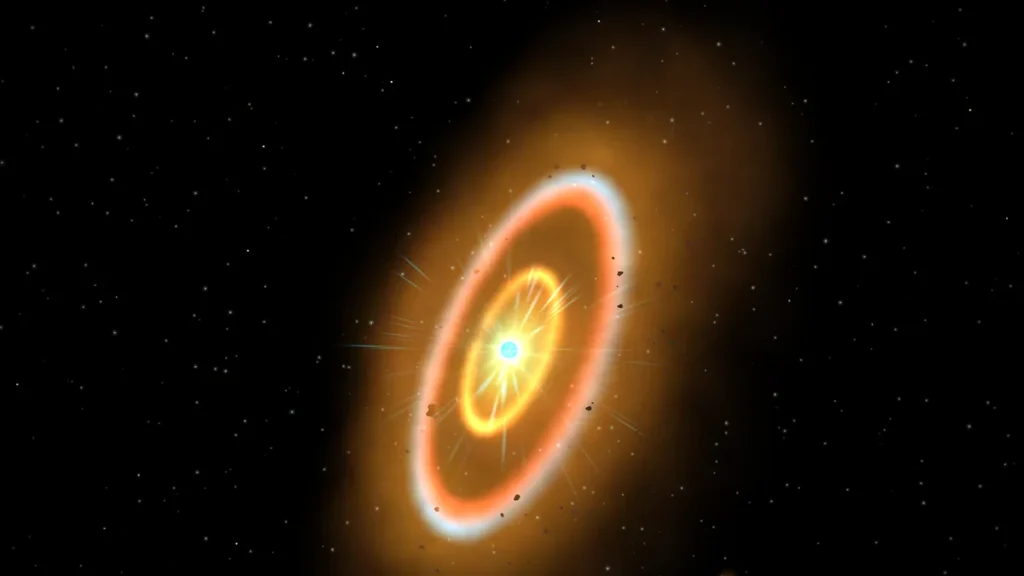
- Yamaguchi led Japanese astronomers studying V1094 Scorpii, a young T-Tauri star about 500 light years away whose protoplanetary disk reaches roughly 380 astronomical units from the star.
- A spatially extended gas disk extends to about 760 astronomical units in Keplerian rotation, meaning material farther from the star orbits more slowly than material closer in.
- The team reprocessed existing ALMA data with PRIISM, an open-source super-resolution tool that replaces CLEAN, and also observed the disk with the Very Large Telescope's SPHERE instrument.
- Gap widths and depths between 100 and 230 astronomical units could not be explained by a one-planet-per-gap model, so the authors say the origin differs across the disk.
New research published Nov. 27, 2026 in The Astrophysical Journal disputes the idea that every protoplanetary disk gap is made by an orbiting planet, said Masayuki Yamaguchi, a postdoctoral fellow at Kyushu University’s Faculty of Science.
Yamaguchi led a team of Japanese astronomers studying V1094 Scorpii, a young T-Tauri star about 500 light years away whose protoplanetary disk reaches roughly 380 astronomical units from the star. The system is rare because of its giant disk with multiple rings, which has drawn extensive research and observations. A 2018 paper first identified V1094 Sco as a giant multi-ringed disk using data from the Lupus survey of the Lupus star-forming complex.
A spatially extended gas disk reaches about 760 astronomical units and rotates in Keplerian fashion, so material farther from the star orbits more slowly than material closer in. The researchers traced this gas disk around the young star to map its structure.
To sharpen the view, the team reprocessed existing ALMA data with PRIISM, an open-source super-resolution tool whose name stands for Python module for Radio Interferometry Imaging with Sparse Modeling. PRIISM replaces CLEAN and is designed to make sharper images from existing interferometry data without new observations. The astronomers also observed the disk with the Very Large Telescope’s SPHERE instrument.
PRIISM had previously revealed unseen disk structures in a 2025 study of 78 disks in Ophiuchus, systems only a few hundred thousand years after star formation. That earlier work demonstrated the tool’s ability to find features in very young disks before it was applied to V1094 Sco.
Gap widths and depths between 100 and 230 astronomical units could not be explained by a one-planet-per-gap model, so the authors say the origin differs across the disk. The innermost gap near 100 astronomical units fits multigap excitation by one low-mass companion of 55 plus or minus 35 Earth masses. A double gap and its scattered-light counterpart at that radius are consistent with that companion, according to the paper’s explanation of the inner structure.
Outer rings from 170 to 230 astronomical units show even spacing without a clear scattered-light counterpart, matching secular gravitational instability, a process in which dust clumps under gravity in low turbulence rather than being carved by a planet. The authors note the outer ring system lacks a clear scattered-light counterpart and is quantitatively compatible with secular gravitational instability rather than planetary carving. Secular gravitational instability inherently produces evenly spaced rings, while exoplanets do not, which supports a mixed origin for different parts of the disk.
The results favor a hybrid path where low turbulence across a wide disk builds long-lasting dust concentrations past 100 astronomical units alongside planet-made structures closer to the star. No planets are forming in the outer rings now, but the dust concentrations create conditions favorable for later planet growth instead of competing with planet formation. That means the outer structures may be nurseries rather than evidence of already-born worlds.
ALMA has not directly detected the innermost gap’s planet because it is a radio telescope, and Yamaguchi said the Subaru Telescope will help get a clearer picture of the hidden planet. He said, “These new stars have bright rings and dark gaps patterned in concentric circles resembling the grooves of a vinyl record”, and said many rings are hard to explain because it is difficult to imagine multiple planets already forming.
Earlier research reached a similar cautionary conclusion. On Nov. 3, 2015, work led by Til Birnstiel, affiliated with the Max Planck Institute for Astronomy and conducted at the Harvard-Smithsonian Center for Astrophysics, showed a gap can be an illusion from particle behavior rather than an unseen planet. Birnstiel’s team used the Smithsonian’s Hydra supercomputer cluster to model particle growth, migration and destruction, finding that cleared small particles can make a gap while larger particles remain.
The 2015 team said longer wavelengths that detect pebbles can distinguish real gaps from dust-free pebble zones, and they planned ALMA observations of the TW Hydrae disk to test this. The team planned to check whether large grains exist inside an apparent gap, which would suggest no planet, or whether the gap remains empty at longer wavelengths, strengthening the planet hypothesis. Birnstiel put it plainly: “If we don’t see light scattered from the disk, it doesn’t necessarily mean that nothing is there.”
ALMA has captured images of many protoplanetary disks and rings as part of the effort to understand planet formation, which the source describes as a primary question in contemporary astronomy. It is unclear whether every ring is made by a planet because disks are complex and many forces are at work. Universe Today introduces the research by noting that rings around very young stars are often read as signposts of planet formation, while the new study asks whether other forces might also carve these structures.
The findings shift how astronomers interpret ALMA disk images and affect the timeline and methods for finding young exoplanets, since gaps can no longer be automatically treated as proof of newborn planets. Researchers must now weigh dust concentrations and secular gravitational instability alongside planetary carving when they read a gap. The new work suggests a more cautious path for targeting future observations of candidate young worlds.


Join the discussion