Key facts
- The researchers told ScienceAlert that an intrinsic quantum-gravity uncertainty determines when an information signal gets to its recipient.
- In Einstein's special relativity, nothing, including information, travels faster than light in a vacuum, limiting how far and fast an influence can spread.
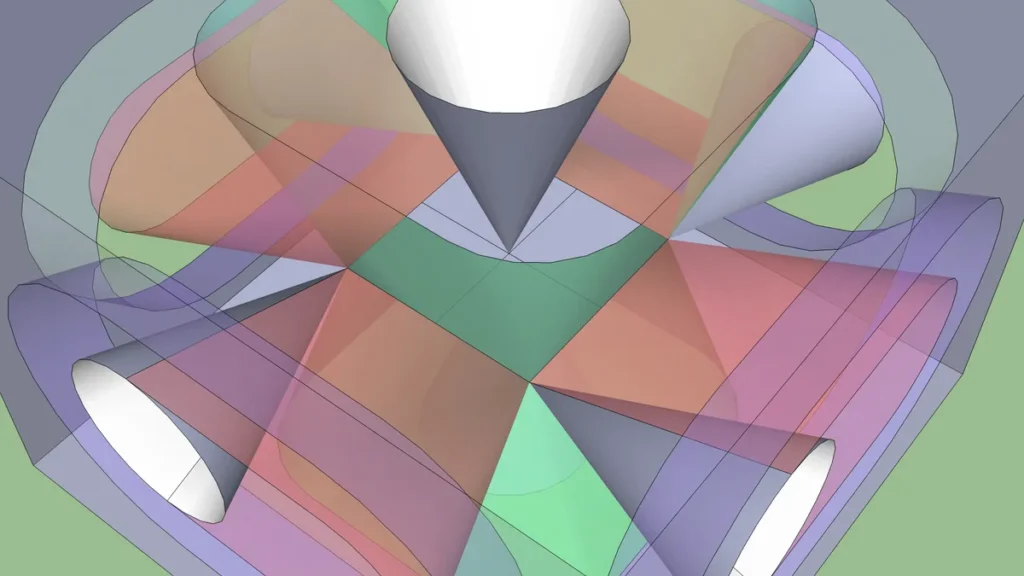
- That light-speed limit creates strict constraints, described as light cones, on which events anywhere in the universe can influence one another.
- General relativity also keeps light-cone boundaries precisely defined even though mass and energy curve spacetime and bend light, so one fixed geometry leaves no ambiguity about which events can influence which.
Researchers Giordano Cintia, Federico Piazza and Samuel Ramos of France’s Center for Theoretical Physics showed mathematically that quantum fluctuations of gravity can blur cause-and-effect boundaries, turning certainty about event order into probability, in work accepted by Physical Review D and posted on arXiv, reported Nov. 26, 2026 by ScienceAlert.
In Einstein’s special relativity, nothing, including information, travels faster than light in a vacuum, limiting how far and fast an influence can spread. Special relativity sets a hard cosmic speed limit that applies to light and to any influence, including information, according to the article. That light-speed limit creates strict constraints, described as light cones, on which events anywhere in the universe can influence one another.
A light cone is an imaginary boundary through spacetime from an event covering everywhere a signal moving at or below light speed could reach; events inside can be influenced, events outside cannot without faster-than-light information. ScienceAlert’s example holds that if the Sun were suddenly extinguished, Earth could not learn of it for eight minutes, the time the last sunlight needs to arrive, illustrating how the finite speed of light delays knowledge of distant events.
A supernova 1,000 light-years away could not cause a sneeze on Earth one second later because the explosion’s light would not reach Earth for roughly another 1,000 years, showing that a distant explosion cannot retroactively cause a local event because its light has not yet arrived. General relativity also keeps light-cone boundaries precisely defined even though mass and energy curve spacetime and bend light, so one fixed geometry leaves no ambiguity about which events can influence which.
Quantum mechanics lets particles and fields exist in superpositions, with properties given by probabilities instead of definite values at the universe’s smallest scales. If gravity is quantum, the spacetime geometry shaped by gravity should follow the same probabilistic rules, meaning spacetime geometry should inherit the same probabilistic behavior as quantum particles and fields.
Using quantum field theory, Cintia, Piazza and Ramos calculated how spacetime-geometry fluctuations might change a light-speed signal traveling between two observers, such as Marseille and Paris or the Moon and Mars, imagining observers exchanging a photon either on Earth or between the Moon and Mars. With known spacetime geometry, departure time and light speed, classical physics calculates a photon’s arrival time precisely. If spacetime geometry carries quantum uncertainty, the photon’s arrival time becomes uncertain too.
The researchers said the photon effectively moves through a quantum superposition of metrics, crossing a superposition of different possible spacetime geometries rather than one defined geometry. Since a metric is a mathematical description of spacetime geometry, the photon moves through several possible geometries at once rather than one defined geometry, because a metric specifies spacetime geometry and the photon is treated as moving through many possible geometries at once.
They modeled the signal passing through a thermal bath of gravitons, hypothetical gravity quanta analogous to photons for light, with energies distributed at a particular temperature, since gravitons would carry gravity the way photons carry light. Rather than averaging out during the journey, the fluctuations create a cumulative uncertainty growing with the square root of elapsed time, like a random walk, building up cumulatively over time in a pattern resembling a random walk rather than canceling out. The researchers offered a naive picture suggested by the random walk in which the photon strikes gravitons along the way, characterizing it as a naive image of the photon striking gravitons while traveling.
The longer a signal travels, the fuzzier the once-sharp boundary of its light cone becomes, since extended travel makes the sharp edge of a light cone increasingly diffuse. This does not necessarily permit faster-than-light information or effects that precede their causes; it adds intrinsic uncertainty to the border between events that can and cannot influence each other, softening the dividing line between causally connected and unconnected events without permitting superluminal messaging or reverse causation.
The researchers told ScienceAlert that an intrinsic quantum-gravity uncertainty determines when an information signal gets to its recipient, linking quantum gravity to uncertainty in signal arrival times in their remarks to ScienceAlert. “There is an intrinsic source of uncertainty due to quantum gravity to the exact time at which an information signal reaches its recipient,” the researchers said.
Under most circumstances the effect is vanishingly small, but it could be profound at a black hole‘s event horizon, meaning the effect is negligible in ordinary situations but may matter at extreme causal boundaries. Hawking predicted in the 1970s that black holes release thermal radiation due to quantum effects near the horizon, gradually shedding mass until they might evaporate entirely, and that gravitons should be part of that radiation, a prediction that gives black holes thermal radiation from quantum effects at the horizon, causing gradual mass loss and possible evaporation, with radiation that ought to contain gravitons. The researchers said a black-hole horizon can be viewed as a bundle of light rays held together by enormous gravity, describing a horizon as light rays bound tightly by strong gravity.
Normally a light-cone boundary’s position uncertainty grows more slowly than the cone expands, but a black-hole horizon defined by light rays that neither escape nor plunge deeper does not expand in time the same way, since an ordinary light-cone boundary’s position uncertainty lags behind the cone’s growth whereas a horizon is a fixed causal edge made of trapped light rays. If quantum uncertainty in the horizon’s position keeps accumulating, it could become comparable to the event horizon’s radius, as continued accumulation of horizon uncertainty could eventually match the horizon’s radius.
The black hole information paradox exists because general relativity forbids anything from returning from beyond the horizon while quantum mechanics forbids destroying information about a system’s state, pitting general relativity’s one-way horizon against quantum mechanics’ ban on destroying information. Theoretical physicist Don Page calculated in 1993 that information about matter fallen into a black hole should begin to be recoverable from Hawking radiation roughly halfway through the black hole’s lifetime, called Page time, meaning information should start emerging from Hawking radiation about midway through a black hole’s life at a point called Page time. Hawking’s original radiation calculation is purely thermal and gives no details about whatever fell into the black hole, since Hawking’s original thermal-radiation result contains no information about infalling material.
They found horizon-position uncertainty reaches the horizon’s radius in about the Page time, so around when information should become recoverable the inside-outside distinction could blur profoundly, as the team’s black-hole extrapolation places horizon blurring at roughly the same moment as Page time. The researchers caution their black-hole calculations are speculative at this time, labeling their black-hole conclusions as speculative for now. They suggest future interferometer experiments measuring tiny fluctuations in light travel time could probe the underlying physics, with interferometers measuring tiny light-travel-time changes proposed as a future test.
The researchers said their mechanism suggests the general-relativity geometric picture may be too classical, implying that general relativity’s geometric description might be overly classical. The research has been accepted by Physical Review D and is available on arXiv.
The broader quantum-gravity debate remains unsettled. A separate Kyushu/Waterloo/Stockholm framework argues some apparent quantum-gravity signs can be described with classical gravity and quantum particles in ordinary spacetime. Work by Aziz and Howl of Royal Holloway, University of London, shows classical gravity can entangle matter without quantum gravity. Neither study addresses the Cintia-Piazza-Ramos causality result directly.
Join the discussion