Key facts
- It will be just 221,667 miles from Earth, or 356,740 kilometers, when the Cold Moon turns full, according to the late astronomer Fred Espenak, which makes it the nearest supermoon of 2026.
- A supermoon can look 30 percent brighter and 14 percent larger than a full moon that sits at its farthest point from Earth, a phase also known as a micromoon.
- According to Around Prague, citing timeanddate.com, on 24 December 2026 the Moon lies about 356,700 km (221,600 miles) from Earth, while apogee on 11 December places it about 406,400 km away.
- Timeanddate calls the full moons of November, December, January and February supermoons, an unusual run for this winter according to Around Prague.
The December full moon reaches peak illumination at 8:28 p.m. EST on Dec. 23, 2026, as the Moon lines up opposite the sun, according to Space.com.
Around Prague says the full phase arrives at 01:28 GMT on Thursday, 24 December 2026, making it a Christmas Eve full moon in Europe. In the United States, the same full moon falls on the evening of 23 December at 8:28 p.m. EST. The Moon appears full for roughly a night on either side of the exact moment, so both 23 and 24 December are worth watching.
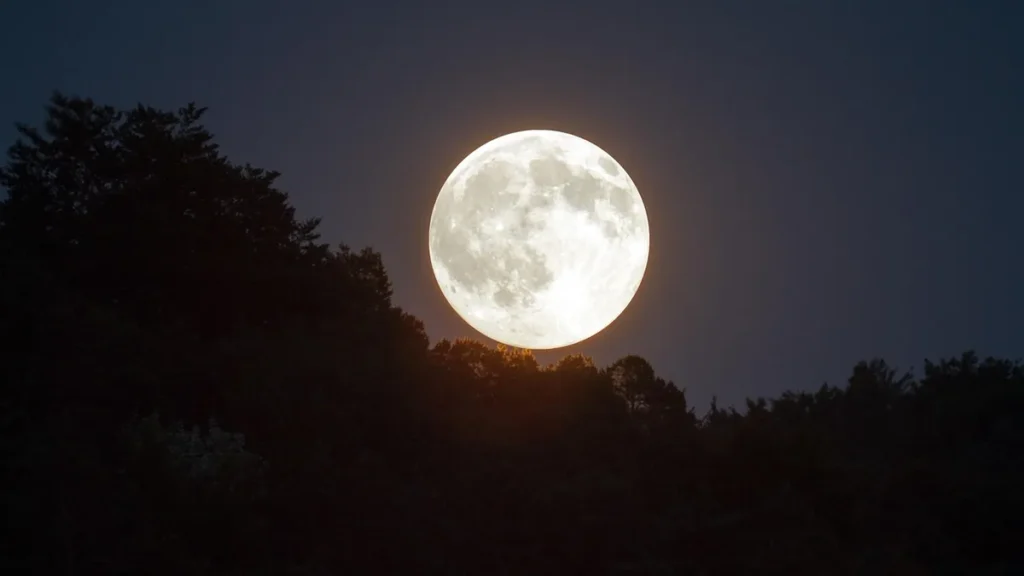
On Dec. 23, 2026, the full Cold Supermoon will rise over the eastern horizon at sunset, just hours before it reaches maximum illumination. Space.com notes that local moonrise or moonset can fall hours earlier or later depending on where a viewer is located. The outlet recommends the Time and Date moonrise and moonset tracker for timings specific to your location.
Around Prague recommends looking shortly after moonrise, when the Moon hangs low over the eastern horizon and looks larger beside buildings and trees. For the strongest visual effect, this low, foreground-framed view is the best time to watch.
Near moonrise and moonset, the Moon may look golden or orange because its light travels through more of Earth’s atmosphere at a low angle, scattering blue light and letting red light through, Space.com explains. National Geographic adds that around golden hour the moon takes on a warm orange hue, appearing in the east around sunset and sinking in the west at dawn.
Perigee is the point in the moon’s orbit where it comes closest to Earth. Space.com cites the late astronomer Fred Espenak, who said, “the Cold Moon will be just 221,667 miles (356,740 kilometers) from Earth,” making it the nearest supermoon of 2026.
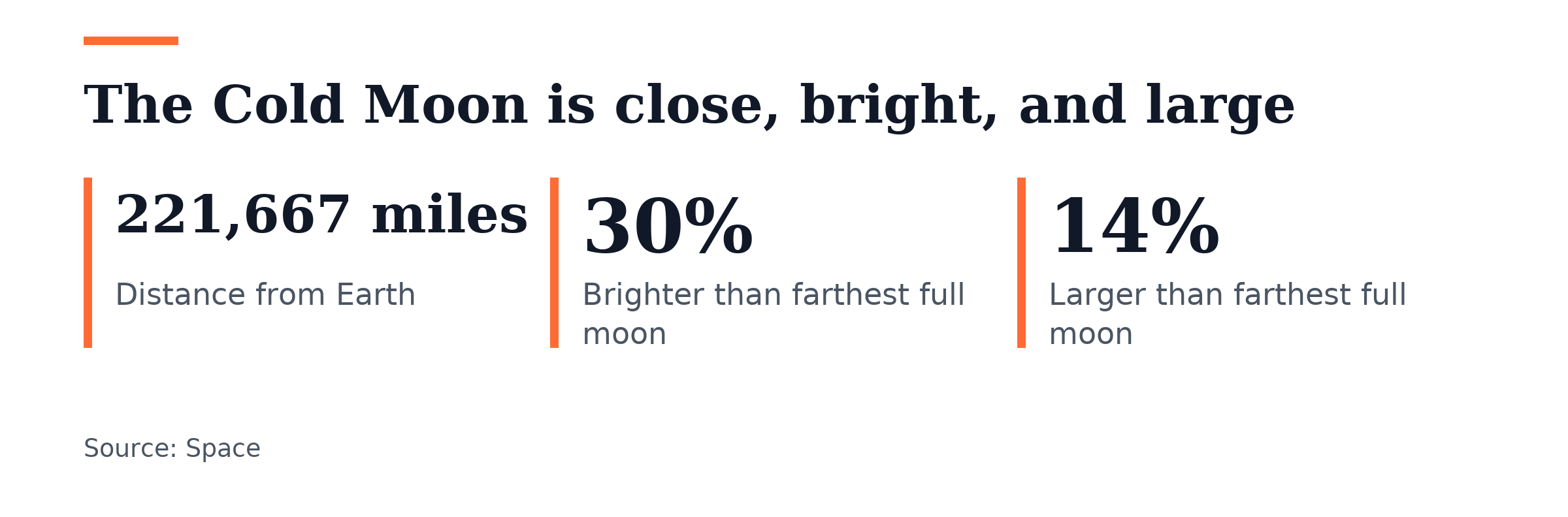
National Geographic calls the last full moon of the year the closest supermoon of the decade so far and says a moon at this distance, 221,667 miles from Earth, has not happened since 2018. On 24 December 2026, the Moon sits about 356,700 km (221,600 miles) from Earth, according to Around Prague’s citation of timeanddate.com, while apogee on 11 December puts it about 406,400 km away.
Compared with a full moon at its farthest point from Earth, also called a micromoon, a supermoon can appear 30 percent brighter and 14 percent larger, Space.com says. Around Prague, also citing timeanddate.com, says a supermoon looks about 7 percent bigger and 15 percent brighter than an average full moon, and that most people notice the brightness more than the size.
National Geographic reports NASA’s comparison of the Cold Moon with the year’s faintest moon. NASA said, “up to 14 percent larger in diameter and 30 percent more luminous than the year’s faintest moon.”
Following the Beaver Moon supermoon on 24 November, December’s Cold Moon arrives as the third consecutive supermoon. Around Prague notes that Timeanddate classifies the full moons of November, December, January and February as supermoons, calling it an unusual run for this winter.
The Old Farmer’s Almanac says December’s full moon is often called the Cold Moon because frigid temperatures prevail in the Northern Hemisphere when it rises, Space.com reports. Around Prague, citing North American and European seasonal traditions, ties the Cold Moon name to the winter solstice and the start of the coldest weather.
The Mohican tribe of North America called the December full moon the Long Night Moon because it falls near the winter solstice, the shortest day of the Northern Hemisphere year, according to Space.com. Around Prague says the Long Night Moon description fits because the Moon rides high in the sky during the year’s longest nights.
Time and Date, as cited by Space.com, says Old English peoples knew the December full moon as the Moon Before Yule. The Celts of Europe called it the Oak Moon after traditions centered around hardy trees, Space.com says.
Space.com links the December full moon to Datta Jayanti, the Hindu festival marking the birth of Lord Dattatreya, who embodies Lord Brahma, Vishnu and Shiva, according to the Government of Maharashtra. It also rises near Christmas on Dec. 25, when Christians mark the birth of Jesus Christ.
Space.com offers a table of local moonrise timings for selected cities around the globe on Dec. 23 and Dec. 24, though the actual times are not reproduced in the text provided. Because moonrise and moonset vary by location, the outlet directs readers to a location-specific tracker rather than relying on a single time.
Space.com recommends Stellarium or SkySafari 7 Pro for planning the best viewing. The outlet notes that full moon times mark the exact instant of full illumination while local moonrise or moonset may be hours earlier or later depending on location.
The Moon can appear larger than usual near the horizon because perigee combines with the moon illusion, which makes the disk seem bigger than it is when foreground objects are present, Space.com says. National Geographic advises watching the Cold Moon rise and set, when its position near the horizon makes it look especially large.
Around the full moon, Jupiter and Mars shine low in the eastern sky during the hour before midnight, while Saturn stays close to the western horizon, Space.com says. Venus appears as a brilliant Morning Star in the southeast just before dawn on Dec. 24, while the red giant Arcturus shines higher in the predawn sky close to Bootes.
Viewers in New York can see Sirius climb into the southeastern sky just after 8 p.m. local time around the full moon, and Space.com calls it the night sky’s brightest star. Space.com describes a Winter Hexagon loop that runs from Rigel in Orion to Aldebaran in Taurus, Capella in Auriga, Pollux in Gemini, and Procyon before closing back at Sirius.
After roughly 10 p.m. in late December, Mars, Jupiter, Uranus, Saturn, and Neptune form an arc across half the sky, National Geographic reports, with Mars and Jupiter visible to the naked eye in the east and Saturn in the southwest. Uranus and Neptune require binoculars or telescopes, with Neptune below Saturn and Uranus high in the southern sky.
In the morning during late December, Saturn and Neptune slip from view while Venus joins the show above the southeast horizon, National Geographic says. The Moon travels between the planets through December and comes especially close to Mars and Jupiter from Dec. 27 to 28.
Space.com recommends using a tripod, a remote shutter release or self-timer, and a smartphone stargazing app to find the exact moonrise point on the local horizon. For landscape photography, the outlet advises a 12–50 mm lens, and at least 400 mm for detailed views of the lunar surface.
The moon can look especially large near the horizon next to foreground objects with an orange-yellow appearance because of Rayleigh scattering, while a cleaner classic view is captured high overhead, Space.com says. Space.com calls this effect Rayleigh scattering, in which shorter bluer wavelengths scatter and longer redder wavelengths reach the eyes.
The December solstice on Dec. 21, 2026, is the shortest day in the Northern Hemisphere and brings extended sky-watching hours for stargazing or aurora hunting in Iceland, Greenland, Canada, and Alaska, National Geographic says. December 21 marks the summer solstice, or the longest day of the year, in the Southern Hemisphere.
The Geminid meteor shower peaks overnight from Dec. 13 to 14, 2026, and can produce more than 100 multi-hued meteors per hour under dark skies, National Geographic reports. The crescent moon sets for the Geminids, leaving dark skies, and the best view comes after midnight.



Join the discussion