Key facts
- A team using 3D radiative magnetohydrodynamic simulations found that a photospheric vortex twists magnetic fields and, with induced small-scale magnetic reconnection, drives a rotating spicule-like jet.
- At the tornado's edge, twisted magnetic field lines developed downward-facing components and rejoined upward-directed fields in the surrounding background and vortex core, which altered their connectivity.
- As the tornado rose and spun, the reconnection points moved along with it, and several fine jet shapes matched the upward flows from those points.
Liufan Gong, lead author on the study, and colleagues at the Yunnan Observatories of the Chinese Academy of Sciences, working with researchers from the University of Science and Technology of China and the University of Sheffield, published simulations in Astronomy & Astrophysics on Nov. 10, 2026. The paper, Formation dynamics of a rotating solar spicule-like event and associated energy-mass transport, appeared under DOI 10.1051/0004-6361/202661571. The author list begins with Gong, who is credited with images of the three-dimensional jet and magnetic tornado structure and with the flux variation figures.
They found that a photospheric vortex twisting magnetic fields, together with induced small-scale magnetic reconnection, can drive a rotating spicule-like jet. The work set out to answer how photospheric vortices help build spicules and how much mass and energy the jets carry into the corona. The research connects photospheric vortices and magnetic reconnection to the mass and energy jets deliver to the lower corona.
It offers a theoretical foundation for how such small jets heat the corona and supply mass to the solar wind, linking small-scale processes to coronal heating and solar wind origins.
The group ran three-dimensional radiative magnetohydrodynamic simulations using the MURaM code in an open magnetic-field configuration spanning the upper solar convection zone to the lower corona. Magnetohydrodynamic simulations model how magnetic fields and electrically conducting fluids such as plasma behave together.
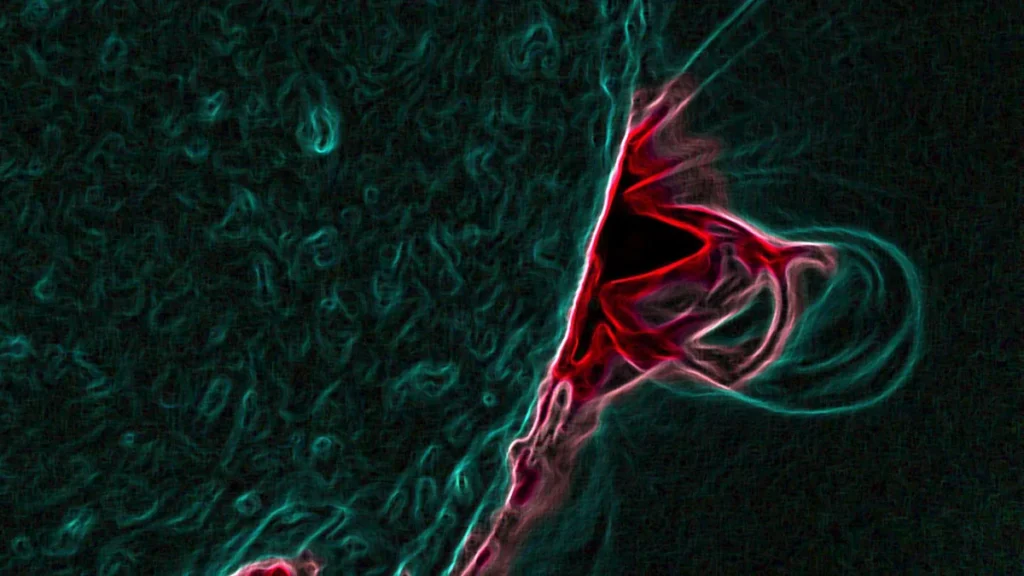
Before the jet appeared, a vortex in the photosphere twisted magnetic field lines. The rotating structure then stretched upward into higher atmospheric layers as a magnetic tornado, carrying the jet with it while the jet climbed inside the tornado around the same axis. The jet rotated about the tornado’s axis as it rose into higher layers, directly linking the vortex motion to the spicule-like jet.
At the tornado’s edge, twisted magnetic field lines developed downward-facing components and rejoined upward-directed fields in the surrounding background and vortex core, altering their connectivity. As the tornado rose and spun, the reconnection points moved along with it. The reconnection worked with the twisting vortex to drive the jet as it ascended through higher atmospheric layers.
Several fine jet shapes matched the upward flows from those reconnection points. That correspondence tied the tornado’s motion directly to the fine structure of the emerging jet.
Spicules are slender jets in the chromosphere that lift relatively cool plasma out of the lower solar atmosphere, move energy upward, and can spin as they develop. Small vortices often appear between granules in the photosphere, driven by convection there.
A height-based force analysis found that pressure gradients drove the plasma upward mainly in the photosphere and lower chromosphere. In the upper chromosphere, the Lorentz force, the electromagnetic force acting on charged particles, took over, with the strongest upward magnetic forces concentrated near the tornado’s edge. Different atmospheric layers contribute differently to launching the jet, with magnetic forces dominating higher in the atmosphere near the tornado boundary.
Around 4,000 km (2,500 miles) above the surface, the average upward mass flux density reached roughly 10−7 kg m−2 s−1, while the average upward Poynting flux density, a measure of electromagnetic energy flow, reached about 525 W m−2. Upward mass transport occurred at every analyzed height. The team calculated these flux densities over the event’s lifetime and found magnetic shearing and twisting dominated the upward electromagnetic energy transport.
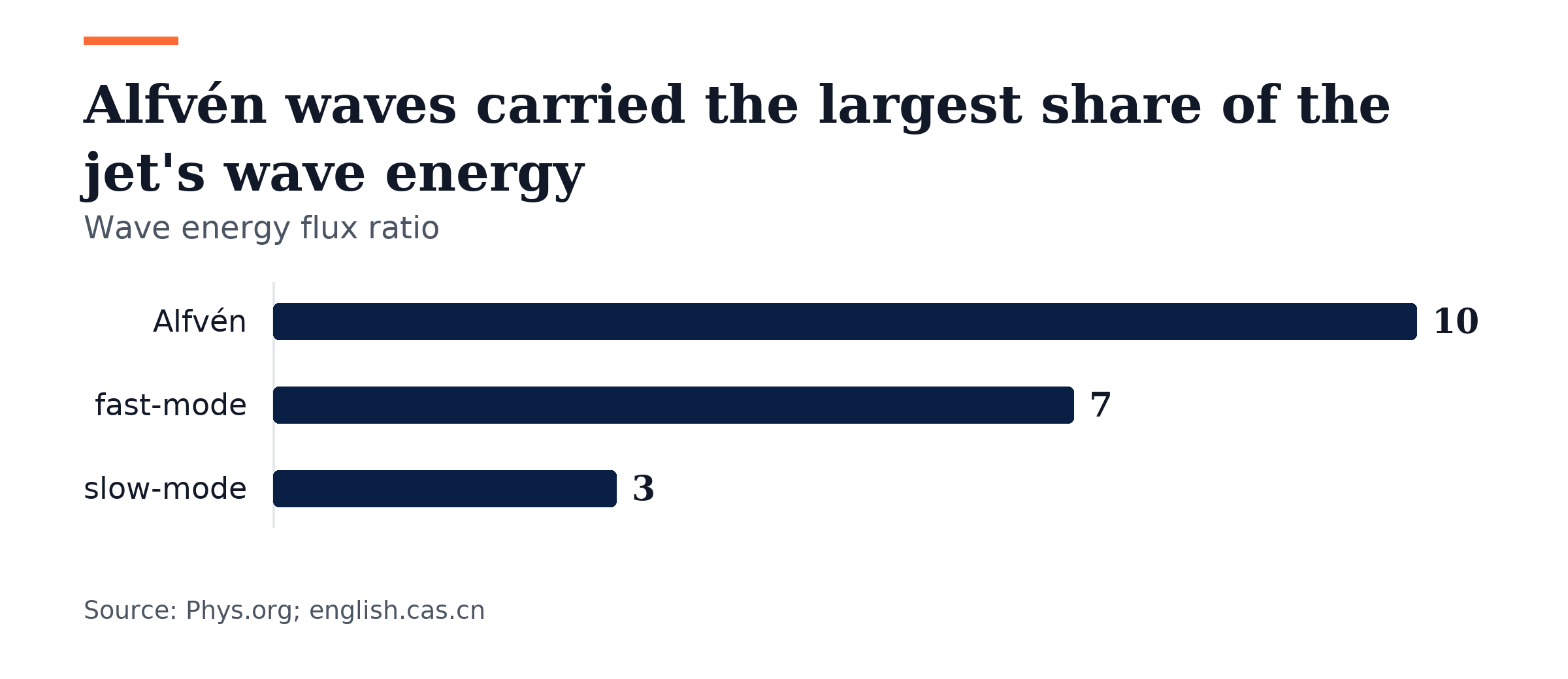
During the jet’s mature stage, Alfvén, fast-mode and slow-mode wave energy fluxes in the lower corona between roughly 3,000 and 4,500 km (1,900 to 2,800 miles) above the surface held a ratio near 10:7:3, and Alfvén waves, magnetic disturbances that travel through plasma, carried about half the combined total. Continuous perturbations of plasma and magnetic fields excited several magnetohydrodynamic wave types during jet formation.
The research received support from the CAS Strategic Priority Research Program, the National Natural Science Foundation of China and other sources. This funding backed the simulation work connecting vortices, reconnection and spicule energy-mass transport.




Join the discussion