
This is a new development in a story we reported earlier: SpaceX files FCC application for up to 1 million orbital data center satellites.
Key facts
- The FCC approved SpaceX's plan to deploy up to one million Starmind orbital satellites, also called compute modules, on Nov. 25, 2026, in the first U.S. authorization of an orbital datacenter network.
- FCC Chairman Brendan Carr said the move unlocks a bold new frontier for computing infrastructure needed to support America's leadership and growth.
- SpaceX's request relies heavily on lower costs from Starship, its next-generation reusable rocket still in development, to help deploy the satellites.
- SpaceX describes Starmind satellites as carrying an average compute payload of 175 kW and up to 250 kW, using deployable liquid radiators for heat and solar arrays based on Starlink technology.
The Federal Communications Commission approved SpaceX’s plan on Nov. 25, 2026 to deploy as many as one million Starmind orbital satellites, which SpaceX also calls compute modules, in the first U.S. authorization of an orbital datacenter network.
The license requires SpaceX to start deployment by November 2033 at the latest, field 100,000 units—10 percent of the maximum—by November 2035, and reach 50 percent by November 2038. The remaining milestone falls on November 25, 2040, and the 15-year approval period starts once SpaceX launches a Starmind satellite to orbit. SpaceX intends to start launching Starmind satellites in 2027, aiming for the third quarter aboard the fully reusable Starship megarocket, and President and COO Gwynne Shotwell told investors in October that launches would begin in 2027. SpaceX’s request relies heavily on lower costs from Starship, its next-generation reusable rocket still in development, to help deploy the satellites.
The constellation is authorized at altitudes between 500 km and 1,002 km and will communicate primarily through optical inter-satellite links, reserving Ka-band within Starlink’s authorization for limited backup and emergency operations. SpaceX describes Starmind satellites as carrying an average compute payload of 175 kW and up to 250 kW, using deployable liquid radiators for heat and solar arrays based on Starlink technology. The agency also cleared SpaceX’s request to back its optical network with additional communications approvals. Via Satellite described the system as an optically linked satellite constellation intended for orbital data processing.
FCC Chairman Brendan Carr said the decision opens a new frontier for computing infrastructure needed to support America’s leadership and growth. “Compute campuses or data centers are essential to sustaining America’s leadership in SI,” Carr said. Carr linked the decision to President Trump’s leadership and said America is leading the world toward a super-intelligence era, while the FCC cited a Kardashev Type II civilization able to use all energy given off by the sun. He said moving compute capacity beyond Earth reinforces American economic leadership and expands prosperity at home.
Musk, SpaceX’s founder and CEO, answered the approval on X with “Much appreciated” and called the system a great asset to America and the world. “This will be a great asset to America and the world.” He had previously posted that data centers in space looked appealing after the midterm election results.
Today roughly 17,000 satellites are in orbit, compared with the 42,000 Starlink satellites SpaceX once sought and the just over 11,000 it operates. Humanity has launched about 28,000 satellites since 1957, and Starlink remains the biggest constellation ever operated. The current total frames uncertainty about whether SpaceX will deploy one million units.
A July Government Accountability Office report warned of engineering and economic barriers, inefficient heat rejection, and collision risks from a major increase in satellites, even as it found space-based datacenters could reduce land, electricity, and water needs on Earth. Analysts cited by Via Satellite consider orbital data centers technically and economically unproven.
Amazon’s satellite unit Leo and other critics said SpaceX is unlikely to deploy all one million satellites, arguing deployment could take centuries. Carr rejected that criticism in March and told Amazon to focus on its own launches and constellation rather than worrying about SpaceX. OpenAI chief Sam Altman said Elon Musk’s optimism about putting datacenters in orbit by 2027 was misleading.
The commission issued waivers even though Amazon, Viasat, and the American Astronomical Society filed petitions to deny, and groups including the Secure World Foundation submitted public comments. The agency said many concerns about feasibility and long-term impact fall outside its regulatory mandate and declined to substitute its judgment for that of private enterprise. It also said it sets no limit on how many space stations can win authorization when they share similar orbital parameters. It skipped a new National Environmental Policy Act review, saying concerns about atmospheric effects from satellites burning up on re-entry remain speculative and unsupported in the record.
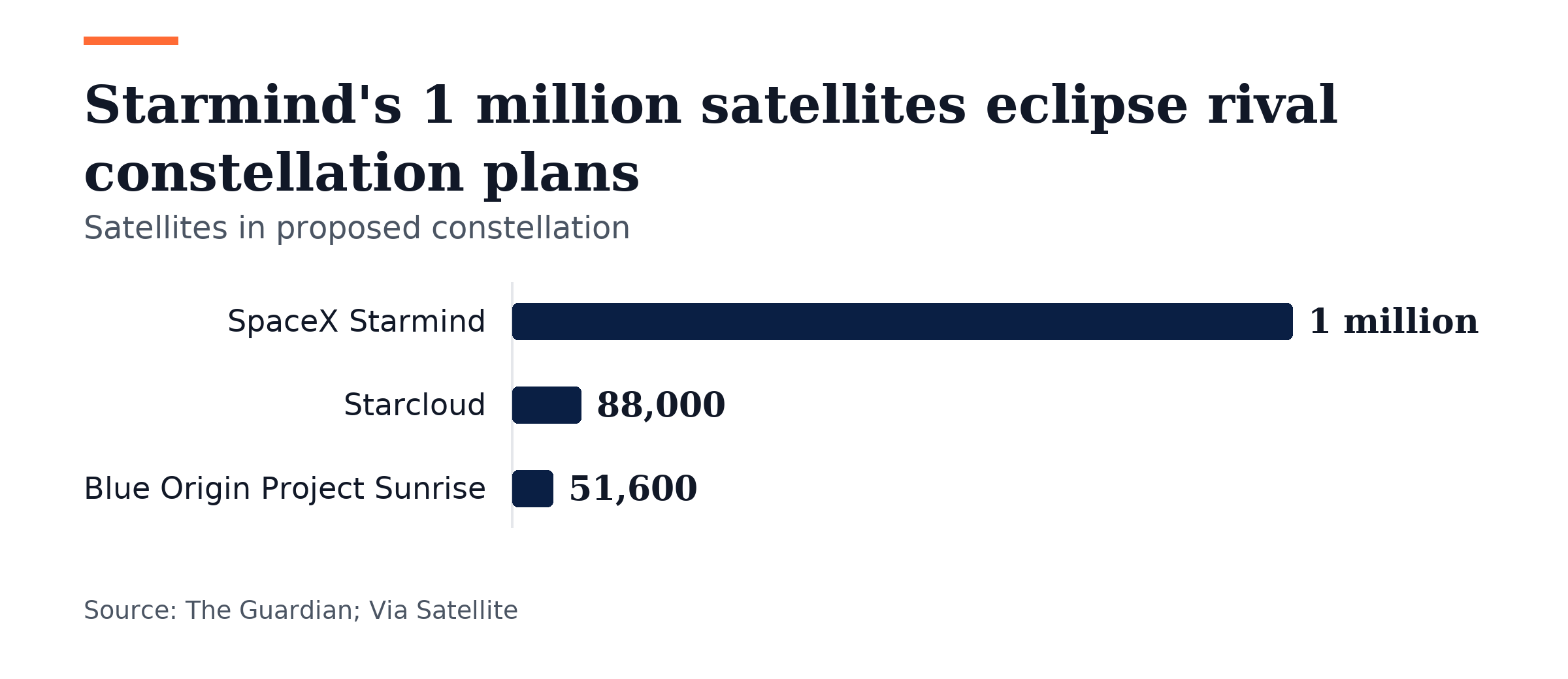
Rival companies are moving in the same direction. Starcloud has filed an FCC application for an 88,000-satellite constellation, while Blue Origin has applied for a 51,600-satellite network named Project Sunrise. Cowboy Space, Starcloud, Blue Origin, and Google have said they want to run data centers in space, and Starcloud and Google have already launched AI pathfinder satellites. Space.com noted that Starship can carry a maximum of 60 V3 Starlink satellites per launch and that about 1,700 liftoffs would be needed for the next-generation Starlink network.
SpaceX submitted its constellation filing at the end of January, around the time it acquired xAI and merged Musk’s space and AI businesses. The Secure World Foundation has urged greater regulatory oversight of orbital data center filings, saying the constellations mark a qualitative shift that raises new technical, environmental, and governance issues beyond routine FCC licensing. SpaceX has said it is targeting a total addressable market of $28.5 trillion over the long haul, including nearly $23 trillion in enterprise AI applications.


Join the discussion