Key facts
- Little red dots are faint, very red early-universe objects linked to supermassive black holes, first observed by JWST in 2022; confirmed examples previously dated from 600 million to 1.5 billion years after the Big Bang.
- The team was led by Takumi Tanaka, a Kavli Institute for the Physics and Mathematics of the Universe graduate student at The University of Tokyo, and included Kavli IPMU professor John Silverman.
- The researchers combined JWST NIRCam near-infrared and MIRI mid-infrared data from COSMOS-Web because cosmic expansion stretched the targets' light beyond the 0.6 to 5 micrometer range of near-infrared instruments alone.
- CW-LRD-z10 is extremely small, shows the characteristic little red dot color, and its spectrum matches previously discovered little red dots, confirming it as the most distant one.
Takumi Tanaka, a Kavli Institute for the Physics and Mathematics of the Universe graduate student at The University of Tokyo, led a team that confirmed CW-LRD-z10 in 2026 as the most distant little red dot yet, an object dating to roughly 400–500 million years after the Big Bang, using the James Webb Space Telescope’s COSMOS-Web data.
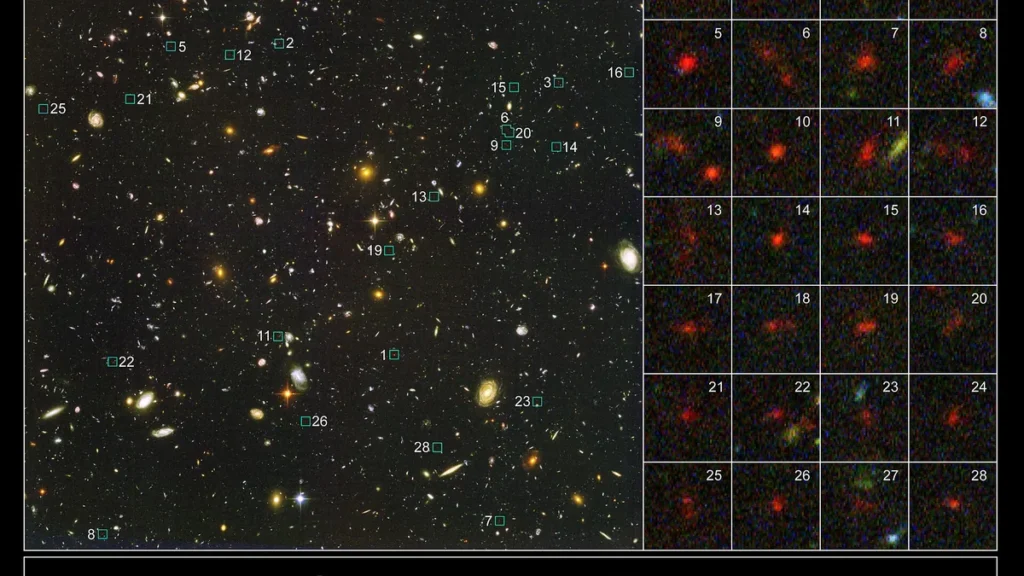
The confirmation rests on spectroscopy: CW-LRD-z10’s light sits at redshift z spec = 10.36, showing how much cosmic expansion has stretched it toward redder, more distant wavelengths. Little red dots are faint, very red early-universe objects linked to supermassive black holes. The team pushed JWST’s NIRCam near-infrared and MIRI mid-infrared observations past the 0.6-to-5-micrometer range of near-infrared instruments alone because expansion had stretched the light so far. CW-LRD-z10 is extremely small, carries the characteristic little red dot color, and its spectrum resembles previously discovered little red dots.
The CW-LRD-z10 candidate report first appeared in The Astrophysical Journal on Dec. 2, 2025, while the new Astrophysical Journal Letters paper adds spectroscopic confirmation of its distance. The paper, EMBER: A Little Red Dot Candidate at z spec = 10.36 in the Seed Black Hole Era, comes from Tanaka and Kavli IPMU professor John Silverman, who worked with high-resolution infrared COSMOS-Web images from JWST.
JWST first observed little red dots in 2022, and previously confirmed examples date from 600 million years after the universe began to 1.5 billion years. CW-LRD-z10 pushes the confirmed population back to roughly 400–500 million years after the Big Bang, intensifying the puzzle of how supermassive black holes grew so fast. The dots vanish before 1.5 billion years and stay missing for about 11 billion years afterward.
Kavli IPMU reports supermassive black holes with billions of solar masses before the universe turned one billion years old, a timing merger or ordinary feeding should not allow, with such objects found from 700 to 800 million years after the Big Bang. That puts them roughly 13 to 13.1 billion years into the past, though how they formed so quickly remains a mystery. Supermassive black holes sit at galactic centers across today’s universe and dwarf ordinary black holes by orders of magnitude; ordinary black holes form from dying massive stars.
Theories say black-hole precursors may have formed at 500 million years of cosmic age, yet confirmed little red dots previously spanned 600 million to 1.5 billion years after the Big Bang. CW-LRD-z10 predates that confirmed range, offering a potential key to how the first supermassive black holes assembled.
The research appeared in Nature on Sept. 16 and grew out of simulations built to study massive black-hole seed formation rather than little red dots themselves. “The most exciting result is that objects resembling Little Red Dots emerge naturally in our cosmological simulations,” says Sunmyon Chon, team leader at the Max Planck Institute for Astrophysics in Germany. Next, they plan to change early-universe conditions and test detailed predictions against JWST observations.
Chon says gas flowing into a black hole at an extremely high rate builds a dense, optically thick structure because angular momentum traps it, with the gas so dense that light struggles to escape. Light escaping this overfed, enshrouded black hole gets reddened, creating a compact, very red object marked by broad hydrogen emission lines, which Chon identifies as key little red dot traits.
Fast-growing galaxies funneled gas to their centers while radiation from nearby star-forming galaxies shut down star formation in neighboring clouds, leaving the early universe with an extraordinary supply of dense gas, the researcher says. That gas collapsed into supermassive stars of several hundred thousand solar masses, and after roughly two million years those stars left massive black-hole seeds; already in gas-rich settings, the seeds could grow extremely rapidly.
Little red dots may reveal missing stages in the formation of the first supermassive black holes, the researcher says. A quasi-star-like system also appeared in the simulations — a black hole sitting within a massive envelope of optically thick gas — marking the first time such a system formed naturally in a cosmological simulation. Chon says the simulations still cannot account for why the dots vanish at later times, which he calls a big mystery.
The Tanaka team plans to study hydrogen emission lines from CW-LRD-z10 for signs of black hole activity, examine how its light is distributed, and hunt for more little red dots from that era. More finds from that era should reveal when they first appeared, how they came together, and what effect they had in the early universe.
Separate Webb imagery originally hunted for Population III stars, the earliest stars after the Big Bang, turned up GLIMPSE-17775, a probable black hole star surrounded by a gas cocoon containing hydrogen, helium, oxygen, iron and sulfur. Its cosmological redshift dates it to about 1.8 billion years of cosmic age, and its spectrum holds more than 40 spectral lines, exceeding the detail of any earlier little red dot. The Astrophysical Journal study found strong element ratios ruling out a rotating gas cloud, though the object lacks the pronounced Balmer break that is typical of little red dots.


Join the discussion