Key facts
- Before impact Dimorphos took 11 hours and 55 minutes to orbit Didymos; after DART hit, the orbit shortened by about 33 minutes, demonstrating that the path of a smaller asteroid can be changed.
- The European Space Agency's Hera spacecraft has arrived at the Didymos-Dimorphos asteroid system to assess the damage from NASA's 2022 DART impact, and its first images are set for release on 25 November 2026.
- A live event at Berlin's Museum of Natural History on 25 November 2026 will showcase a major release of sharper Hera images.
- Universe Today gives Didymos at 780 meters wide and Dimorphos at 151 meters wide.
The European Space Agency’s Hera spacecraft has arrived at the Didymos-Dimorphos asteroid system to inspect the damage from NASA’s 2022 DART impact, and its first images are set for release on 25 November 2026.
NASA’s DART spacecraft deliberately struck the moonlet Dimorphos in 2022 at more than 22,000 kilometers per hour and was destroyed on impact. The collision sent a debris trail about 10,000 kilometers long into space, seen by telescopes on Earth and in orbit. Because DART was a one-way mission, close-up tracking of the result was impossible until Hera arrived.
Before the impact, Dimorphos took 11 hours and 55 minutes to orbit the larger asteroid Didymos. After the strike, that orbit shortened by about 33 minutes. Ground-based observatories followed the pair for four years and detected the slowdown, and some scientists were surprised by the size of the change compared with pre-mission calculations.
BBC News gives Didymos as roughly 730 meters across and Dimorphos as roughly 150 meters across. Universe Today puts the parent asteroid at 780 meters wide and the moonlet at 151 meters wide. The smaller body orbits the larger one as a binary pair.
Hera will spend the next year studying Dimorphos and will also examine Didymos. Its central task is measuring the mass of Dimorphos so planners can work out how effective DART’s shove was. The result would help predict what would happen if another asteroid had to be struck and would be vital if a space rock were ever found on a path to hit Earth.
Patrick Michel, principal investigator of ESA’s Hera mission, says DART exploded inside the asteroid, leaving its final state unknown, and that the impact may have left a crater or reshaped the asteroid entirely. “Hera is a sort of Inspector Columbo going back to the crash scene to investigate what is the outcome of this impact,” Michel said.
Hera carries three main imaging tools. The Asteroid Framing cameras handle black-and-white photography and navigation, HyperScout H monitors 25 color bands and uses spectroscopy (the study of how matter absorbs and emits light) with lab comparisons to meteorite samples to reveal the composition of Didymos and Dimorphos, and TIRI, supplied to ESA by JAXA, maps surface temperature. The suite is intended to clear up ambiguity about the math underlying the planetary defense mission.
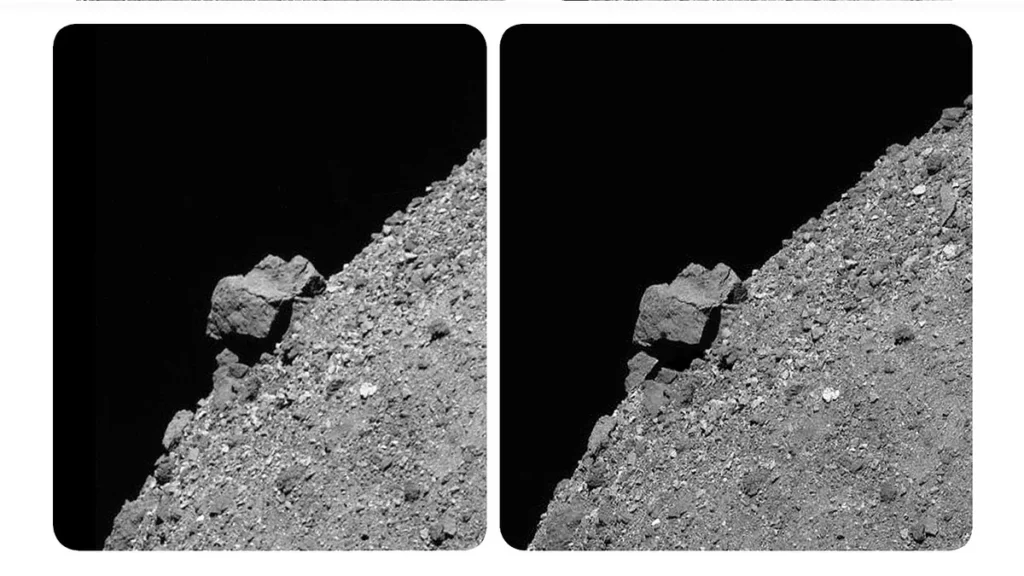
The Asteroid Framing cameras captured Didymos from about 28.5 kilometers away, resolving features around 2.7 meters across and revealing a spinning-top shape. Didymos rotates every 2.2 hours, and that spin pulls boulders and gravel toward the middle, making the asteroid fatter at the center than at the poles.
In visible-light images, Dimorphos appears almost entirely in Didymos’s shadow as a tiny sunlit speck. TIRI shows the entire 151-meter-wide asteroid in focus, glowing cool purple in infrared. Because solid rock sheds heat more slowly than porous or fragmented rock, the temperature map reveals how solid Didymos is.
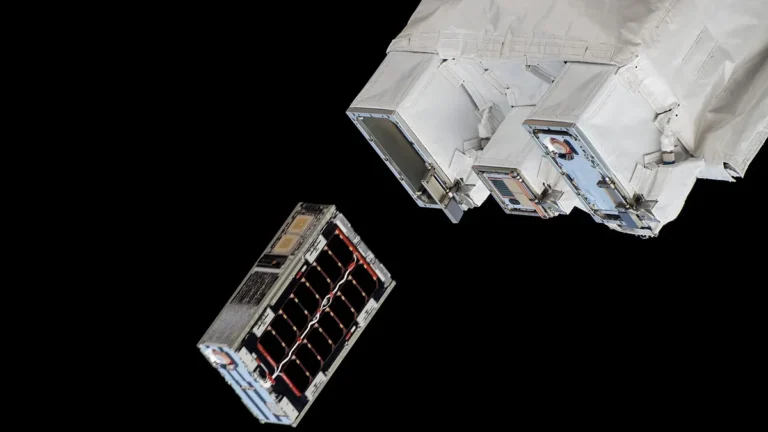
Hera carries two small, shoe-box-sized satellites that can study the impact site up close and later land on the asteroid. The mission will eventually launch two CubeSats, Juventus and Milan, to use ground-penetrating radar and land on Dimorphos to determine its composition.
Prof Simon Green, a planetary scientist on Hera’s science team, says measuring an asteroid’s properties would let experts state the mass of spacecraft, speed and timing needed to deflect it enough to miss Earth. Carolyn Ernst of Johns Hopkins Applied Physics Laboratory, who works on both DART and Hera, says kilometer-wide asteroids could cause global devastation, while medium-sized rocks like Dimorphos could wipe out a city.
Ernst says small asteroids are not too much of a threat because the atmosphere protects them, but a middle size range holds unknown objects whose impact could cause problems for humanity. She notes there are far fewer potential threats than millions of years ago, though objects remain in the Solar System.
The Didymos-Dimorphos system poses no threat to Earth. The 2022 DART collision was the first ever test of planetary defenses to determine what action could be taken if a space rock headed for Earth.
A new space telescope called the Near-Earth Object (NEO) Surveyor is set to launch in 2027 to track hazardous asteroids. The mission is intended to gather as much intelligence as possible about space rocks to be as well-equipped as possible for whatever the universe throws at us.
Apophis, about 450 meters long and discovered in 2004, was initially considered capable of hitting Earth as early as 13 April 2029. Scientists now say it will not hit Earth for at least the next 100 years and will instead fly just 32,000 kilometers above the surface in 2029, offering a rare close-up study chance.
Two spacecraft will head to Apophis: NASA’s Osiris-Apex, which previously grabbed a sample from Bennu, and Ramses, a joint ESA-JAXA mission. The visits are part of a broader plan for more asteroid encounters after the flyby.
ESA provided some of the best pictures of the asteroid pair since the DART impact in 2022. A live event at Berlin’s Museum of Natural History on 25 November 2026 will showcase a major release of sharper Hera images. Universe Today described the event as the first high-resolution view of one of the largest impacts made on another body in the solar system.

Join the discussion