This is a new development in a story we reported earlier: China to launch Pakistan's first astronaut aboard Shenzhou-24.
Key facts
- Muhammad Zeeshan Ali became the first foreign national to fly on a Chinese space mission and the first foreign crew member to visit Tiangong.
- Shenzhou-24 commander Tang Hongbo, 51, made his third trip to Tiangong. He previously flew Shenzhou-12 in 2021. He also flew Shenzhou-17 in 2024, becoming the first taikonaut to visit the station three times.
- Ali, 40, served as a payload specialist and was due to spend about a week, or several days, aboard Tiangong conducting experiments.
- Pilot Wu Yi was on his first spaceflight aboard Shenzhou-24.
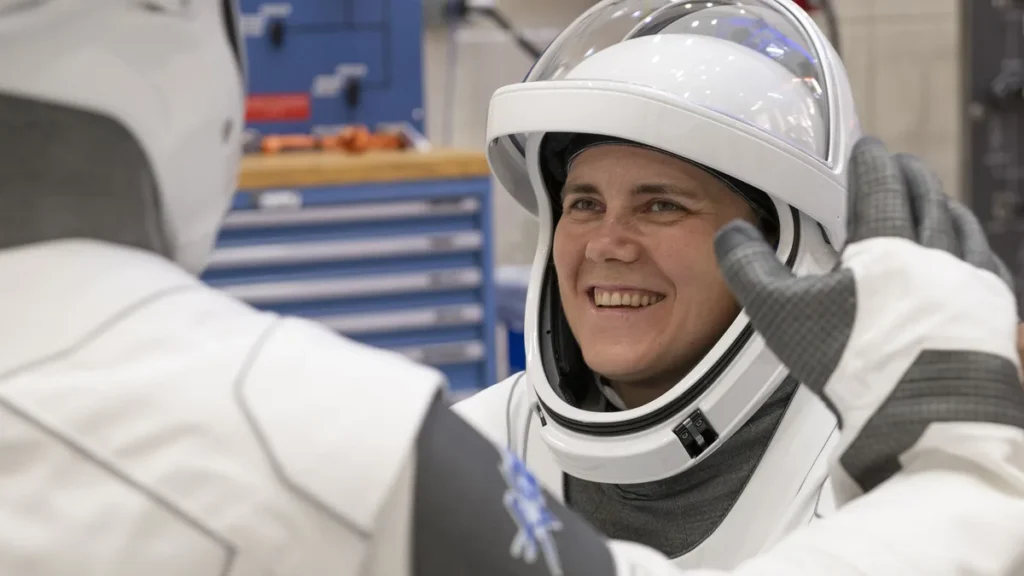
Pakistan Air Force pilot Muhammad Zeeshan Ali launched to the Tiangong space station aboard Shenzhou-24 from the Jiuquan Satellite Launch Center in Inner Mongolia at 8:18 a.m. on Nov. 25, 2026.
Ali, 40, served as a payload specialist and was due to spend about a week aboard Tiangong conducting experiments. SUPARCO selected him from two trained candidates to operate Pakistani experiment hardware in the station’s science modules rather than manage spacecraft systems. Commander Tang Hongbo, 51, was making his third trip to Tiangong after Shenzhou-12 in 2021 and Shenzhou-17 in 2024, the first taikonaut to visit the station three times. Pilot Wu Yi was on his first spaceflight; a Long March 2F carried Shenzhou-24 from Jiuquan. China’s Manned Space Agency confirmed the launch was successful.
The flight made Ali the first foreign national to fly on a Chinese space mission and the first foreign crew member to visit Tiangong. He was not the first Pakistani to travel to space: Monaco-based polar adventurer Namira Salim flew Virgin Galactic’s Galactic 04 in October 2023 after buying a $200,000 ticket in 2006. A suborbital flight reaches outer space but flies below orbital velocity, so it cannot remain in orbit around Earth.
Docking was expected about 3.5 hours after liftoff, briefly bringing Tiangong’s occupancy to six, the station’s design maximum during crew handovers. Shenzhou-24 was to remain docked as the continuing crew’s emergency return vehicle while the outgoing crew left on the earlier spacecraft. Ali was scheduled to return to Earth aboard Shenzhou-23 with Zhang Zhiyuan and Li Jiaying, while Zhu Yangzhu was to remain aboard for another six months on China’s first year-long mission.
Zhu Yangzhu’s longer stay was meant to study how extended time in space affects human health, including blood vessel ageing, through about 90 experiments. Shenzhou-23 had launched in May 2026 with three taikonauts for an approximately 12-month stay, and its vehicle stays docked as the emergency return craft while Shenzhou-24 serves as the new emergency vehicle.
China’s Manned Space Agency and SUPARCO announced the agreement in February 2025, and the two agencies signed the formal astronaut cooperation framework in Islamabad on Feb. 28, 2025. They chose Ali and Khurram Daud as candidates in February 2026, and the two finalists enrolled in Beijing for training alongside Chinese taikonauts. Daud, a pilot from the Pakistan Navy, trained with Ali and was to serve as backup until a formal naming announcement.
Pakistan’s federal minister Ahsan Iqbal gave November 25 as the launch date in October 2026, though China’s space agency had not confirmed a specific launch date when Tech Times published. China’s Manned Space Agency announced the payload specialist choice on Nov. 7, 2026, and the Foreign Ministry issued its statement two days later.
The pair began training in April 2026 at China’s Astronaut Research and Training Center, covering centrifuge work, pressure-chamber tests, weightlessness adaptation, orbital systems classes, and mandatory Mandarin. Final official word on which candidate would fly came on Nov. 23, 2026, the day before the SpacePolicyOnline report, although both governments had said a formal naming would precede the Nov. 25 launch window.
Four experiments chosen by SUPARCO from 300 Pakistani university proposals cover food security and climate resilience, along with life and biological sciences and materials science. The payload specialist was not assigned spacecraft systems, navigation, or spacewalk duties; the role involved operating Pakistani experiment hardware and carrying out prescribed research protocols. Ali said at a pre-launch press conference that the mission would demonstrate the reality of the friendship between Pakistan and China.
Diplomatic ties between Pakistan and China began in 1951, and the 75th anniversary falls in 2026. Guo Jiakun, a Chinese Foreign Ministry spokesperson, described the mission as a major milestone in cooperation between China and Pakistan on Nov. 9, 2026. He called it “another major milestone in China-Pakistan cooperation.” Pakistan’s prime minister, Shahbaz Sharif, publicly praised the astronaut selection, and President Xi Jinping urged stronger bilateral ties in May 2026.
Tianhe, the core module, launched in April 2021, and Wentian and Mengtian were added to the station in 2022. Continuous crewing began in June 2022. The station has a mass of 100,000 kilograms, or 220,462 lbs, and a volume of 340 cubic meters, or 12,007 cubic feet, orbiting at 390 kilometers, or 242 miles. China requested International Space Station participation in 2007 with no result, and the 2011 Wolf Amendment bars NASA from using federal funds to cooperate with China or Chinese-owned companies without prior FBI notification to lawmakers.
An April 2026 analysis from the University of Washington’s Jackson School framed Tiangong as the hub of China’s Space Silk Road strategy, which aims to build technical dependencies and diplomatic relationships with Global South nations such as Kazakhstan, Ethiopia, the UAE, and Nigeria. The ICUBE-Q CubeSat launched on China’s Chang’e-6 mission in May 2024, and the PRSC-EO3 Earth-observation satellite went up on a Chinese rocket during April 2026. Pakistan’s first lunar rover, Jinnah-1, has a mass of 35 kilograms, or 77.2 lbs, and carries terrain-testing, radiation, and plasma sensors, with deployment planned on China’s Chang’e-8 mission around 2029. Observers and Pakistani officials called the astronaut program CPEC in orbit, an expansion of the roughly $62 billion China-Pakistan Economic Corridor into space; CPEC links China’s Xinjiang region to Pakistan’s Gwadar port and is the flagship project of the Belt and Road Initiative.
Chinese law, including the 2017 National Intelligence Law, governs Tiangong operations and data, and groups under Chinese jurisdiction must assist national intelligence efforts. This applies regardless of astronaut nationality or experiment ownership, a fixed condition future Tiangong partners must weigh. The International Space Station is funded through 2030, and China hopes to put taikonauts on the Moon by 2030, while the United States seeks the same goal through Artemis.


Join the discussion