Key facts
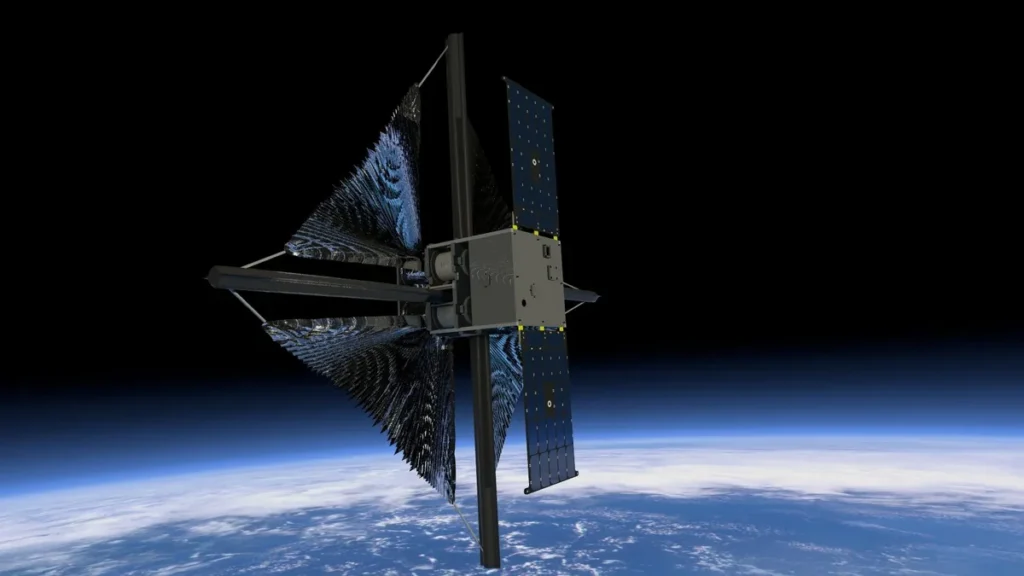
- Researchers at the Rochester Institute of Technology published an arXiv preprint describing a liquid-crystal solar sail that steers sideways while its surface stays pointed at the Sun.
- Grover Swartzlander Jr., a professor at RIT and an author of the paper, conceived the diffractive solar-sail idea nearly a decade ago.
- The sail bends sunlight at steep, predictable angles through diffraction, so a simple roll steers the spacecraft without tilting the sail away from the Sun.
- The stacked three-layer film measures 5.5 micrometers in thickness, roughly one-tenth of a human hair's width.
Researchers at the Rochester Institute of Technology published an arXiv preprint in 2026 describing a liquid-crystal solar sail that steers sideways while its surface stays pointed at the Sun. The research team presented the design as a computer simulation rather than a hardware prototype.
The paper is titled “Optimized Bragg Grating Liquid Crystal Solar Sail” by Sai Keshav Sasanapuri et al., published on arXiv in 2026 with DOI 10.48550/arxiv.2610.28942. The arXiv preprint has not been peer-reviewed and exists only as computer simulations so far.
Solar sailing relies on a basic physical exchange. Light particles transfer momentum and exert a slight force when they reflect from a surface, and that reflected force is what solar sailing harnesses to move a craft. This momentum transfer is the physical basis for solar sailing generally, and the sources note that flight demonstrations over the last decade have validated the concept.
Several proof-of-concept solar-sailing flights over the past decade have shown that photon-driven propulsion is feasible.
Conventional solar sails must tilt to change direction, cutting the sunlight they catch and making control harder. The sources compare conventional sailing to holding an umbrella against wind: angling it to turn reduces the force on it and complicates handling. Steering is a fundamental hurdle for solar sails.
Grover Swartzlander Jr., a professor at RIT and an author of the paper, conceived the diffractive solar-sail idea nearly a decade ago. Diffractive means using diffraction, the bending of light by patterns, to steer. He realized microscopic optical patterns reflecting light to the side could replace mechanical tilting, laying groundwork for what became diffractive solar sails.
The new sail bends sunlight at steep, predictable angles through diffraction, so a simple roll steers the spacecraft without tilting the sail away from the Sun. Diffraction sends light to one side, producing an equal and opposite kick on the sail in the other direction, which enables steering by roll alone. A thin, rollable film that redirects light without tilting the sail could make control simpler for spacecraft builders.
Earlier diffractive models carved patterns into metal-coated films, but scaling those films and rolling them to fit inside a rocket fairing proved difficult. Those packaging limits motivated the researchers to turn to liquid-crystal materials for the new sail concept. Liquid crystals are materials that flow like liquids but have molecules that can be aligned in ordered structures.
Technical guidance for the RIT group came from BEAM Engineering and from researchers at the Johns Hopkins Applied Physics Laboratory who study diffractive sails. That outside input helped shape the shift from rigid etched films to flexible liquid-crystal plastics that can be stowed compactly before deployment.
Rod-shaped molecules in these pliable, light plastic materials form tiny spirals, creating layers whose varying refractive indices steer light via the Pancharatnam phase. The spiral molecular structure creates the optical layering needed to diffract broadband sunlight without requiring the sail to change its attitude relative to the Sun.
The Pancharatnam phase twists the direction in which light waves wiggle, its polarization, to bend or delay the light. By controlling polarization through twisted molecular alignment, the material can redirect light while remaining facing the solar source head-on.
Sails made from this material are lightweight, flexible, easy to manufacture at scale, and fit inside a compact spacecraft. These manufacturing and stowage properties address the practical limitations that hindered earlier metal-coated diffractive sail prototypes.
One liquid crystal layer interacts with only a narrow wavelength range, so the rest of the light passes through with its pushing power lost. This selectivity means much of the solar spectrum would escape a single-layer sail, which is why the researchers pursued a multilayer design.
A three-layer liquid-crystal stack was designed by the research team using computer simulations paired with an optimization algorithm. The optimization algorithm was used to arrange the layers so the combined film captures enough sunlight to produce useful propulsion while staying ultrathin.
The highest layer takes blue and visible light, the next layer takes infrared, and the final layer takes longer infrared rays. Dividing the spectrum across three layers lets the film respond to different colors of sunlight without mechanical reorientation of the whole sail.
If the middle layer is omitted, near-infrared wavelengths used by solar panels pass through, and the layers could be tuned to transmit red light needed for plant photosynthesis while the rest pushes the sail. This selective transmission is described as added flexibility for potential future designs, not as a demonstrated feature of a built device.
The stacked three-layer film measures 5.5 micrometers in thickness, roughly one-tenth of a human hair’s width. The extreme thinness supports the goal of building very large, rollable membranes that can fit inside a launch vehicle fairing.
The concept is still at a very early stage, and no prototype of the three-layer system has been built. Swartzlander’s work received backing from NASA’s Innovative Advanced Concepts program. The authors have only modeled the system in simulations, so the claimed performance and durability remain unverified in hardware.
Scientists have proposed parking a giant sheet at the Sun-Earth L1 Lagrange point to deflect a small fraction of sunlight reaching Earth and intentionally cool the planet. A Lagrange point is a location where the gravitational pull of two large bodies balances the motion of a smaller object between them. The sunshade concept is presented as a long-standing scientific proposal for intentional planetary cooling, not as an active mission in either source.
A conventional sunshade would have to tilt to hold position, shrinking its shadow, while a diffractive shade could hold position without losing size. Tilting a conventional shade to maintain its L1 position would reduce the shaded area, whereas diffraction could provide lateral force without changing the sail’s orientation.
The material has not been tested to survive launch or exposure to the constant stream of particles from the Sun. Launch loads and the sustained solar-wind environment are two physical conditions the untested material would have to endure before any space demonstration. No flight or prototype test of the new liquid-crystal sail idea has been announced.
The paper offers a step toward solving a fundamental problem in solar sail design, and Phys.org says it is only a matter of time before someone tests the idea in the vacuum of space. Phys.org frames the work as progress on a core sail-design challenge while acknowledging that an actual vacuum-of-space test has not yet occurred.
Proposals to shade the Earth with a sail remain only concepts rather than active projects, and the study does not alter that status. Around Prague states that Earth-shading remains a conceptual idea rather than a funded or scheduled program after reviewing the paper.




Join the discussion