Key facts
- Totality from the Aug. 12, 2026 solar eclipse was visible in northern Spain, where the phase lasted less than two minutes.
- The Aug. 12, 2026 solar eclipse brought totality to parts of Iceland, Portugal, and Spain, while a substantial partial eclipse was visible across much of western Europe.
- Astrophotographer Alexandre Tournay set up near Brussels on Aug. 12, 2026, to photograph the Moon crossing the solar disk during the eclipse.
- Tournay deliberately positioned himself near a local airport on eclipse day because he hoped an aircraft would cross the Sun during the eclipse.
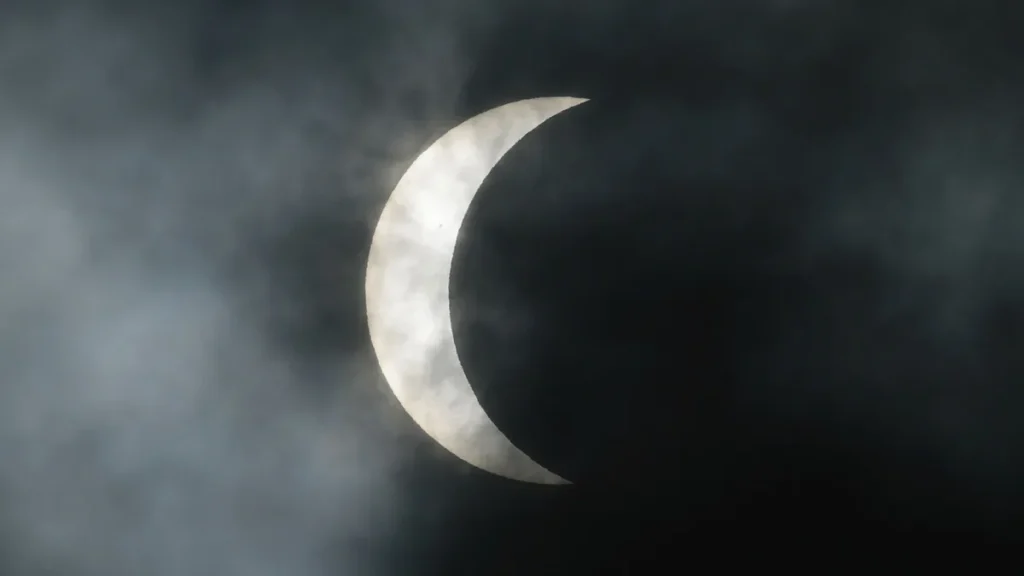
Astrophotographer Alexandre Tournay set up near Brussels on Aug. 12, 2026, to photograph the Moon crossing the solar disk during a solar eclipse.
Totality reached parts of Iceland, Portugal and northern Spain on Aug. 12, 2026, and in northern Spain the total phase lasted less than two minutes, arriving late in the day with the Sun low in the sky. Much of western Europe saw a substantial partial eclipse, while Brussels lay outside the path of totality.
Tournay traveled to the Brussels area specifically to document the eclipse, hoping to record the Moon’s silhouette moving across the face of the Sun as seen from western Europe. He deliberately positioned himself near a local airport because he wanted an aircraft to cross the Sun during the eclipse, combining the celestial event with a terrestrial one. By choosing a site close to an airport, he increased the odds of capturing a plane in front of the partially eclipsed Sun.
Against the odds, an aircraft crossed the partially eclipsed solar disk, leaving a contrail behind it as Tournay photographed from near Brussels. Tournay said, “Against the odds, one did, passing across the partially eclipsed solar disk with its contrail trailing behind it.” Flight tracking data identified the aircraft as Cargolux 5933, a Boeing 747 freighter traveling from Mexico City to Luxembourg on Aug. 12, 2026, and Tournay used flight tracking to confirm the plane in his frame. The aircraft appeared at just the right moment, streaking across the partially covered Sun.
Tournay said his eclipse image needed a more elaborate workflow than ordinary frame stacking because that approach brings out solar chromosphere detail but would oversharpen the airplane and Moon edges. Standard solar imaging stacks many video frames to reveal the roiling surface of the Sun, but that technique would make the aircraft and Moon edges look too sharp, so Tournay changed his method. To make the picture, he combined a stack of 1,000 solar frames with one separate frame that kept the silhouettes sharp and stopped the motion of the aircraft and Moon against the disk.
He named his eclipse photograph “Phaethon’s Flight” after Phaethon, the figure in Greek mythology who tried to drive his father Helios’s Sun-bearing chariot across the sky. The myth tells of Phaethon begging Helios to drive the Sun chariot, losing control, and being killed by Zeus. Tournay connected the ancient tale to a modern machine crossing the eclipsed Sun, and he called it fascinating to record with contemporary gear a sky occurrence that earlier peoples could comprehend solely through myth. The lucky aircraft transit made the Phaethon tale seem right, comparing the plane to a modern chariot pulling the eclipse through the sky.
For the Aug. 12, 2026 total solar eclipse, 178 Smithsonian Journeys travelers and nine experts gathered in northern Spain inside the path where the Moon fully covered the Sun. Smithsonian Journeys ran a six-day astronomy, wine, and culture program around the eclipse, lodging travelers at Spanish wineries inside the path of totality. The travelers split into nine small groups at two wineries on Aug. 12, 2026, for eclipse-day festivities and sky-gazing.
Visitors reached the wineries by different routes: some came from Basque Country to vineyards near León, while others traveled to Ribera del Duero through Madrid and the World Heritage locations of Segovia and Ávila. The two eclipse-watching wineries were Finca Torremilanos, a century-old biodynamic bodega in Ribera del Duero, and Bodega Gordonzello in the León wine region. Finca Torremilanos makes biodynamic wines, while Bodega Gordonzello focuses on native Spanish grape varieties, and both offered tours, tastings, and unobstructed views for the eclipse.
On Aug. 12, 2026, viewers in northern Spain put on eclipse glasses at about 7:30 as the partial eclipse began. Observers put on protective eyewear at the start of the partial phase before the Moon moved farther across the Sun.
Traveler David T. said the group had perfect weather for viewing the Aug. 12, 2026 eclipse in northern Spain. David T. said, “And we were blessed with perfect weather for the viewing.” He watched from Gordonzello and said the social atmosphere and clear skies made the eclipse experience better than expected. Vivian B. said she loved watching the eclipse away from crowds at a winery with telescopes and a TV showing solar flares and every minute of the event.
Tour operator Jennifer Kefer said the two wineries sat in the path of totality and offered unobstructed views of the western sky, calling the sites perfect because both lay in the path with clear sightlines toward the west. Traveler Krisha Tripuraneni took a video capturing the period of totality and the excitement it caused during the northern Spain eclipse, and Smithsonian published traveler footage showing the totality phase and the excited reaction of the group.
Smithsonian held panel discussions with astronomers and other experts at each winery as a prelude to the evening eclipse. The experts included astronomers, astrophysicists, and planetarium directors who traveled with the groups and added insight before the eclipse. Traveler Abigail J. said the Smithsonian eclipse experts were available and knowledgeable, and she learned more than expected about the eclipse, astronomy, and space. The tour included nine experts in astronomical fields who joined the travelers in northern Spain, and Abigail J. praised their accessibility.



Join the discussion