Key facts
- Researchers define the conventional habitable zone as the orbital band where Earth-like worlds wrapped in CO2-H2O-dominated greenhouse atmospheres can maintain liquid surface water.
- Assessing whether aqueous reservoirs can support life depends heavily on their specific chemical makeup.
- Liquid water is present on Earth and multiple other planetary bodies throughout the solar system.
- The paper ends by identifying key questions that future research on planetary habitability should address.
Astrobiology Web reported that researchers published a Nature Communications study on Nov. 23, 2026, comparing the chemistry of liquids on early Mars, dwarf planet Ceres, Europa, Enceladus and Titan.
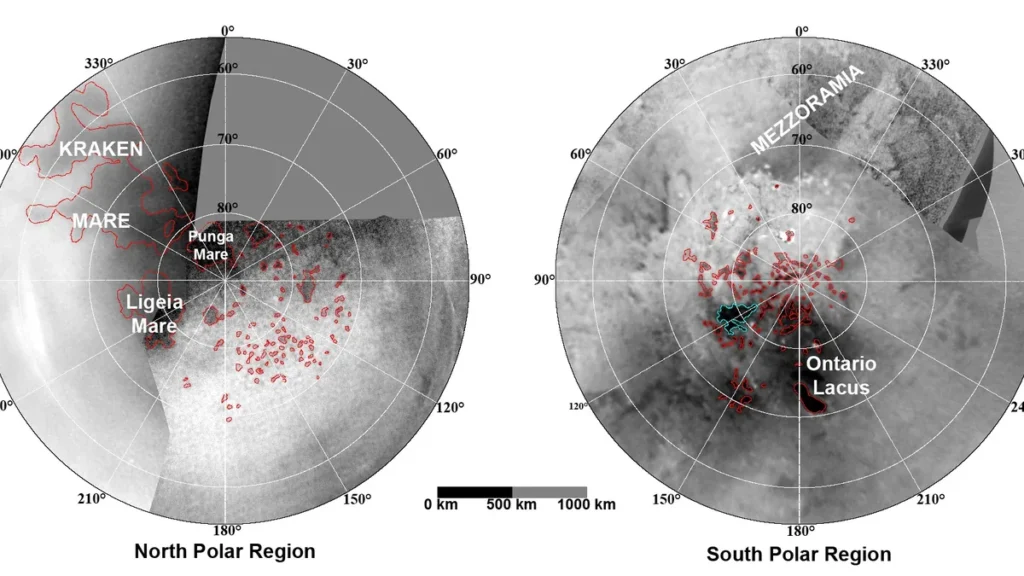
The study estimates the chemical makeup of liquids thought to exist on early Mars, dwarf planet Ceres, Jupiter’s moon Europa and Saturn’s moons Enceladus and Titan. These bodies are treated as candidates because their water chemistry helps determine whether hidden or ancient oceans could support biology. Identifying their chemical traits supports efforts to prioritize targets in the search for life beyond Earth.
Scientists have found subsurface oceans and liquid-water reservoirs on dwarf planets and icy moons in the outer Solar System, broadening views of planetary habitability beyond the classical habitable zone. The authors argue that small icy worlds with liquid water below the surface can be habitable even without surface water. Heat from inside these bodies can keep the reservoirs liquid without sunlight.
The conventional habitable zone is the orbital band where Earth-like planets with CO2-H2O-dominated greenhouse atmospheres can keep liquid water on the surface. This definition is narrower than optimistic versions that would stretch the zone from early Mars to recent Venus. The classical version focuses on surface conditions maintained by greenhouse gases.
The potential for life in aqueous reservoirs depends heavily on the specific chemical makeup of the water. Earth serves as the chemical baseline in the paper, which describes modern ocean chemistry and its relationship to life before examining other worlds. The study’s approach centers on the link between composition and biology.
Earth and multiple other planetary bodies throughout the solar system hold liquid water. Having liquid water across several worlds gives researchers a starting point for comparing aqueous chemistry and judging habitability. That premise underpins the study’s survey of the solar system.
Optimistic definitions would extend the Solar System’s habitable zone from early Mars to recent Venus. That broad reach differs from the narrower classical definition, which rests on Earth-like planets and surface liquid water maintained by greenhouse gases. It broadens the places where scientists might look for habitable conditions.
Internal heat sources power this broader habitability concept by keeping water liquid inside planets or in below-surface reservoirs. Oceans below the surface on icy moons and dwarf planets stay liquid thanks to internal body heat instead of sunlight. That makes potentially habitable conditions possible far from the star.
The study brings together data on Earth’s water-reservoir chemistry and what that chemistry means for life today. Modern ocean chemistry on Earth provides the reference point for understanding how water composition relates to biological activity. Researchers then compare this baseline with conditions inferred elsewhere in the solar system.
The authors also chart limits on changes in Earth’s ocean chemistry over time and its interaction with living organisms. Piecing together changes in Earth’s ocean chemistry over geological time reveals how the oceans and life have shaped each other. That history gives context for assessing chemical environments on other worlds.
The study closes by pointing to key questions for future research on planetary habitability. The authors reviewed Earth’s ocean history. They also considered the inferred ocean chemistry of Mars, Ceres, Europa, Enceladus and Titan. Those questions aim to guide the next stages of research into planetary habitability, and readers can access the open-access Nature Communications paper The chemistry of habitable oceans in the Solar system through PubMed.




Join the discussion