
Key facts
- Researchers at the University of Ottawa tested the CCC+TL cosmological model between 2025 and 2026 and found it consistent with several major astronomical observations.
- A Big Bang nucleosynthesis test found the model's predicted abundances of hydrogen, helium and other light elements matched standard-framework calculations.
- Under Lambda-CDM the universe was about 300 million years old at cosmic dawn, while CCC+TL places it at roughly 4.6 billion years old at the same observed redshift.
- The model also agreed with cosmic chronometer measurements, which trace the expansion history of the universe by comparing how old galaxies are at different distances.
University of Ottawa adjunct professor Rajendra Gupta and postdoctoral researcher Nikolaos Samaras tested the CCC+TL cosmological model between 2025 and 2026 and found it consistent with major astronomical observations. The University of Ottawa released materials about the research on November 11, 2026. Their results appear in a Monthly Notices of the Royal Astronomical Society paper.
CCC+TL stands for covarying coupling constants plus tired light (light loses energy over vast distances). It proposes a universe about 26.7 billion years old, nearly twice the standard 13.8-billion-year estimate, without dark matter or dark energy. The 26.7-billion-year figure is nearly twice the widely accepted 13.8-billion-year age, which rests on Planck satellite cosmic microwave background results from 2013 and 2018 plus Atacama Cosmology Telescope measurements in Chile that fit Lambda-CDM. Gupta first put the universe’s age at 26.7 billion years in a 2023 paper, potentially explaining the Methuselah star, for which some age estimates exceed the universe’s age.
In CCC+TL, only quantities measured in units of length change together through a shared scaling function over cosmic time, while dimensionless constants stay fixed. Those constants govern how particles and forces interact. The model attributes effects normally assigned to dark matter and dark energy to changes in fundamental physical constants over time. In the framework, the shared scaling function alters length-based quantities while leaving dimensionless constants unchanged, preserving the standard Big Bang nucleosynthesis predictions even as it puts the universe’s age at 26.7 billion years.
CCC+TL modifies Einstein’s field equations for general relativity and the Friedmann-Lemaître equations for cosmic expansion. The researchers could not simply adjust standard computer models because the framework changes the mathematics of gravity and expansion. They wrote model-specific equations and programs for each test.
The team ran a Big Bang nucleosynthesis consistency test. Its predicted abundances of hydrogen, helium and other light elements matched standard-framework calculations. “A central requirement for any alternative cosmology is that it preserves the key empirical successes of standard Big Bang nucleosynthesis,” Samaras and Gupta said. The paper “A Big Bang Nucleosynthesis Consistency Test of the CCC TL Cosmology,” published in Universe, 2026; 12(7):193, with DOI 10.3390/universe12070193.
Samaras and Gupta concluded the CCC+TL model is consistent with primordial helium and other light-element observations.
CCC+TL also agreed with cosmic chronometer measurements, which trace expansion history by comparing how old galaxies are at different distances. These measurements provide an independent check on the changing expansion history of the cosmos across billions of years.
In a Monthly Notices of the Royal Astronomical Society study, the researchers examined all 175 galaxies in the SPARC database and reproduced their rotation curves without dark matter. Rotation curves track orbital speeds of stars and gas at different distances from galactic centers. Under conventional gravity, visible matter alone generally cannot explain those motions, which is one of the major reasons scientists believe dark matter exists.
CCC+TL attributes the Bullet Cluster’s extra gravity to the galaxies instead of the hot gas, with no dark matter involved. The Bullet Cluster is a pair of merging galaxy clusters from which Vera C. Rubin derived much of the evidence for dark matter. The hot gas in the cluster emits X-rays and holds most of the ordinary matter, while observations tie much of the gravity to the galaxies instead. Standard cosmology says unseen dark matter passed through the collision alongside the galaxies.
The researchers call the Bullet Cluster result only an initial proof of concept and say more detailed investigations are necessary. Alongside postdoctoral researcher Utkarsh Kumar, Gupta and Samaras applied the model to supernova time-dilation observations in a separate study still pending review. The effect stretches distant events in time as seen from Earth, and their analysis offered support for the model while the paper remained under review.
The older timeline places the universe at roughly 4.6 billion years old at cosmic dawn, compared with about 300 million years under Lambda-CDM at the same observed redshift. That gives early galaxies billions of years to form and mature. The researchers say work in Galaxies 13, 115 shows early galaxies would be about 12 times larger than standard cosmology predicts, for both size and mass.
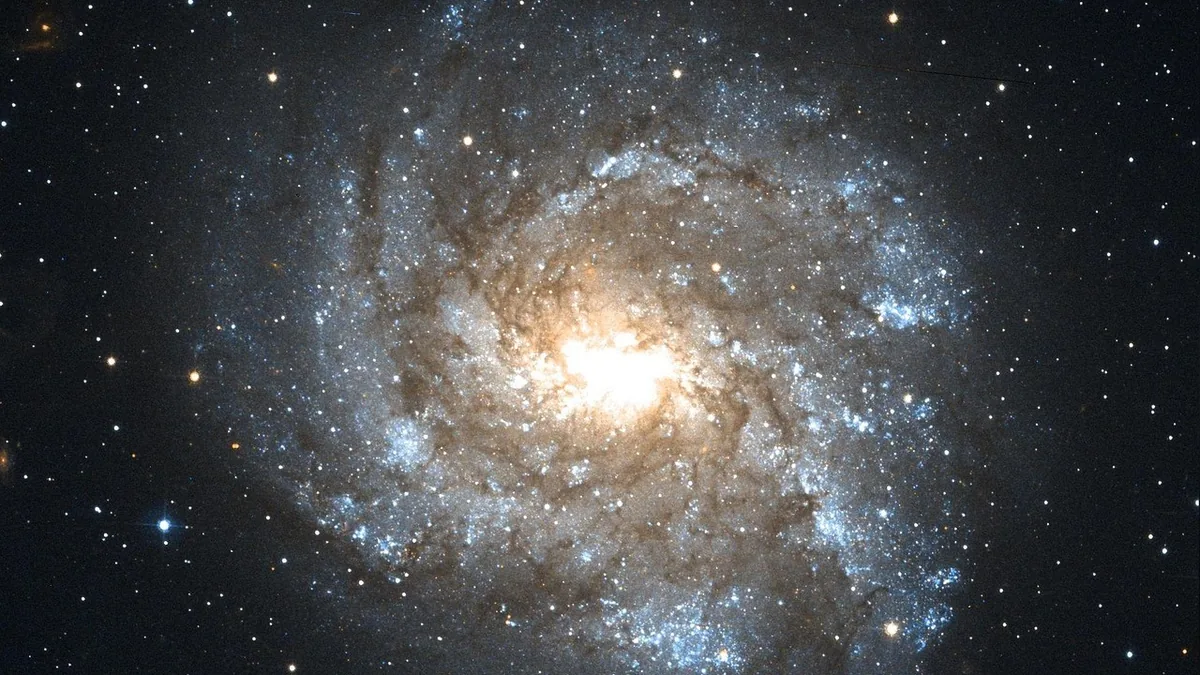
James Webb Space Telescope observations revealed mature galaxies in the early universe, challenging Lambda-CDM and renewing interest in alternatives such as Modified Newtonian Dynamics and CCC+TL. At that point in cosmic history, conventional cosmology says such galaxies should only be starting to form. Gupta predicts galaxies exist well beyond the distances the telescope has reached, calling early galaxies predictable rather than impossible under the new model.
The telescope’s GLIMPSE program GO 3293 will use NIRCam and gravitational lensing aimed at the Abell S1063 galaxy cluster to study early galaxy formation and cosmic reionization. The ultra-deep observation probes an exceptionally early period and aims to search for distant galaxies, potentially reaching redshifts greater than 50. According to conventional models, there may not have been enough time for large galaxies to assemble at extreme redshifts, while CCC+TL imposes no such restriction because its timeline allows more time for galaxies to develop. Gupta says the program offers a chance to test his prediction of galaxies beyond JWST’s current reach.
CCC+TL remains outside the mainstream and requires further independent examination. Lambda-CDM continues to explain a broad range of observations, and any replacement must show comparable or greater success. A yet-to-be-published Cosmic Microwave Background challenge still awaits the model. The researchers describe the results as encouraging but unconventional.
Gupta says their findings meet that yet-to-be-published Cosmic Microwave Background challenge. The researchers tested CCC+TL against nucleosynthesis, cosmic chronometers, SPARC galaxies, the Bullet Cluster and supernova time dilation, and Gupta frames the results as clearing a CMB test that has not yet appeared in print. “Most emerging models explain only a limited set of observations,” Gupta said.
The standard 13.8-billion-year age comes from the European Space Agency’s Planck satellite cosmic microwave background results released in 2013 and finalized in 2018, matched by Atacama Cosmology Telescope observations in Chile. Both the Planck and Atacama results fit Lambda-CDM, and that standard age relies on the two unseen components, which have never been directly detected. By the 1970s scientists accepted dark matter, with Vera C. Rubin’s work making it official, and by the 1990s Hubble deep field observations led to the Lambda Cold Dark Matter model. Dark matter supplies extra gravity for galaxy motions and large cosmic structures, while dark energy is the name given to whatever causes the expansion to accelerate, and no direct detections of either exist despite decades of research.
In 1929 Edwin Hubble found that more distant galaxies show greater redshift, taken as evidence of expansion, and Fritz Zwicky proposed tired light. Most cosmologists set tired light aside decades ago, but Gupta has revived a version of it within CCC+TL, arguing the effect runs alongside cosmic expansion rather than replacing it. Tired-light models do not explain time dilation, but Gupta argued in earlier papers that CCC+TL gets around those objections. In Lambda-CDM, ordinary matter gathered inside haloes of dark matter to form galaxies, while CCC+TL abandons both dark matter haloes and dark energy hypotheses.
Gupta proposes in a separate paper that observations attributed to dark matter and dark energy likely originate from covarying coupling constants. “Observations attributed to dark matter and dark energy likely originate from covarying coupling constants,” Gupta said. This is an argument beyond the observational tests, exploring where the two dark components come from in a separate paper by Gupta.
If further research supports the findings, the theory could offer a very different explanation for how the Universe evolved. The theory could address the puzzle of galaxies that look large and mature at a time when conventional cosmology says they should barely have started forming. By the 1990s, Hubble deep field observations led scientists to theorize dark energy, a powerful cosmic force driving expansion. Dark matter acceptance by the 1970s and dark energy theorizing in the 1990s became part of Lambda-CDM, the predominantly accepted model.
Join the discussion