Key facts
- Dominion Dynamics is designated as the prime contractor for the project, while Telesat LEO, a subsidiary of Telesat Corporation, serves as subcontractor.
- The $2.2 million covers phase-one development and contains a National Research Council of Canada Industrial Research Assistance Program contribution to Dominion Dynamics.
- Dominion plans two post-phase prototypes: one small enough for a dismounted soldier to carry and another larger unit for uncrewed systems such as Dominion Scout.
- The equipment is meant for Arctic and expeditionary use, powered by tactical sources and built with open interfaces to work with current military hardware.
Dominion Dynamics and Telesat unveiled a $2.2-million effort on Nov. 19, 2026 to develop ruggedized antennas built for Arctic use, intended to link dismounted soldiers and uncrewed military platforms with Telesat’s Lightspeed low Earth orbit constellation. The companies named the Canadian Armed Forces as the first customer for the terminals, with other government organizations possible future users. The joint release announcing the work is dated Nov. 19, 2026.
As prime contractor, Dominion Dynamics will take responsibility for executing the project, while Telesat LEO ULC, a subsidiary of Telesat Corporation, acts as subcontractor in a supporting role. The first development phase receives $2.2 million in funding and contains a contribution from the National Research Council of Canada‘s Industrial Research Assistance Program to Dominion Dynamics. That federal program helps companies pay for research and development. Via Satellite reported the funding as $2.2 million Canadian dollars, equal to $1.5 million U.S. dollars.
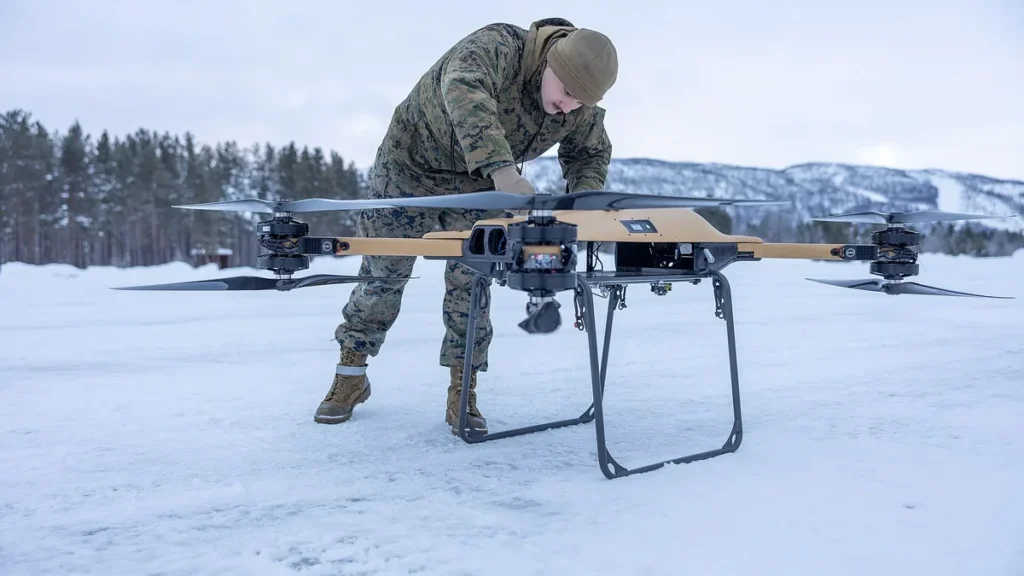
After phase one, Dominion intends to build two prototypes. One would be small enough for a soldier to carry on foot, and the other would be a larger unit meant for uncrewed systems, including Dominion Scout. The prototypes mark the next stage of the work, with one unit meant for dismounted operations and the other supporting uncrewed military aircraft.
Scout is an uncrewed combat aircraft that Dominion calls Canada’s first sovereign Autonomous Collaborative Platform. Presented by Dominion as a sovereign Canadian autonomous platform, it is tied to future fighter operations and designed to add capability to Canada’s future fighter fleet.
The equipment is meant for Arctic and expeditionary use, reflecting demands placed on military users in remote and harsh environments. It would draw on tactical power sources and use open interfaces intended to simplify integration with current military hardware. The antennas are meant to securely connect dismounted operators and uncrewed platforms to the Lightspeed constellation. Testing planned for after the prototypes are built will include cold-weather field trials plus connectivity checks over the Telesat Lightspeed service, verifying cold-weather performance and satellite connectivity.
The companies are seeking a communications link from the Arctic to command centres under Canadian control, with intellectual property kept inside the country. They described the work’s central goals as domestic control of communications and intellectual property.
Telesat Corporation trades on Nasdaq and TSX under the ticker TSAT, and the company is described as among the largest satellite operators in the world. Its network is built around open standards and relies on software-defined architecture working across commercial and military Ka-band spectrum, a range of radio frequencies used for satellite communications. Telesat points to nearly 60 years of innovation, along with engineering excellence, as its background.
The first two Lightspeed satellites are set to launch no earlier than June 2027, followed by 15 production satellites no earlier than September, with no year specified for the later flights, Telesat disclosed with its third-quarter results. Telesat expects commercial service at high latitudes to begin near the close of the first quarter of 2028, after the initial satellite deployments, a schedule that determines when the network can support terminal trials.
Dominion Dynamics was founded in 2025. The Ottawa-based defence technology firm works on autonomous systems, sensing and communications, plus command and control, serving Canada and allied countries. Dominion has fielded AuraNet with Canadian military personnel working in the High Arctic. Months before the Telesat partnership, Dominion completed its $139-million Series A financing, SpaceQ Media Inc. reported, with the round intended to increase manufacturing capacity and grow the engineering team.
Mitch Carkner, Dominion Dynamics’ chief operating officer, said that people on patrol in remote areas, as well as uncrewed systems, should connect to a Canadian network using domestically built equipment, tying the gear to national connectivity and domestic manufacturing priorities. Stephen Hampton, a Telesat vice president, described the deal as evidence that Canada’s defence industrial base is growing stronger. Mélanie Joly, who is Canada’s industry minister, welcomed the initiative as evidence that public research funding helps Canadian firms build technology for isolated northern regions.
Jenna Sudds, the Member of Parliament for Kanata, said the collaboration points to the strength of the area’s technology and defence sector and supports national security, sovereignty and defence capabilities. She linked the partnership to local innovation in Ottawa-Kanata and national defence priorities. “This is exactly the kind of innovation and collaboration we need to build Canada strong,” Sudds said.
Carkner said the technology may additionally help the Canadian Rangers and Canadian Coast Guard, along with the Royal Canadian Mounted Police and High North emergency management. He listed those applications while explaining the project’s potential beyond the Canadian Armed Forces.



Join the discussion