Key facts
- The simulated Martian atmosphere used 95% CO2, 2.7% N2, 1.6% Ar, and 0.15% O2 at 6 mbar pressure.
- A generalized linear model found simulant, radiation, and their interaction were significant predictors of tardigrade survival at p less than 0.001, while atmospheric conditions were not significant.
- The LD50 value for X-rays was about 650 Gy in unwashed Mars global simulant-1 for anhydrobiotic Ramazzottius cf. varieornatus.
- Washing Mars global simulant-1 raised the LD50 to 2090 Gy, still below the control LD50 of 3020 Gy.
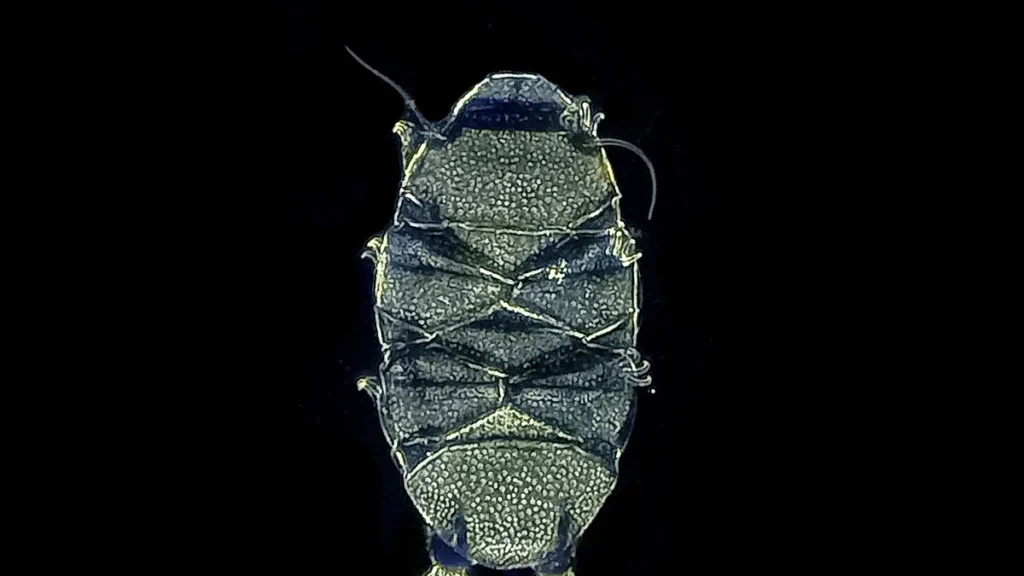
Researchers tested whether anhydrobiotic tardigrades — dried animals able to survive without water — of the species Ramazzottius cf. varieornatus could endure Martian-style air, X-ray radiation and Mars global simulant-1 regolith, the loose rock and dust that blankets a planetary surface, for as long as 28 days, according to a study published Nov. 19, 2026 in the journal Astrobiology.
The study found that survival in control samples of terrestrial atmosphere and sand with zero radiation remained constant from setup to completion, and researchers used that constant survival as the baseline for measuring the effects of the Martian simulant — imitation Martian surface material — radiation, and their interaction. A generalized linear model — a statistical method that tests which factors predict an outcome — found that the simulant and the radiation, alone and together, predicted tardigrade survival at p less than 0.001. Atmospheric conditions were not significant predictors.
According to that statistical result, survival hinged more on the regolith material and X-ray exposure than on the makeup of the Martian air. The study found that the LD50, the radiation dose that kills half a population, was about 650 Gy for X-rays in unwashed Mars global simulant-1, with Gy the unit of absorbed radiation dose. At that radiation level, half of the dormant tardigrades embedded in the raw Martian regolith simulant died.
Washing the simulant raised the LD50 to 2090 Gy, still below the control figure of 3020 Gy measured with terrestrial sand and no radiation. The comparison shows washing cut the simulant’s harm without bringing radiation tolerance back to the terrestrial-sand level.
The study’s authors said the data complement earlier work showing the extreme hardiness of anhydrobiotic tardigrades, and support a high likelihood that ultraviolet-shielded tuns survive on Mars. Tuns are the animals’ dried, dormant form. The authors link these results to wider expectations that dormant tardigrades can survive in shielded Martian settings.
An earlier study co-led by Corien Bakermans, professor of microbiology at Penn State Altoona, found that tardigrade activity dropped in simulated Martian regolith. It appeared in the International Journal of Astrobiology on Dec. 5, 2025, and used simulants modeled on material NASA’s Curiosity Rover sampled at the Rocknest deposit in Gale Crater.
With MGS-1 simulant, significant inhibition of tardigrade activity — reduced activity — appeared within two days, and exposed tardigrades displayed no activity after only two days, Bakermans said. OUCM-1 also inhibited activity, though less damaging than MGS-1. “For the MGS-1 simulant, we saw significant inhibition – reduced activity – within two days,” Bakermans said.
Washing MGS-1 with water before introducing tardigrades mitigated the harm to their activity, and that tardigrades mixed with rinsed MGS-1 showed almost no reduced activity, Bakermans said. She said the rinse removed something damaging that dissolves in water — possibly salts or another compound — a water-soluble component, though she noted water is scarce in space.
The earlier release described planetary protection as shielding extraterrestrial bodies from Earth contaminants, along with the reverse, a practice regulated by space agencies including NASA. Countries agreed to the practice. The practice applies in both directions: keeping Earth organisms off other worlds and keeping extraterrestrial material from contaminating Earth.
The release said MGS-1 came first as a global Mars regolith simulant, while OUCM-1 came later to imitate the specific Rocknest sampling area. Both simulants copy the regolith Curiosity gathered at Gale Crater, which lies south of the Martian equator.




Join the discussion