Key facts
- Voyager 2 took a slower track past Jupiter, Saturn, Uranus and Neptune and will reach one light-day of distance in 2035.
- Voyager 2 launched 16 days before Voyager 1.
- Voyager 2 crossed into interstellar space in November 2018.
- NASA turned off the Cosmic Ray Subsystem on Voyager 1 on Feb. 25, 2025, and the Low-Energy Charged Particle instrument on April 17, 2026.
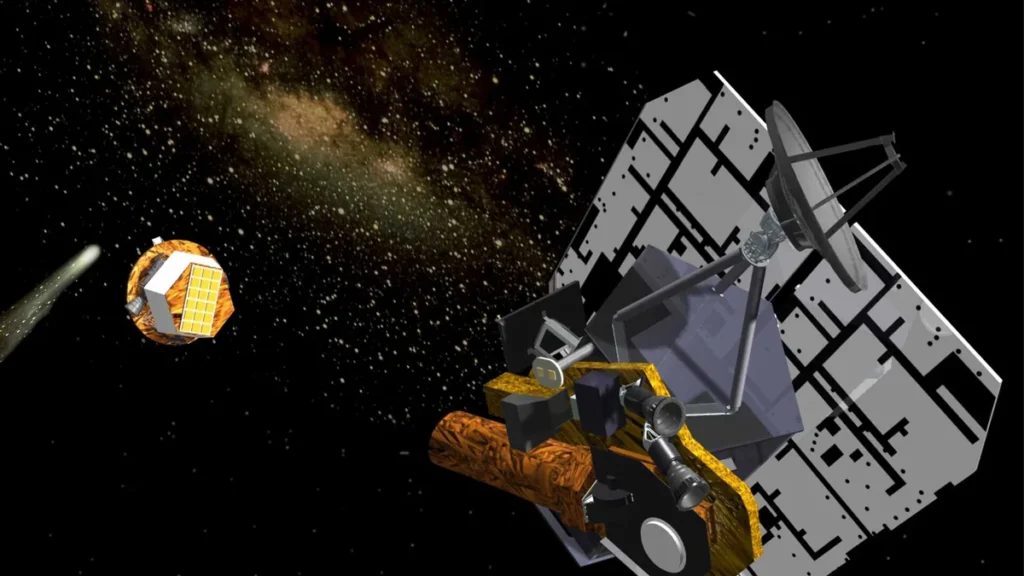
Voyager 1 reached the one-light-day distance from Earth on Nov. 18, 2026, becoming the first human-made object to travel that far from our planet at 5:16:07 a.m. EST, or 10:16:07 UTC. At that mark, the spacecraft was about 16.1 billion miles (25.9 billion kilometers) from Earth, and light needed 24 hours to cross the gap, so a radio signal between Voyager 1 and NASA’s Deep Space Network takes more than a day in either direction. One light-day equals 25.9 billion kilometers or about 16.1 billion miles, the distance light travels in a single day at approximately 186,282 miles per second. NASA’s Jet Propulsion Laboratory said the crossing would not produce any physical change in the spacecraft, but it arrived at a delicate moment as power supplies shrink and the probe operates with two working science instruments while speeding away from the sun at nearly 38,000 mph. NASA said the voyage from the September 1977 launch took 49 years, two months and 11 days, and Voyager 1 has flown at a steady 37,763 mph since a Saturn gravity assist in 1980. Voyager 1 entered interstellar space in August 2012 and is still gathering data, and Voyager 2 joined it there in November 2018; both now move through the zone beyond the sun’s particle stream where conditions shift to those between the stars. Voyager 1’s faster path brought it to the one-light-day mark on Wednesday, Nov. 18, while Voyager 2 trails behind and will reach the same distance in 2035, more than eight years later. Voyager 2 launched 16 days before Voyager 1 but took a slower route past Jupiter, Saturn, Uranus and Neptune. As of Wednesday, Voyager 2 was still more than 13.4 billion miles from Earth, with messages to the spacecraft taking about 20 hours to arrive. Suzanne Dodd, project manager for the Voyager missions at JPL, said current science investigates magnetic field strength and direction, plasma density, and energetic particle detection, and she emphasized the importance of measuring how these phenomena change as the spacecraft travels farther from the sun. Linda Spilker, the JPL project scientist, said researchers are studying how far the sun’s influence reaches out to Voyager 1 in interstellar space, and the team hopes to observe the spacecraft’s magnetic field shift direction as it moves from solar influence to interstellar space. Voyager 1 now has two working science instruments, following the shutdown of the Cosmic Ray Subsystem on Feb. 25, 2025, and the Low-Energy Charged Particle instrument on April 17, 2026; eight of the 10 instruments from launch are no longer operating. Each Voyager loses 4 watts of power per year, and after 50 years in space Voyager 1’s three radioisotope thermoelectric generators now produce about 215 watts, converting heat from decaying plutonium-238, with output dropping by about 4 watts a year according to JPL. In early September, engineers replaced three power-consuming devices with lower-power alternatives in an operation nicknamed the Big Bang, and without it another instrument might have been switched off as early as summer 2027. Based on current power use and decay, Voyager 1 should turn off its last science instrument in the 2030s and fall silent in 2036 when power can no longer carry a radio signal to Earth, though JPL’s team thinks communications can last into the early 2030s. Dodd said the team does not expect major operational changes until after each spacecraft marks its 50th anniversary next August and September, and power margins remain very thin because the spacecraft are cold in interstellar space. A JPL representative said the Big Bang should keep remaining science instruments going until after the 50th anniversary, although the thermal state of the spacecraft must also be balanced. Last month Voyager 1 suddenly stopped responding to commands in an approximately 48-hour glitch before quickly recovering. On Oct. 18 and 19, the Deep Space Network failed to detect Voyager 1’s signal on two scheduled attempts 24 hours apart, and contact resumed Oct. 20. Engineers determined one group of thrusters had gone offline and the fault protection system switched to backups, but as of JPL’s Oct. 29 update the cause was still under investigation. Badaruddin said this was the first time the team had seen the spacecraft do something like this. Kareem Badaruddin, Voyager’s interstellar mission manager, is one of just three full-time team members keeping the aging Voyagers healthy and on course, and he compared the mission to a relay race, saying he is just carrying the baton for now. Junior team members Nshan Kazaryan and Bhavana Gupta are taking on key roles in anticipation of more responsibility. Alan Cummings, a senior research scientist at Caltech, worked on Voyager’s Cosmic Ray Subsystem since before the twin spacecraft departed Florida in 1977 and was the last person to touch Voyager 1 before launch. Cummings said the one-light-day achievement was not a scientific milestone but an engineering milestone, praising the JPL engineers who built the spacecraft with redundancy and the Deep Space Network engineers who collect data and send commands. Voyager 1 beams data to Earth from its 12-foot-wide antenna using a transmitter with roughly the power of a 23-watt light bulb, and the Deep Space Network collects the data and sends commands across the growing distance. Both Voyagers are always Earth-pointed, always telemetering, and always downlinking science data, which is unusual because most spacecraft turn back and forth between observation and downlink periods, and none of the Voyager instruments require pointing, according to Badaruddin. Voyager 1 flew past Jupiter in March 1979 and Saturn in November 1980, and a close flyby of Saturn’s moon Titan bent its path up and out of the plane of the planets, sending it beyond the plane of the solar system in the early 1980s. That trajectory allowed the probe to image several of Saturn’s other moons and discover new ones. On Feb. 14, 1990, Voyager 1 turned its cameras back for a final family portrait of the solar system including the Pale Blue Dot image, then shut off its cameras for good, and Voyager 1 crossed the orbit of Pluto in 1989. On Feb. 17, 1998, it passed Pioneer 10 to become the most distant human-made object at a distance of 69.4 astronomical units from the Sun, a position it has held ever since. Voyager 1 crossed the heliopause on Aug. 25, 2012, at a distance of about 122 astronomical units, becoming the first spacecraft to reach interstellar space, and Voyager 2 followed in November 2018. Cummings’ instrument provided clear evidence of the crossing, with low-energy ions from inside the heliosphere disappearing and cosmic rays from outside abruptly increasing in a 2013 Science paper. The Voyagers have upended predictions about the magnetic field beyond the heliopause because its direction did not rotate to the expected interstellar orientation, and models suggest the field will not fully align with that orientation for hundreds of astronomical units, according to a 2026 study by members of the Voyager magnetometer team. The team continues to measure the magnetic field gradually as Voyager 1 travels farther into interstellar space. In the summer of 2027, Voyager 1 and Voyager 2 will each reach 50 years in space, with Voyager 1 marking the date on Sept. 5 and Voyager 2 on Aug. 20. Voyager 1 traveled about 16 billion miles (26 billion kilometers) at the one-light-day mark, more than four times the distance from the Sun to Pluto. Within the next decade, scientists may receive the last signal ever from Voyager 1, and Voyager 1 is now almost one light-day away from Earth, still just a fraction of a light-year. At 37,844.49 mph (60,773 kmh), Voyager 1 will take another 300 years to encounter the Oort Cloud and another 30,000 years to pass through it, though it will lose all of its power before reaching the beginning of the Oort Cloud. Voyager 1 carries a gold-plated copper phonograph record including greetings, messages, sounds, music, and encoded images of life on Earth, and the Voyagers will carry on billions of years after both power supplies run dry. Cummings said the Voyagers will be among the last pieces of evidence that humans ever existed on Earth. NASA invited the public to celebrate with a global Shine Bright for Voyager’s Light-Day event on Tuesday evening, Nov. 17, and created a website that flashes Voyager’s VGR call sign in Morse code. NASA’s website let visitors click a link, start the feature, and aim a phone or tablet at the sky as the page handled the rest, while JPL scheduled a moderated discussion on Thursday, Nov. 19, at noon ET with updates on both Voyager probes and a live question-and-answer session. Voyager 1 lifted off from Cape Canaveral, Florida, on Sept. 5, 1977, 16 days after its twin Voyager 2, launching from Launch Complex 41 on a Titan 3E-Centaur rocket, and each spacecraft is roughly the size of a small car with a magnetometer boom extending more than 50 feet (15 meters) to carry magnetic-field instruments. The spacecraft explored gas giants Jupiter and Saturn and returned images with higher resolution than predecessors Pioneer 10 and 11, and Voyager 2 would go on to explore Uranus in 1986 and Neptune in 1989. Voyager 1 flew within 4,034 miles (6,492 km) of Titan on Nov. 12, 1980, and returned images showing a world shrouded in a dense and substantial atmosphere. In December 2004, Voyager 1 crossed the termination shock, the outer boundary of the influence of high-energy particles making up the solar wind, and on Aug. 15, 2012, it left the protection of the Sun’s magnetic field, making it more susceptible to cosmic radiation. Failing memory, computer glitches, power issues, and challenges with an aging propulsion system led to several nail-biting moments over the past decade when scientists might lose contact forever. Voyager 1 is headed toward the star AC +79 3888 or Gliese 445, more than 17 light years from Earth, and is expected to pass within about 1.7 light-years of Gliese 445 in 40,000 years. NASA’s Deep Space Network is a set of three antennas for following distant missions, and the weather in the Goldstone, Australia region had been violent in recent weeks, creating unique problems for DSN operations. Senior team member Jack Lippincott provided critical knowledge of DSN operations and data interpretation and helped the team deal with those problems. The goal of the mission is science, so the team is concerned not just with keeping contact but with keeping science instruments going as long as possible. Each Voyager carries a 12-inch gold-plated copper Golden Record holding 115 images, spoken greetings in 55 languages, and about 90 minutes of music and sounds from Earth, and billions of years from now, once the sun expands and Earth is gone, the spacecraft will still be traveling with the record aboard.

Join the discussion