
Key facts
- Yahoo Tech reports the public light event on Wednesday, Nov. 18, 2026, at 2:16 a.m.
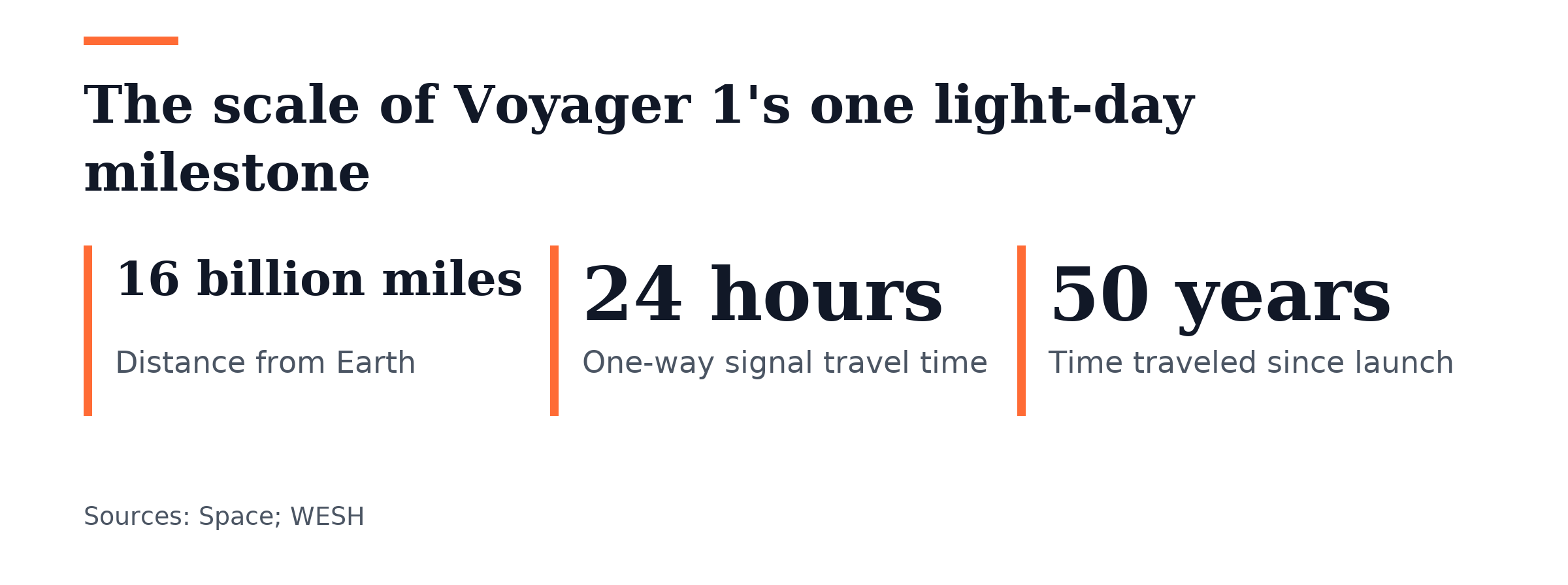
- One light-day equals roughly 16 billion miles or 26 billion kilometers, the span light covers in one day.
- Participants should repeat the Morse code sequence for about one minute.
- NASA created an automated flasher that opens on a phone or tablet browser to show the VGR sequence.
NASA is inviting people around the world to shine lights into the night sky after sunset on Tuesday, Nov. 17, 2026, for “Shine Bright for Voyager’s Light-Day.” Voyager 1 will reach one light-day from Earth on Wednesday, Nov. 18, 2026, placing it more than 16 billion miles away.
Yahoo Tech reports the public light event on Wednesday, Nov. 18, 2026, at 2:16 a.m. One light-day equals roughly 16 billion miles or 26 billion kilometers, the span light covers in one day.
NASA encourages participants to flash the spacecraft’s call sign, VGR, in Morse code using a flashlight, phone, bike light, or other portable light source. V is three quick flashes plus one long flash; G is two long flashes plus one quick flash; R is one quick flash, one long flash, and another quick flash. Participants should repeat the sequence for about one minute.
An automated flasher created by NASA opens on a phone or tablet browser to show the VGR sequence. People can capture their light signals in photos or video and post them online while tagging @NASA.
Voyager 1 launched on Sept. 5, 1977, and traveled for nearly 50 years as the most distant human-made object from Earth. The spacecraft entered interstellar space in August 2012 and still gathers data, according to NASA as reported by Yahoo Tech.
Yahoo Tech says the probe found an unknown ring at Jupiter plus seven moons. Voyager 1 was the first spacecraft to enter the heliosphere, where outside influences exceed the sun’s, according to NASA. Voyager 1 carries the Golden Record, a time capsule with songs, spoken greetings in 55 languages, natural sounds, and messages.
WESH reports that Voyager 1 departed on Sept. 5, 1977, shortly after Voyager 2, and after almost fifty years both craft remain active and are sending data home. The outlet calls it the most distant human-made object from Earth and says it was the first craft to reach interstellar space. It adds that some instruments were turned off to save power, yet the probe still returns useful data.
Voyager 2, the twin spacecraft, is expected to reach the same one-light-day milestone in November 2035 because the two probes took different routes through the solar system. According to Yahoo Tech, Voyager 2 left Earth two weeks after Voyager 1 in 1977 and will reach the one-light-day distance around November 2035.
The celebration is a symbolic tribute rather than an actual attempt to communicate with Voyager 1 because flashlight and phone signals cannot reach the probe. At one light-day, radio signals traveling at light speed take approximately 24 hours to reach Voyager 1, and NASA communicates with the spacecraft using its Deep Space Network of radio dishes.
Dr. Tiffany Kataria of NASA’s Jet Propulsion Laboratory in California joined WESH 2 to explain the milestone’s significance and the spacecraft’s discoveries and accomplishments. A moderated discussion takes place Thursday, Nov. 19, 2026, at noon Eastern Time, or 1700 GMT, at NASA’s Jet Propulsion Laboratory, with Voyager mission team members and NASA leadership.
Topics at the discussion include the status of both Voyager spacecraft, their continuing observations in interstellar space, and the difficulty of operating probes that are nearly 50 years old. NASA will preview a Voyager documentary planned for release in 2027, coinciding with the mission’s 50th anniversary.



Join the discussion