Key facts
- NASA's James Webb Space Telescope has observed massive galaxies with large-scale gaseous outflows that greatly reduce star production.
- Cosmic Noon occurred about 8 to 12 billion years ago, when star formation across the cosmos reached its highest rate.
- Outflows are large-scale movements of gas from a galaxy's interior to its exterior, typically driven by supernovae or powerful outbursts from supermassive black holes.
- In gas-rich galaxies, sufficiently cold gas collapses under its own weight to form dense clouds that produce new stars.
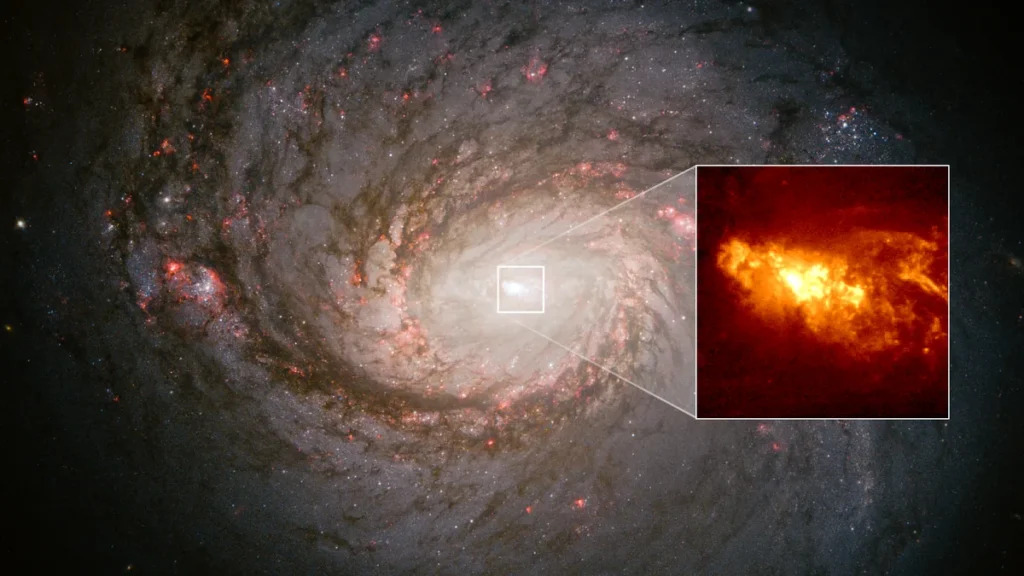
NASA’s James Webb Space Telescope observed massive galaxies from cosmic noon with large-scale gaseous outflows that greatly reduce star production, Universe Today reported Nov. 17, 2026.
Cosmic noon occurred about 8 to 12 billion years ago, when star formation across the cosmos reached its highest rate. Universe Today’s reporting defines cosmic noon as the epoch when the volume-averaged star formation rate in the universe peaked. The new paper in Astrophysics and Space Science uses JWST data to describe an observed relationship between outflows from a galaxy’s central core and the shutdown of star production during that era.
Outflows are large-scale movements of gas from a galaxy’s interior to its exterior, typically driven by supernovae or powerful outbursts from supermassive black holes. In gas-rich galaxies, sufficiently cold gas collapses under its own weight to form dense clouds that produce new stars. Such outflows likely take away large amounts of gas, which then cannot form new stars.
JWST showed that outflows driven by accretion onto supermassive black holes correspond to a quick shutdown or quenching of star formation. Rebecca Davies, lead author and astrophysicist at Swinburne University of Technology in Melbourne, said in an email that growing supermassive black holes at galaxy centers launch winds that expel gas that would otherwise form stars. She said JWST lets researchers gauge how much cold star-forming gas is expelled, allowing them to measure the cold star-forming gas expelled from galaxies.
Sirio Belli, an associate professor at the University of Bologna in Italy and a co-author, said in an email that JWST shows outflows are more abundant and powerful than previously thought, strongly affecting galaxy evolution. He described them as “outflows are more abundant and more powerful than we thought” and offered one possibility: a central supermassive black hole releases energy that removes or heats gas and prevents new star formation.
Rebecca Davies said quenching happens if a galaxy runs out of gas or cannot turn gas into stars because the gas has become too hot or turbulent to collapse. She said outflows appear frequently in massive galaxies during cosmic noon, though most are not quenching. Instead, they maintain equilibrium and stop galaxies from converting all their gas into stars too quickly.
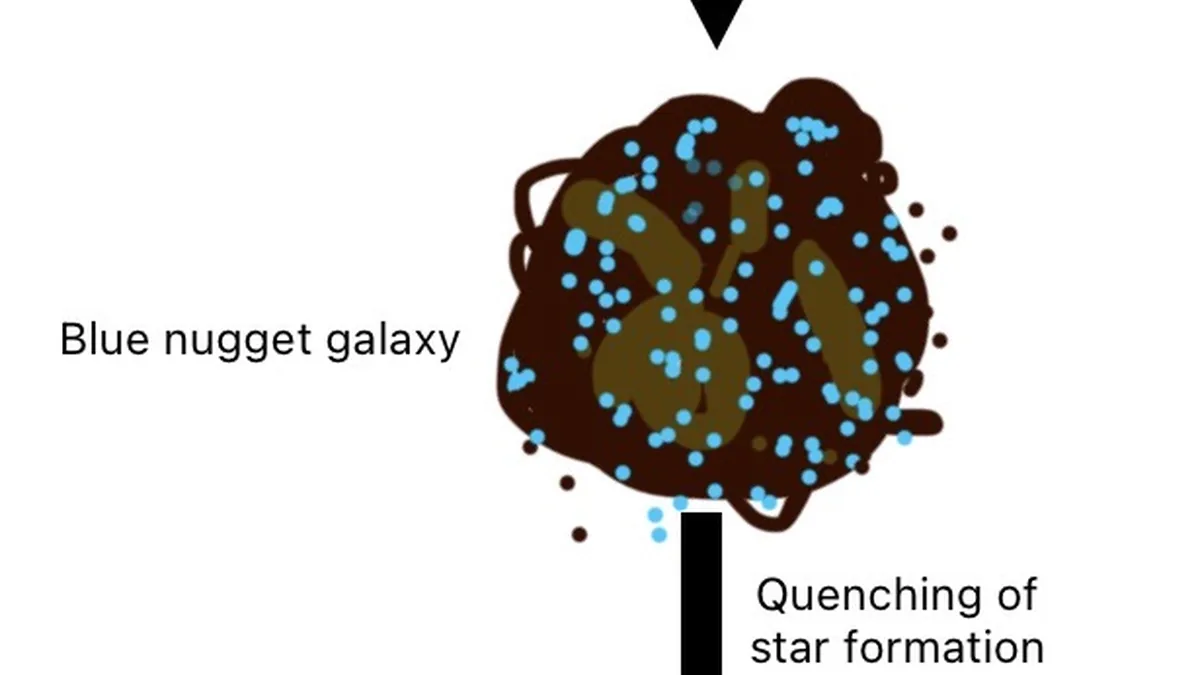
The trigger for outflows powerful enough to shut down galaxies remains unknown to researchers, and the reporting identifies this as a key open question in the field. Rebecca Davies said mergers between galaxies or radio jets from central supermassive black holes may trigger the most powerful outflows. Researchers have not confirmed which of these events drives the strongest ejections.
Sirio Belli said galaxy quenching ends the formation of new stars and planets, with strong repercussions on the likelihood of habitable systems developing. He said a quenched Milky Way at Cosmic Noon would likely have formed few new stars over the past 10 billion years, so our 5-billion-year-old solar system would not exist today. He also said excessively strong star formation creates problems such as stellar explosions that could harm planetary habitability. Researchers are only beginning to investigate how galaxy-scale processes affect the habitability of planetary systems, he said.
As massive galaxies age, their active galactic nuclei, the energized centers of galaxies, become quiescent, like Sag A*, the black hole at the center of the Milky Way. Rebecca Davies said the Milky Way’s black hole had a major flare a few million years ago, smaller outbursts a century or two ago, and flickers almost daily as hot gas swirls just outside it. The Milky Way’s black hole thus offers a nearby example of a center that has grown quieter after earlier, stronger activity.
For decades, astronomers have suspected that the internal dynamics of massive galaxies such as the Milky Way play a major role in regulating star formation. The article situates Earth on the outskirts of the Milky Way around a yellow dwarf star before turning to those galactic processes. The Webb results connect central black-hole activity to the shutdown of star production, giving astronomers observational support for a suspicion that has persisted for decades about how these galaxies evolve over time.


Join the discussion