This is a new development in a story we reported earlier: SpaceX readies Starship Flights 15 and 16 for upcoming test milestones.
Key facts
- Elon Musk said via X on Sunday evening, Nov. 15, that Starship V4 will be about 70 meters long, roughly a 40% length increase, and will allow more than 60% more propellant load.
- Musk said the V4 will have 9 engines, adding three more Raptor-Vacuum engines that are higher-thrust V4 engines.
- SpaceX recovered the Starship upper stage at its Texas launch tower for the first time on Saturday, Nov. 14, using the tower's chopstick arms.
- Musk said the V4 height is probably closer to 150 meters, making the next Starship nearly 500 feet tall.
Elon Musk said via X on Sunday evening, Nov. 15, that Starship V4 will be about 70 meters long, roughly a 40% length increase that allows more than 60% more propellant load.
The announcement followed the first Ship catch, which SpaceX achieved at its Texas launch tower on Saturday, Nov. 14, using the tower’s chopstick arms. The catch came during Flight 15, which launched Friday, Nov. 13 as the vehicle’s 15th test flight. Ship delivered its Starlink V3 satellite batch as planned during the mission, but Super Heavy hit a low-fuel alarm and splashed down in the Gulf of Mexico instead of catching.
The original plan had called for a double catch, with Super Heavy landing 6.5 minutes after launch and Ship circling Earth for 22.5 hours to deploy Starlink V3 satellites before returning. SpaceX had caught the Super Heavy booster on three previous flights, but had never attempted the Ship catch maneuver before Flight 15. The company called the recovery a first because the upper stage returns from orbit faster and hotter than a booster. The mission marked the first attempt to catch the Ship upper stage, following three prior Super Heavy booster catches.
Dan Huot said during SpaceX’s Ship-landing webcast on Saturday that catching a Starship was the missing link and that everything changes. Huot made the remark after the first recovery of the Ship upper stage at the launch tower. “We caught a Starship, and now everything changes.”
The announcement built on a graphic Musk shared in August 2025 outlining the vehicle’s progression from V2 to V3 to V4, with V4 expected to debut in 2027. Musk said the V4 will have nine engines, adding three more Raptor-Vacuum engines that are higher-thrust V4 engines. “Starship V4 will be ~70m long, which is roughly a 40% length increase and allows >60% more propellant load.”
The current V3 Ship carries six Raptor V3 engines, split evenly between sea-level and vacuum versions, while V4 doubles its vacuum engines compared with V3. In August 2025, Musk said V4 would add three engines to a longer ship and fly in 2027. V4 stretches the ship and doubles its vacuum engines relative to V3.
Musk said the V4 height is probably closer to 150 meters, making the next Starship nearly 500 feet tall. The current V3 Starship stands 408 feet tall when stacked, and SpaceX calls it the largest and most powerful rocket ever built. Musk’s August 2025 slide put the full stack at 466 feet (142 m), assigning 200 feet (61 m) to Ship, but he later called those figures out of date. The V4 Ship will match the height of a fully stacked Falcon 9, while Ship spans 30 feet across and the Falcon 9 payload fairing is 17.1 feet wide.
The current V3 Ship upper stage stands 171 feet (52 m) tall and carries six Raptor V3 engines, and the Super Heavy V3 booster uses 33 Raptor engines according to SpaceX. Flight 15 flew the V3 configuration on Nov. 13. The full stacked vehicle stands 408 feet tall.
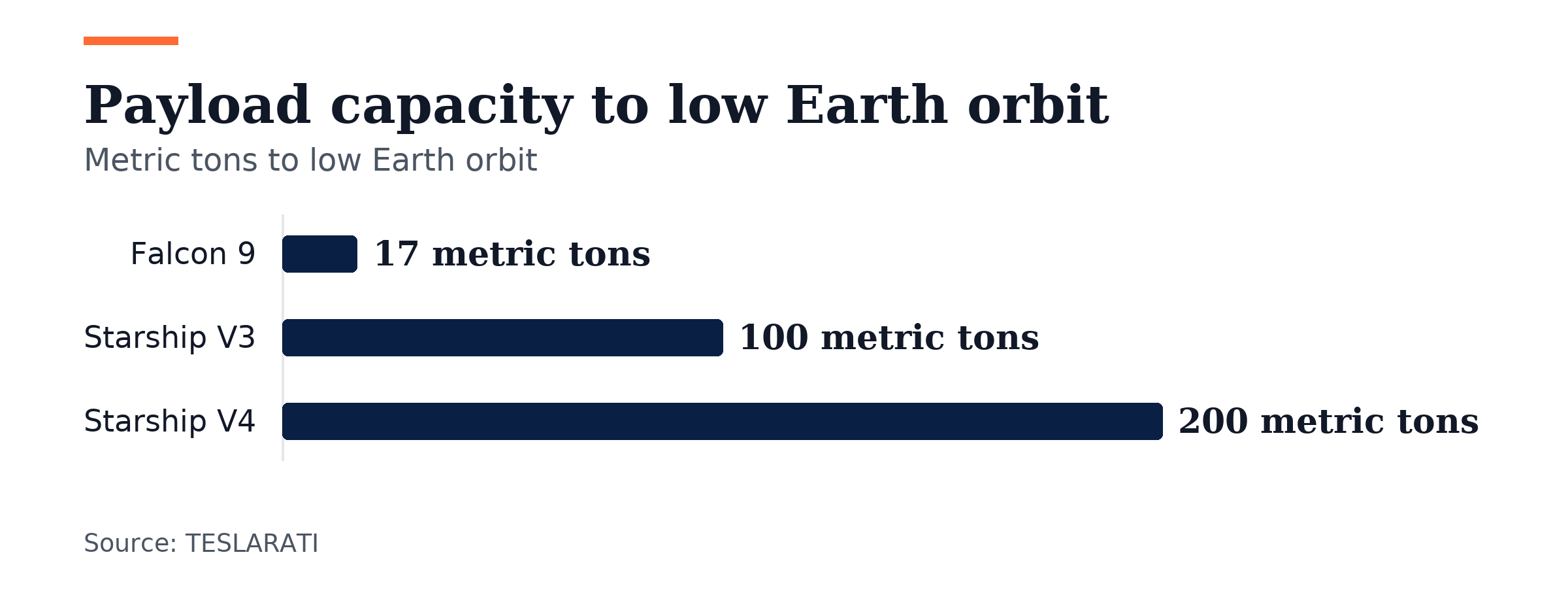
The IPO prospectus projects V3 at about 100 metric tons to orbit and future generations at 200 metric tons, potentially as soon as V4. SpaceX’s reusable Falcon 9 can deliver about 17 metric tons to low Earth orbit for comparison.
Each Starship lunar mission depends on loading an orbital propellant depot through a series of tanker flights before the lander leaves. A NASA safety panel member estimated last month that NASA would need around 22 tanker flights, while Musk said the need would be more like 6 to 8 flights depending on which ship hauls the propellant. According to Musk, a V4 tanker could carry over 200 tons of propellant per flight, reducing the lunar refill to five or six launches.
SpaceX advertises lunar cargo flights beginning in 2028 or later at $100 million per metric ton, and says a Starship lander can land as much as 100 tons on the surface. NASA is targeting Artemis IV for a 2028 lunar landing, and the administration has set a 2030 start date for work on a permanent lunar base. Musk said in February that SpaceX was shifting focus to a self-growing city on the Moon that he believes could take under 10 years to build. This lunar settlement goal sits alongside the advertised cargo flights and the depot-based refueling concept that V4 will streamline.
Musk said Ship 42 could probably be reflown after a few weeks of refurbishment following his Sunday inspection of the vehicle at the pad. SpaceX has never reflown a ship, and months separated its two booster reflights, so returning Ship 42 to flight within weeks would mark the program’s first ship reflight. Musk said Ship 42’s heat shield looks great and its engines look great, and that immediate reusability would require many small fixes, comparing the goal to airplane operations.
Flight 15 demonstrated that the ship can complete a full orbital mission and return to the tower, and Musk pointed to Ship 42 as the reusability test case because none of the future cadence plans work without ships that fly more than once. SpaceX said executing the catch maneuver was a big deal for the program.



Join the discussion