
Key facts
- The standard active-learning rule of uncertainty sampling performs worse than random search, with an AUC of 0.210, since later detections show low predictive uncertainty close to known chemistry.
- The preprint by R. I. El-Kholy and Z. M. Hayman is submitted to ApJ as arXiv:2611.16741 [astro-ph.GA], version 1 submitted Thu, 12 Nov 2026 12:55:54 UTC.
- The team detected 10 aromatic molecules in TMC-1, ring-shaped carbon structures that form a small but significant part of the cloud's carbon.
- The GOTHAM dataset of calibrated spectra, molecular abundances, and analysis software is publicly available, and Brett McGuire of MIT and NRAO says sharing GOTHAM's research democratizes access to big data in astronomy.
R. I. El-Kholy and Z. M. Hayman report a pre-registered retrospective test at TMC-1 showing that reranking machine-learning candidates as detections accumulate improves discovery, in a paper submitted Nov. 12, 2026.
The test rests on a machine-learning list of 1,510 candidates consolidated to 1,434, using species reported through September 2026. The researchers ask whether reranking a list as new detections accumulate beats a static list, a question they say was untested. TMC-1 sits in the Taurus Molecular Cloud, and its chemistry centers on large hydrocarbons and nitrogen-rich compounds, unlike the oxygen-rich molecules found around forming stars.
For each yearly origin from 2022 to 2025, the researchers applied logistic regression, a statistical sorting method, to seven released features and retrained the model using the detections known at that origin. The model then ranked later detections above candidates never detected. The measurement asks how well rankings built at each yearly origin separate species detected later from candidates never detected, and it produced a pooled AUC of 0.867.
The researchers’ pooled result compares with 0.706 for the best single-criterion baseline across the yearly origins, a difference of 0.160 with a 95% interval of 0.095 to 0.230. The interval frames the edge of the reranked ordering over the best fixed ordering.
The researchers find the benefit holds under a shifted date boundary and two alternative feature regimes. It does not extend to the top 100 candidates, where the detection counts are 12 versus 7.
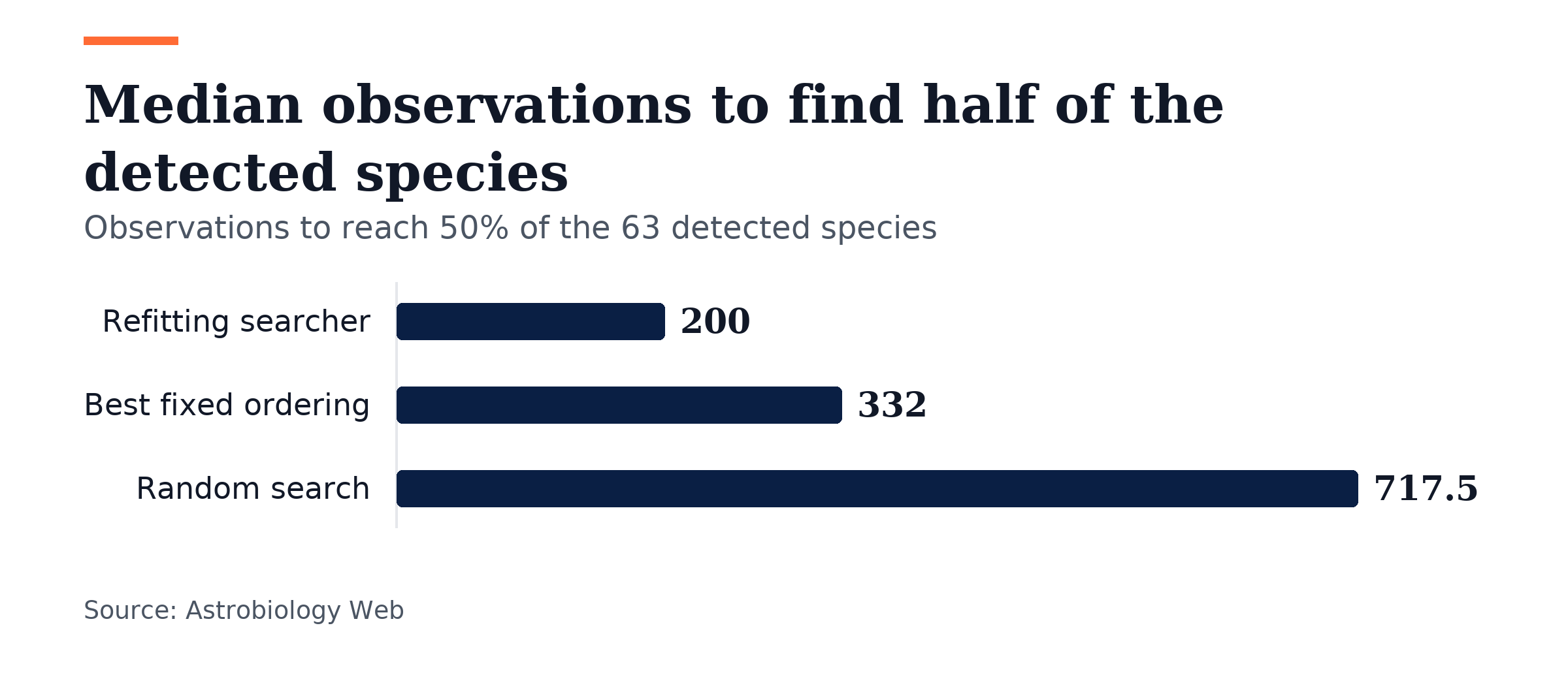
In the researchers’ simulation, a searcher refitting on its own observations reaches half of the 63 detected species within a median of 200 observations. That compares with 332 observations for the best fixed ordering and 717.5 for random search. The count tracks observations needed to find half of the species on the list that were later detected.
The researchers find the standard active-learning rule of uncertainty sampling performs worse than random search, with an AUC of 0.210. The authors say newly detected species cluster near known chemistry at low predictive uncertainty, which defeats the rule.
The researchers find gaps also exist in the candidate pool itself. Of 101 species in the validation set, 37 are absent from the candidate list, and only 13 appear in a pool rebuilt from source databases, including 2 of the 11 radicals and none of the ions. The authors conclude that generating candidates, not ranking them, is the main bottleneck for finding new interstellar molecules.
The team treats candidate generation rather than ranking as the main constraint. It releases 100 recommended targets with code and frozen inputs, so others can run prospective tests, with code and data at DOI:https://doi.org/10.5281/zenodo.23312984.
El-Kholy and Hayman submitted the preprint to the Astrophysical Journal as arXiv:2611.16741 [astro-ph.GA], and they submitted version 1 on Thursday, Nov. 12, 2026, at 12:55:54 UTC. The 13-page paper carries three figures and three tables. The second subject classification is Instrumentation and Methods for Astrophysics (astro-ph.IM), placing the work within astrophysical instrumentation and methods, while astro-ph.GA places it within galaxy astrophysics. The first version is a 198 KB file uploaded by Reham El-Kholy PhD.
The cloud under study is already well mapped. MIT researchers censused 102 molecules in TMC-1, exceeding every other known interstellar cloud, using over 1,400 observing hours on the Green Bank Telescope in West Virginia. The observations appeared in The Astrophysical Journal Supplement Series, and TMC-1 itself is a cold interstellar cloud where sunlike stars form.
The Green Bank Telescope is the world’s largest fully steerable radio telescope, located in West Virginia. It is also one of the NSF’s premier radio telescopes. Researchers in Brett McGuire’s group collected the data and made the full dataset publicly available.
The GOTHAM survey — GBT Observations of TMC-1: Hunting Aromatic Molecules — logged 1,438 hours on the Green Bank Telescope and charted more than 100 molecular species, including complex and aromatic structures found only in deep space. Its results appear in The Astrophysical Journal Supplement Series, and the survey used the largest amount of telescope time ever for such a census.
The team detected 10 aromatic molecules in TMC-1, ring-shaped carbon structures that form a small but significant part of the cloud’s carbon. In 2021, GOTHAM data produced the first discovery of individual PAH molecules in space, answering a puzzle dating back to the 1980s and revealing a large reservoir of reactive organic carbon. McGuire says the 2021 data answered that three-decade-old mystery, and the team is releasing the fully calibrated, reduced, science-ready product freely for anyone to use because datasets like this should be open to the scientific community.
The GOTHAM dataset of calibrated spectra, molecular abundances, and analysis software is publicly available. The release is the product of a diverse collaboration spanning multiple institutions and specialties led by McGuire. McGuire says, “Sharing GOTHAM’s research in this way allows us to democratize access to big data in astronomy,”
Before the GOTHAM release, most telescope data was inaccessible or too cumbersome for outside researchers to analyze, so discoveries stayed with the teams that collected it. Now astronomers everywhere can explore TMC-1 without needing advanced computing or data-cleaning skills. The calibrated release opens TMC-1 to astronomers worldwide, letting them pose new questions, build advanced chemical models, and potentially uncover phenomena no one expected.
The dataset is the largest and most comprehensive survey of its kind and sets a new benchmark for astronomical legacy data. The dataset is also the single largest publicly released molecular line survey, enabling the community to pursue discoveries such as biologically relevant molecules and offering a new benchmark for chemical conditions before stars and planets form. To handle the immense dataset, researchers built an automated system to organize and analyze the results and used advanced statistical methods to determine the amount of each molecule, including isotopic variants such as carbon-13 and deuterium.
Ci Xue, a postdoc in McGuire’s group and the project’s principal researcher, calls the census a new benchmark for the initial chemical conditions for the formation of stars and planets. Xue says, “This molecular census offers a new benchmark for the initial chemical conditions for the formation of stars and planets”. Xue is also co-PI of GOTHAM and lead author of the paper describing its automated pipeline, and she calls the project the single largest amount of telescope time for a molecular line survey reduced and publicly released to date and serving as a benchmark for pre-star and pre-planet chemistry, enabling discoveries such as biologically relevant organic matter.
Brett McGuire is an associate professor of chemistry at the Massachusetts Institute of Technology and an adjunct assistant astronomer with the National Radio Astronomy Observatory, an organization with a long-standing data-sharing mission. Astronomers at MIT, the National Radio Astronomy Observatory, the University of British Columbia, and partners expect new opportunities for collaboration and cross-disciplinary breakthroughs from the release. Because new molecule discoveries keep happening in TMC-1, astronomers expect further advances in understanding how cosmic chemistry shapes the universe.



Join the discussion